Dwelling Insurance: What a DP Policy Is and Who Actually Needs One
What dwelling insurance covers, how DP-1, DP-2 and DP-3 differ from a homeowners policy, who needs one, and the gaps to close with endorsements.

Table of contents
Dwelling insurance is the policy people end up with when a homeowners policy will not fit, and the reason it will not fit is usually that the owner does not live there.
What it actually is
A homeowners policy is a package. One document covering the structure, your belongings, your personal liability, and the cost of living elsewhere after a loss, mostly on an open-peril basis.
A dwelling policy, written on a DP form and frequently called dwelling fire insurance, is not a package. It covers the building, and everything else is either optional or absent.
That difference is not a defect. It exists because the package assumes an owner-occupier with belongings and a personal liability exposure at the address, and a great many insured buildings do not have one.
The three forms
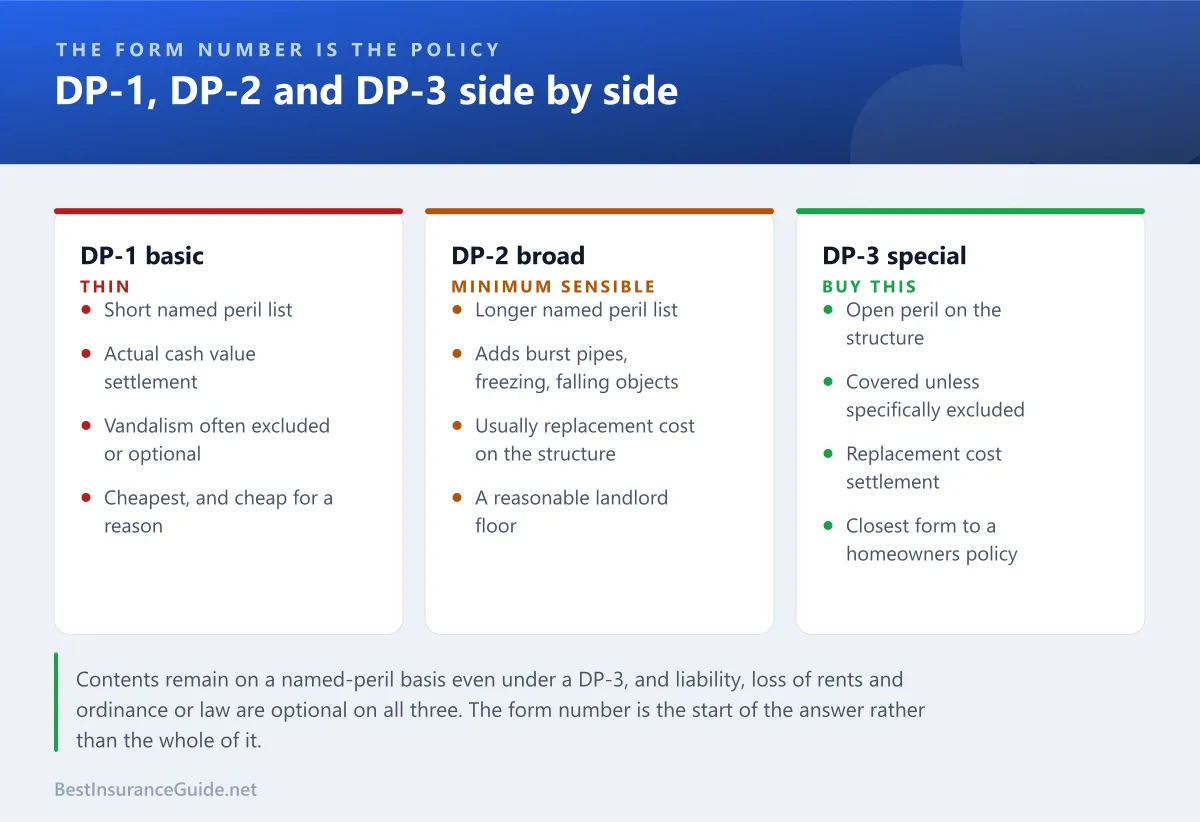
The form number tells you almost everything, and the difference between them is larger than the premium difference suggests.
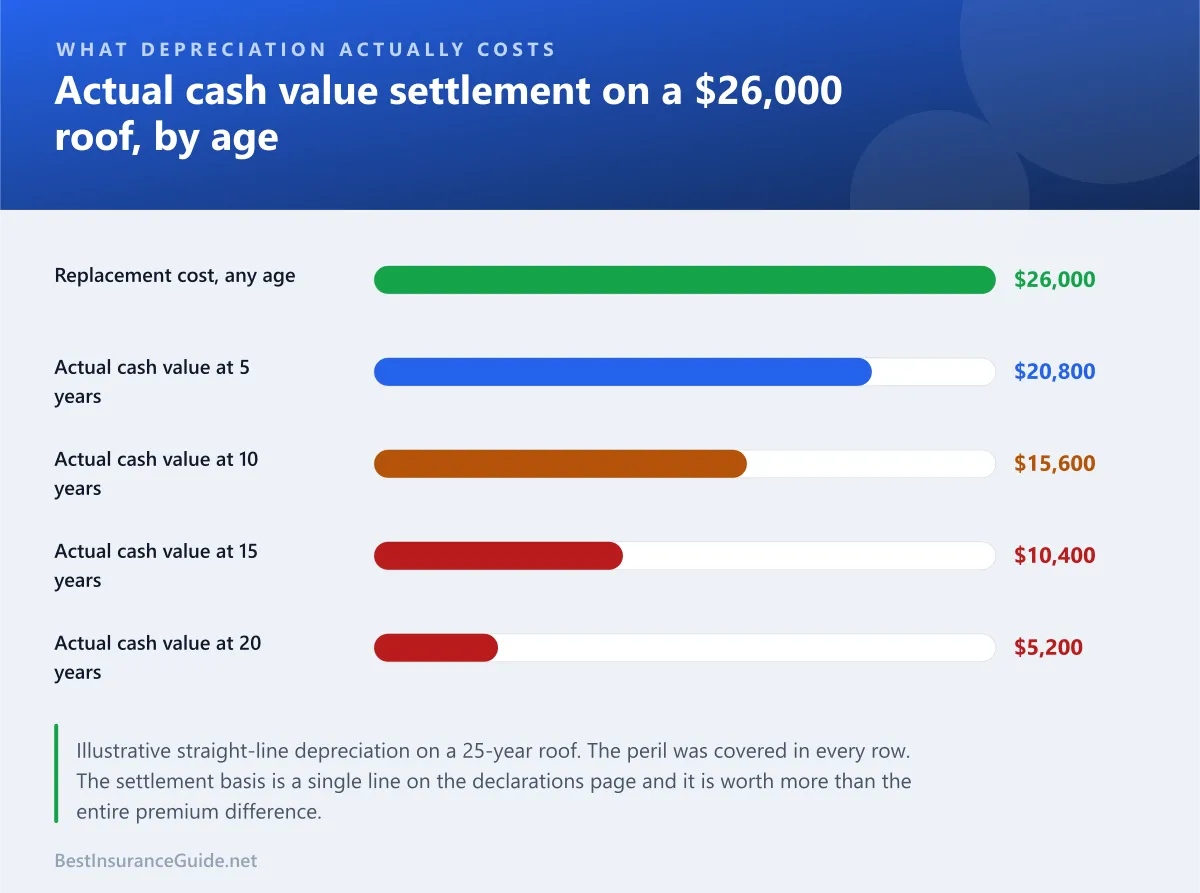
DP-1, the basic form. Named perils only, and a short list of them: fire, lightning, and internal explosion, with extended coverage perils such as windstorm, hail, riot, aircraft, vehicles and smoke usually added. Settlement is on actual cash value, meaning depreciated. Vandalism is frequently excluded or optional. This is the cheapest form and it is genuinely thin.
DP-2, the broad form. A longer named-peril list adding burst pipes, falling objects, weight of ice and snow, freezing, and accidental damage from electrical current. Settlement is usually replacement cost on the structure. This is the form most landlords should be looking at as a minimum.
DP-3, the special form. Open peril on the structure: everything is covered except what the policy specifically excludes. Contents, where covered, generally remain on a named-peril basis. This is the closest thing to a homeowners policy and it is what a well-advised owner of a decent rental property buys.
The exclusions on a DP-3 are the familiar ones: flood, earth movement, wear and deterioration, mechanical breakdown, infestation, mould beyond a covered water loss, and neglect.
Worked example: the same fire on three forms
A $280,000 rental house, twelve years old, with $180,000 of fire and smoke damage to the structure.
| DP-1 | DP-2 | DP-3 | |
|---|---|---|---|
| Peril covered | Yes, fire is basic | Yes | Yes |
| Settlement basis | Actual cash value | Replacement cost | Replacement cost |
| Depreciation applied | $54,000 | $0 | $0 |
| Loss of rents included | Optional, often not bought | Optional | Optional |
| Structure settlement | $126,000 | $180,000 | $180,000 |
The peril was covered on all three. The settlement basis is what produced a $54,000 difference, and it is a line on the declarations page rather than anything hidden in the wording.
Who ends up on a dwelling policy
Six situations account for nearly all of them.
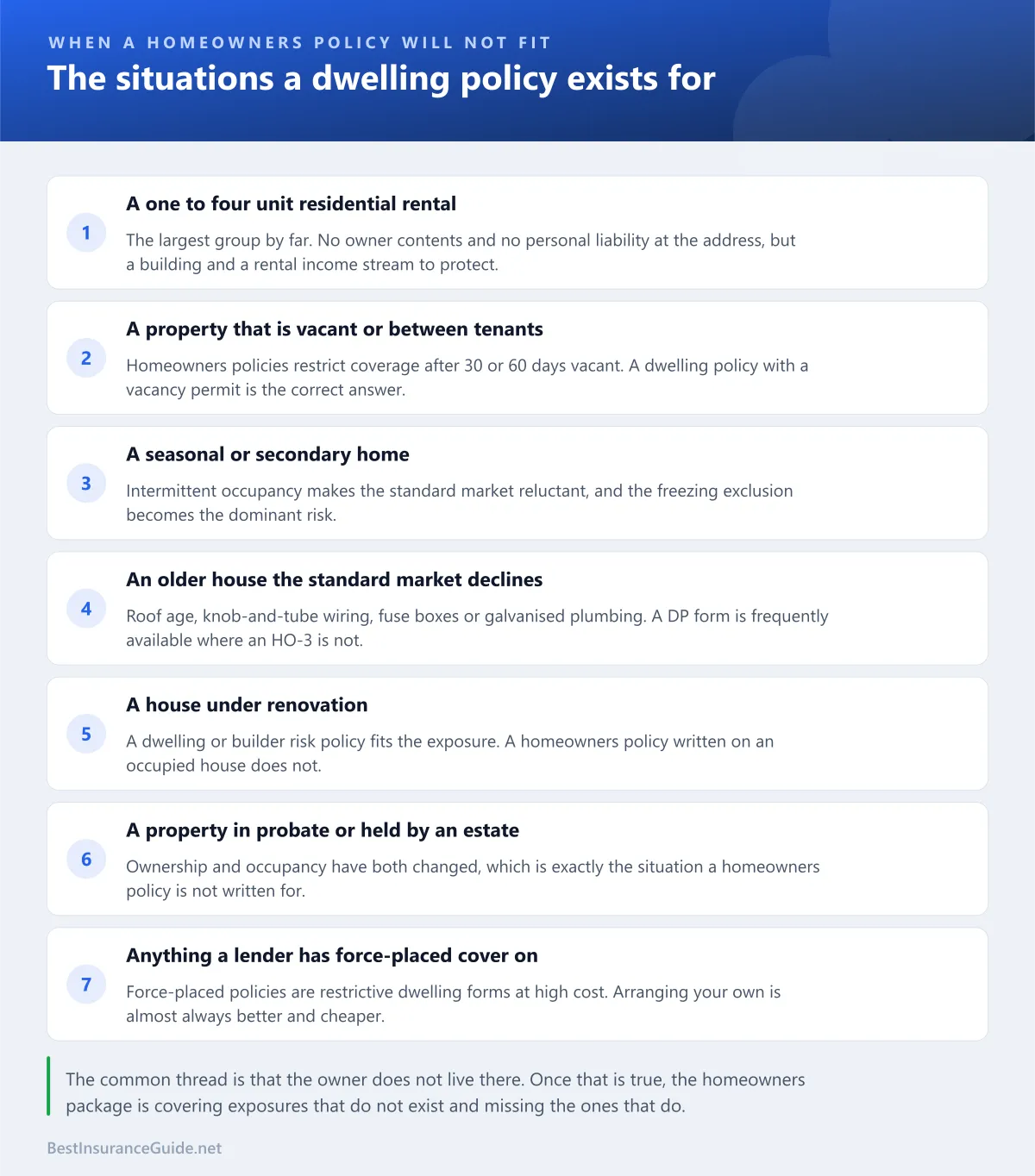
Landlords of one to four unit residential property. The single largest group. The owner has no belongings and no personal liability exposure at the address, but does have a building, appliances, and a rental income stream to protect.
Owners of vacant or unoccupied property. Standard homeowners policies restrict or void coverage once a property has been vacant beyond a stated period, commonly 30 or 60 days. A dwelling policy with a vacancy endorsement is the correct answer for a house between tenants, in probate, or under renovation.
Seasonal and secondary homes, where occupancy is intermittent and the standard market is reluctant.
Older homes the standard market declines, typically for roof age, knob-and-tube wiring, fuse boxes, or galvanised plumbing. A DP form is frequently available where an HO-3 is not.
Homes in poor condition or under renovation, where a builder’s risk or dwelling policy fits and a homeowners policy does not.
Owners placed by a lender, in which case the force-placed policy is usually a very restrictive dwelling form and is almost always worse and more expensive than anything you could arrange yourself.
What you have to add
This is where dwelling policies go wrong, because the things that are optional are the things that matter.
Liability. Not standard on most dwelling forms. A landlord without it is personally exposed to injury claims from tenants, their guests, contractors and passers-by. Treat this as mandatory. Limits of $300,000 or $500,000 are the usual starting point, with an umbrella above it where the owner has assets or multiple properties.
Loss of rents, sometimes called fair rental value. Pays the rental income lost while the property is uninhabitable after a covered loss. For a landlord whose mortgage does not pause during a nine-month rebuild, this is not optional in any meaningful sense.
Contents the owner keeps on site. Appliances, window coverings, carpets, lawn equipment, and furniture in a furnished let. The tenant’s belongings are never covered and never should be, which is why the lease should require the tenant to carry their own renters insurance.
Water backup coverage, for sewer and drain backup and sump pump failure, excluded by default exactly as it is on a homeowners policy.
Ordinance or law coverage, which matters disproportionately here because dwelling policies are so often written on older buildings where a substantial repair triggers current code requirements.
Vandalism and malicious mischief, which is excluded or restricted on many DP-1 forms and after extended vacancy on most forms.
Vacancy endorsement, where the property will be empty beyond the policy’s stated period.
What it costs, and the false economy
For the same building, a dwelling policy is frequently cheaper than a homeowners policy because it covers less. That is a real saving only if the coverage you dropped was coverage you did not need.
The false economy is DP-1. It is the cheapest thing on the shelf and it is cheap because it pays depreciated values on a short list of perils. On a twelve-year-old roof, actual cash value settlement can approach half of replacement cost, and the premium saving over a DP-3 is a small fraction of that difference.
The honest comparison is between a DP-3 with liability, loss of rents and ordinance or law added, and whatever else you are considering. Compared like for like, the gap narrows considerably and the DP-3 usually wins.
Buying one properly
Insure to rebuild cost, not to market value or to the mortgage balance. These are three different numbers and in many markets the rebuild cost is the highest of them.
Choose DP-3 unless there is a specific reason not to.
Add liability, and set the limit against your actual exposure rather than the default.
Add loss of rents if the property is let, at a limit reflecting a realistic rebuild period rather than a few weeks.
Add ordinance or law, particularly on anything built before about 1980.
Tell the insurer the truth about occupancy. A policy written as owner-occupied on a property that is let is a claim denial waiting to happen, and it is the most common avoidable failure in this whole category.
Require tenants to carry renters insurance with a minimum liability limit, and ask to be named as an additional interested party so you are told if the policy lapses.
The short version
A dwelling policy covers a building without the homeowners package around it, and it exists for the many buildings whose owner does not live in them.
The form number decides most of it. DP-1 is basic named perils on a depreciated basis and is a false economy. DP-2 is broader and settles on replacement cost. DP-3 is open peril on the structure and is what most owners should buy.
The things that go wrong are the optional ones. Liability, loss of rents and ordinance or law are not standard, and a landlord without the first two is exposed in exactly the ways that actually happen.
For the owner-occupier equivalent, see what home insurance covers and hazard insurance versus homeowners insurance.
Loss of rents, in more detail
For a landlord this is the coverage that decides whether a covered loss is an inconvenience or a financial problem, and it is bought thinly more often than it is bought properly.
What it pays. The rental income you lose while the property is uninhabitable following a covered loss, for the time reasonably required to repair it.
What it does not pay. Vacancy for any other reason. A tenant who leaves, a unit that will not let, a rent arrears problem, or a market downturn. The trigger is physical damage from a covered peril, nothing else.
How it is limited. Usually as a percentage of the dwelling limit, commonly 10% to 20%, or occasionally as a stated dollar figure or number of months.
The mistake is setting the limit against a few weeks rather than a realistic rebuild period.
Worked example: a nine-month rebuild
A $300,000 rental let at $2,100 a month, damaged by fire.
| 10% of dwelling limit | 20% of dwelling limit | |
|---|---|---|
| Loss of rents limit | $30,000 | $60,000 |
| Rent lost over nine months | $18,900 | $18,900 |
| Additional costs, re-letting and cleaning | $2,400 | $2,400 |
| Covered | $21,300 | $21,300 |
At nine months either limit works. Stretch the rebuild to eighteen months, which is entirely realistic after a widespread regional event when contractor capacity collapses, and the rent lost is $37,800 and the 10% limit no longer does.
The premium difference between those two limits is small. The mortgage on the property does not pause for either of them.
Vacancy, which voids more claims than anything else
The most common way a dwelling policy fails to pay is not an exclusion anybody argued about. It is vacancy.
Most policies restrict coverage once a property has been vacant beyond a stated period, commonly 30 or 60 consecutive days. After that, vandalism, glass breakage, water damage and theft are typically excluded outright, and the rest of the policy may be affected.
Vacant and unoccupied are different. A furnished house whose owner is away for three months is unoccupied. An empty house between tenants is vacant. Wordings treat them differently and the definitions are in the policy.
Four situations produce unexpected vacancy: a property between tenants for longer than expected, a house in probate, a renovation that ran long, and a seasonal property closed up out of season.
The answer in all four is a vacancy permit endorsement, arranged before the vacancy rather than after a loss. It costs premium and it keeps the policy responsive. Telling the insurer is not optional; a claim on a vacant property that was never disclosed is a claim that will not be paid.
Landlord practicalities
Three things sit alongside the policy and matter as much as it does.
Require tenant renters insurance in the lease, with a stated minimum liability limit, and ask to be named as an additional interested party so you are notified if it lapses. This is not about protecting the tenant’s belongings; it is about their liability policy answering the claim when they cause damage to your building, rather than your insurer paying and then pursuing them.
Keep the occupancy classification accurate. A property insured as owner-occupied and let out, or insured as a long-term let and used for short-term rentals, is misclassified. Short-term letting in particular is excluded or restricted on most dwelling forms and needs a specific endorsement or a different policy.
Document the property’s condition annually. Photographs, dated, inside and out, plus records of maintenance and system replacements. On an older building, the argument at claim time is frequently about whether damage is sudden or the result of long-term deterioration, and a maintenance record is what settles it.
Related reading
How much is homeowners insurance on a $400,000 house covers the owner-occupier equivalent and how a rebuild cost is established, which applies equally to a dwelling policy. The AOP deductible explained covers the deductible structure that carries across both forms.
A note on scope
Dwelling policy forms, the perils each covers, and which coverages are standard rather than optional vary between insurers and between states, and change over time. The DP-1, DP-2 and DP-3 descriptions here reflect the common structure of these forms rather than any particular insurer’s wording.
Your state insurance department publishes consumer guidance on residential property forms, and the NAIC publishes comparative material on policy types. Your own declarations page and the endorsement schedule attached to it are the authoritative statement of what you actually hold. This site is independent and not affiliated with any insurer.