Zero Down Car Insurance: What $0 Down Actually Means
How zero down car insurance works, why no deposit is rarely truly zero, what instalment fees cost, and how to get cover started when cash is tight.

Table of contents

There is no version of insurance in which the cover is free. What “zero down” describes is a payment schedule, and understanding where the money went is the whole of the subject.
What is actually being offered
Three different things get marketed under the same phrase, and they are not equivalent.
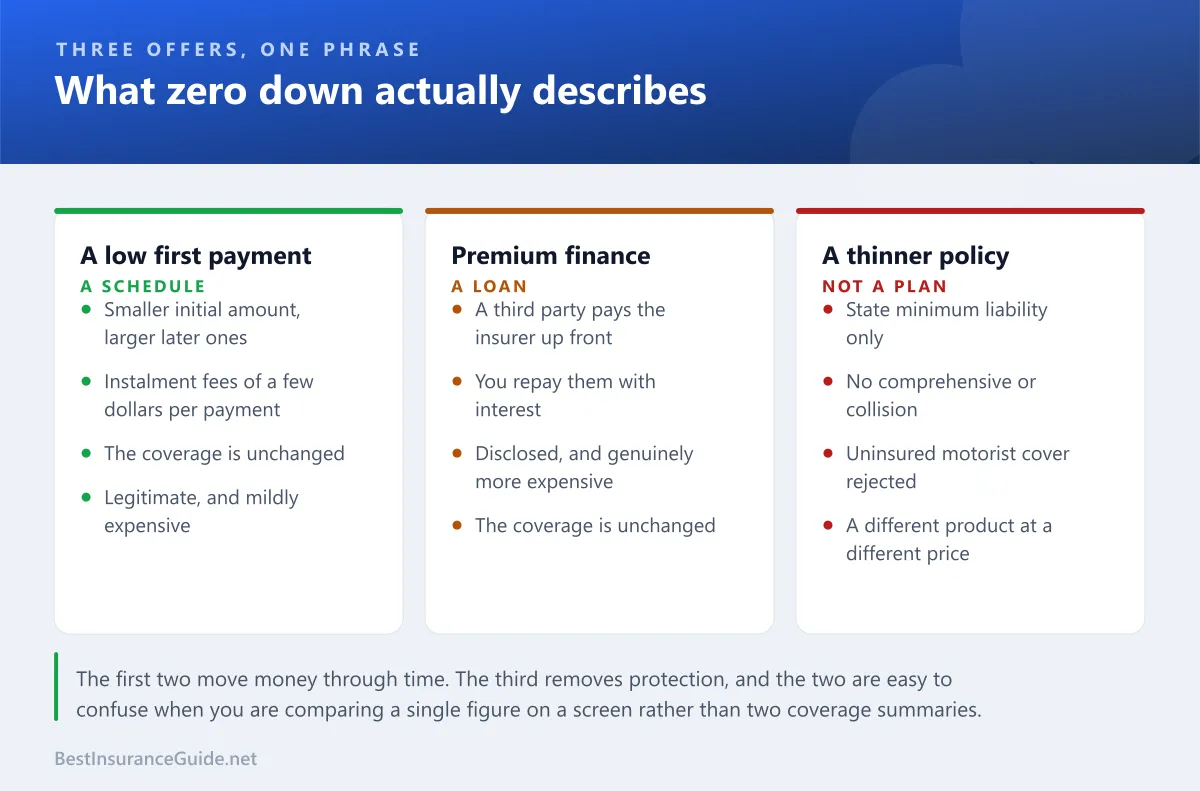
A low first payment. The most common. Not zero, but a smaller initial amount than the usual first instalment, with the remainder loaded onto later payments. Legitimate, and the cost is in the instalment fees.
A premium finance arrangement. A third party pays the insurer the annual premium and you repay them over the term, with interest. Legitimate, disclosed, and genuinely more expensive than paying the insurer directly.
A thinner policy. The first payment is low because the coverage is minimal: state minimum liability, no comprehensive, no collision, no uninsured motorist cover. This is not a payment plan at all. It is a different product sold at a different price, and it is the version worth being careful about.
The first two move money through time. The third removes protection, and the two are easy to confuse when you are looking at a single number on a screen.
Where the money goes
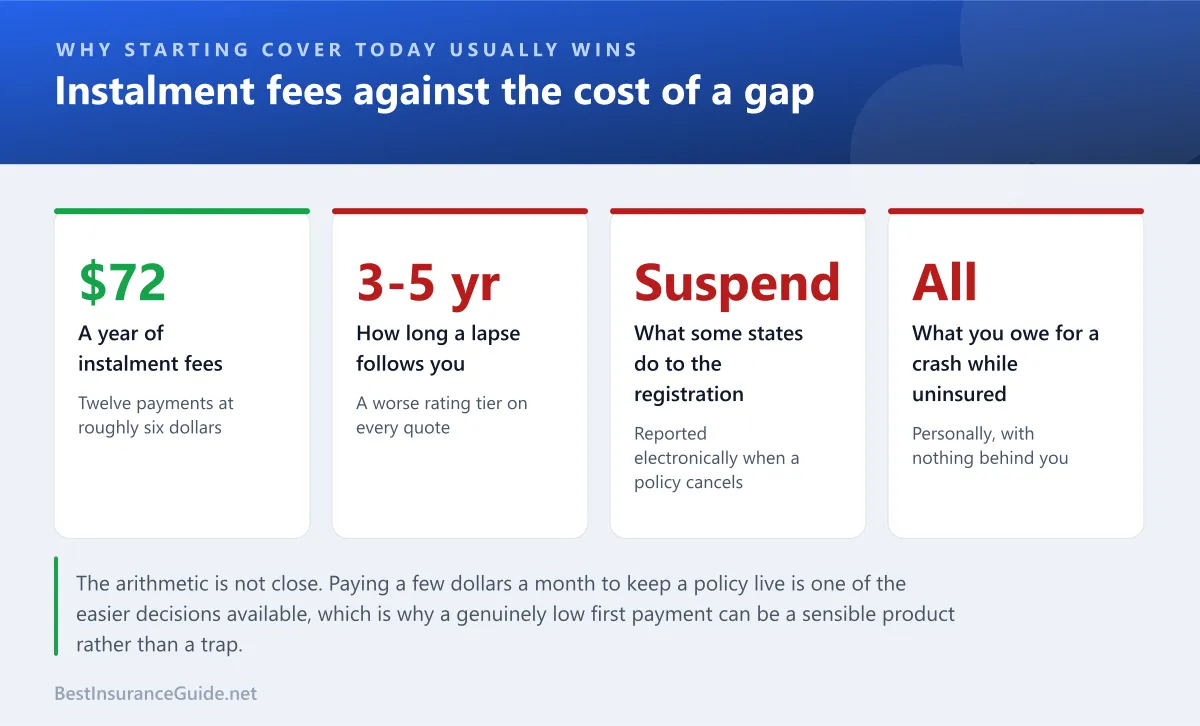
Instalment fees. Most insurers charge a small fee per payment, commonly a few dollars. Twelve monthly payments at $6 is $72 a year for the privilege of paying monthly, which on a $1,400 policy is roughly 5%.
Premium finance interest, where that arrangement is used, which is a genuine interest rate on the outstanding balance.
The lost paid-in-full discount. Many insurers reduce the premium for paying the term in one payment, commonly in the region of 5% to 10%. Choosing instalments forfeits it.
Worked example: the same policy, four payment schedules
A $1,320 six-month premium.
| Paid in full | Two payments | Monthly | Zero down monthly | |
|---|---|---|---|---|
| Paid at inception | $1,320 | $660 | $242 | $0 to $60 |
| Paid-in-full discount | -$92 | None | None | None |
| Instalment fees | $0 | $12 | $36 | $36 |
| Finance charge, where applicable | $0 | $0 | $0 | Varies |
| Total for the term | $1,228 | $1,332 | $1,356 | $1,356 plus finance |
The spread between the cheapest and most expensive way of paying for the identical coverage is over $100 on a six-month term. That is not a scandal; it is the ordinary cost of spreading payments, and it is worth knowing rather than discovering.
When it is a reasonable choice
Deferring cost is not automatically a mistake, and there are situations where it is clearly right.
You need cover today to drive legally, and the alternative is a lapse. A lapse is far more expensive than any instalment fee, because it raises every future quote for years and in several states triggers registration suspension.
You are between pay cycles and the timing rather than the total is the problem.
You need the vehicle for work and the income depends on being on the road this week.
In all three, paying a bit more to start cover now is straightforwardly the better decision. The instalment fees cost tens of dollars. A lapse costs hundreds a year for several years.
When it is a bad deal
When the low payment was achieved by cutting the coverage. This is the important one. A quote that reached its number by dropping to state minimum liability, removing comprehensive and rejecting uninsured motorist cover is not a cheaper payment plan; it is a materially worse policy.
When the finance rate is high and you could have paid in two instalments instead of twelve.
When it becomes permanent. Paying instalment fees indefinitely because the first month was tight is a slow, invisible cost.
When the payment schedule is unaffordable. A zero down policy whose later payments you cannot meet cancels, which produces exactly the lapse you were trying to avoid, plus a cancellation on your record.
What actually lowers the first payment
If the problem is genuinely the money rather than the schedule, five things reduce the premium itself rather than deferring it.
Raise the deductibles. Moving comprehensive and collision from $500 to $1,000 reduces the premium immediately. Be careful in hail states, where comprehensive is the claim you are most likely to make.
Drop collision on a low-value vehicle. Once the annual collision premium plus the deductible approaches what the car is worth, the coverage has stopped earning its place. Keep comprehensive, which is cheap and answers theft, weather and animals.
Correct the mileage. A great many policies are rated on a commute that no longer exists. This is immediate and free.
Ask for every discount, not the ones the quote engine applied: multi-vehicle, safe driver, telematics, paperless, defensive driving course, good student, away at school, anti-theft, and occupational or affinity discounts.
Bundle. If you rent, a renters policy is inexpensive and the multi-policy discount on the auto side frequently exceeds what it costs. That is the largest routine discount available to most households.
Consider a six-month term rather than twelve, which reduces the size of each payment cycle and lets you re-shop sooner.
Questions to ask before signing
Is this a payment plan or a different policy? Ask for the coverage summary, not the payment schedule, and compare it against what you have now.
What are the liability limits, and is uninsured motorist cover included?
Is comprehensive and collision included, and at what deductible?
What is the total cost over the term, including all fees and any finance charge?
What happens if a payment is late? Ask about the grace period and the cancellation notice specifically.
Is there a paid-in-full discount, and what is it worth?
Can I switch to fewer instalments later without a fee?
The short version
Zero down car insurance is a payment schedule, not a discount. The cover is paid for either way, and spreading it costs instalment fees and sometimes finance interest, commonly adding a few percent to the term.
That is frequently a sensible trade, because starting cover today rather than lapsing is worth far more than the fees. What is not a sensible trade is a low first payment achieved by removing comprehensive, collision and uninsured motorist cover, and those two things are easy to confuse when you are comparing a single figure.
If the money is genuinely tight, reduce the premium rather than deferring it: raise the deductibles, drop collision on a car that no longer warrants it, correct the mileage, and bundle a renters policy if you rent.
For the full discount list, see auto insurance discounts, and for switching without creating a gap, how to switch car insurance.
What a lapse actually costs
Since the strongest argument for a low first payment is avoiding a gap in coverage, it is worth being specific about what a gap costs.
Higher premiums for years. Insurers rate continuous coverage as a strong predictor, and a gap moves you into a worse tier. The effect commonly persists for three to five years and is not small.
Loss of loyalty and claims-free credits, which restart rather than resume.
Registration and licence consequences. Several states are notified electronically when a policy cancels and suspend the registration promptly, with reinstatement fees attached.
A worse market. Some insurers decline new business from applicants with a recent lapse entirely, which narrows the field to more expensive carriers.
Personal liability during the gap. The obvious one, and the largest. A crash during an uninsured period is a personal debt for everything you caused.
Worked example: instalment fees against a lapse
| Monthly instalments | Two-week lapse | |
|---|---|---|
| Instalment fees over a year | $72 | $0 |
| Premium effect over three years | $0 | Several hundred dollars a year |
| Reinstatement and registration fees | $0 | Varies by state |
| Exposure during the gap | None | Everything you cause |
The arithmetic is not close. Paying a few dollars a month to keep the policy live is one of the easier decisions in personal finance, which is exactly why a genuinely low first payment can be a sensible product rather than a trap.
Reading the offer properly
The single most useful habit is to stop looking at the payment and start looking at the coverage summary.
Find the liability limits. If they read as the state minimum, the low payment is largely explained.
Find comprehensive and collision. If either is absent, this is a different product from the one you are comparing it against.
Find uninsured and underinsured motorist cover. In many states these are optional and are the first thing removed to reach a headline price.
Find the deductibles, and check they are figures you could actually produce.
Find the total cost for the term, including every fee, and compare it against the same coverage paid in fewer instalments.
Find the cancellation terms, specifically the grace period and how much notice you get.
If all six of those match what you have now and the payment is simply spread differently, it is a payment plan. If any of them are worse, it is a cheaper policy wearing a payment plan’s clothes.
Two things worth doing before you buy
Ask your current insurer what a different payment schedule would cost. Switching from twelve instalments to two, or paying a term in full, frequently saves more than moving to a new carrier would, and it takes one phone call.
Ask for the full discount schedule. Payment arrangements are the least efficient way to reduce what insurance costs, and discounts are the most efficient. Most drivers are missing at least one they qualify for.
If you are buying today with very little
A practical sequence for the situation this article is usually being read in.
Quote your existing insurer first, if you have one, and ask specifically what payment schedules they offer. Moving from twelve instalments to two, or asking for a different payment date, is frequently enough and costs nothing.
Ask whether they will move the due date to sit just after you are paid. Many will, and it removes the recurring problem rather than deferring it.
Reduce the premium before deferring it. Raise the deductibles to a level you could still produce, correct the mileage, and drop collision on a vehicle whose value no longer justifies it.
Ask for every discount by name, since quote engines apply some automatically and leave others for you to claim.
Quote a renters policy alongside, if you rent. The bundling discount on the auto side frequently exceeds the cost of the renters policy, which makes it the rare change that reduces the auto premium and adds protection at the same time.
Then, if it is still short, take the low first payment rather than going without cover. Starting cover today is worth more than the instalment fees several times over.
Set a reminder to re-shop in six months, because a short term lets you re-price sooner and because the circumstances that made today tight may not last.
The order matters. Every step before the last one reduces what the insurance costs. The last one only changes when you pay it.
Two questions that settle it
Is the coverage identical to what I would otherwise buy? Put the two coverage summaries side by side rather than the two payment schedules. If the limits, the deductibles and the comprehensive, collision and uninsured motorist lines all match, then this is genuinely a payment arrangement and the only question is what the fees cost.
Can I meet every payment in the schedule? A zero down policy whose later instalments you cannot pay cancels, which produces the exact lapse the arrangement was supposed to prevent, plus a cancellation on the record.
If the answer to both is yes, spreading the cost is a reasonable and slightly expensive convenience. If the answer to either is no, the offer is solving a different problem from the one you have.
Related reading
How long does it take to get car insurance covers the other half of buying under time pressure, including how to avoid the coverage gap this article warns about. What is towing insurance covers one of the inexpensive add-ons frequently stripped out to reach a low first payment.
A note on scope
Premium figures, fees and discount percentages here are illustrative rather than quotes, and they vary substantially by insurer, by state and by individual circumstances. Payment plan terms, instalment fees, grace periods and cancellation practices differ between insurers and change over time.
Your state insurance department publishes consumer guidance on payment plans and cancellation rules, and the NAIC publishes comparative material. The policy documents and payment schedule you are offered are the authoritative statement of what any particular arrangement costs. This site is independent and not affiliated with any insurer.