Small Business Insurance in Illinois: The Biometric Law Nobody Priced For
Illinois workers compensation rules, the Biometric Information Privacy Act exposure, Chicago liability costs, and what a small business programme needs.

Table of contents

Illinois has one statutory exposure that has caught more ordinary businesses off guard than anything else in the state, and it has nothing to do with the usual list.
What the state requires
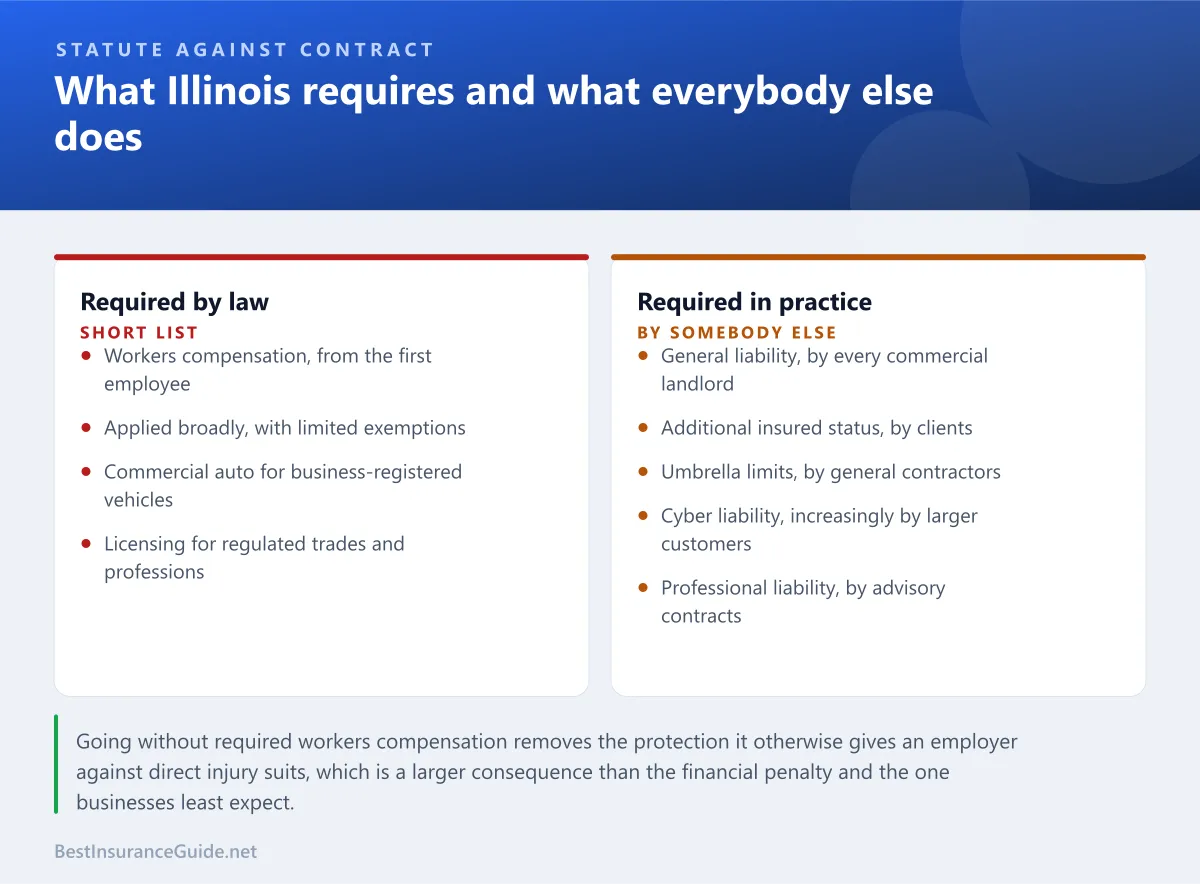
Workers compensation, for employers with employees, applied broadly and from the first employee for nearly all businesses. Illinois treats certain hazardous occupations as covered without exception, and the penalties for going without include financial sanctions and the loss of the employer’s usual protection against direct injury suits.
Commercial auto liability, for vehicles registered to the business, at Illinois statutory minimums which are inadequate for any commercial operation.
Licensing requirements for regulated trades and professions, which vary by activity.
Everything else exists because a landlord, a client, a lender or a franchise agreement demanded it.
The BIPA exposure
This is the Illinois-specific issue and it deserves the emphasis, because it has produced claims out of all proportion to the businesses involved.
The Biometric Information Privacy Act regulates how private entities collect, store and use biometric identifiers: fingerprints, facial geometry, iris scans, voiceprints and similar.
Three features make it unusual.
It creates a private right of action. Individuals can sue directly rather than relying on a regulator.
Damages are assessed per violation, with statutory amounts, which in a class action across an employee base multiplies rapidly.
It applies to ordinary operational technology. A fingerprint time clock, a facial recognition access system, or a voice authentication system in a call centre all fall within it.
The businesses affected are frequently not technology companies. They are manufacturers, restaurants, care providers, logistics operators and retailers who installed a fingerprint clock to stop buddy-punching.
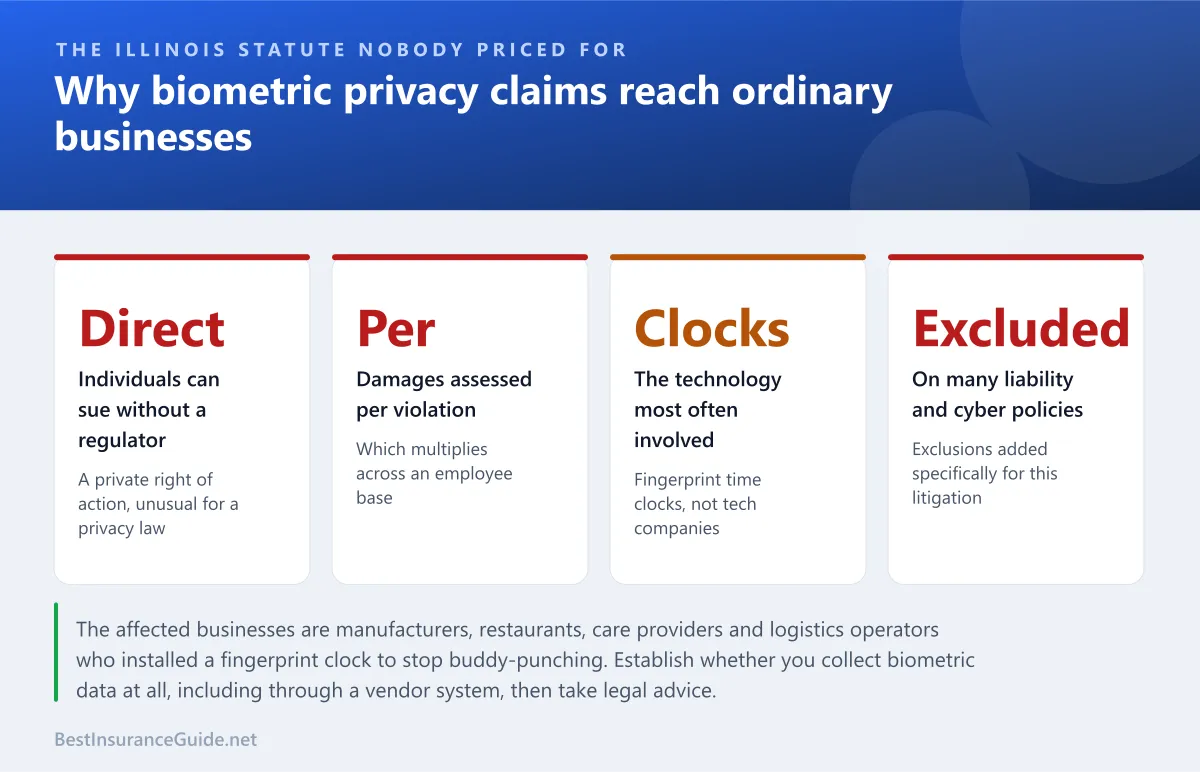
The insurance position is the concerning part. Many general liability and cyber policies now carry explicit exclusions for biometric or statutory privacy violations, added specifically in response to this litigation. Coverage litigation on the point has been extensive.
What to do, practically.
Establish whether you collect biometric data at all, including through a vendor’s system. Many businesses do not realise they do.
Obtain the written consent and retention policy the statute requires, before collection, and maintain the schedule it demands.
Ask your broker in writing whether any policy you hold responds to a biometric claim, and whether cover can be added.
Review vendor contracts, since a time clock supplier’s terms frequently push responsibility to the employer.
This is genuinely a matter for legal advice rather than an insurance question alone, and the exposure is real enough to warrant it.
Chicago and downstate
Illinois has a wide internal spread and it affects a business programme.
Chicago and Cook County carry the state’s highest liability, auto and property rates, driven by claim frequency, litigation costs, theft and repair costs. Premises liability exposure is higher and property crime affects both the property and inland marine lines.
The collar counties rate below Chicago while sitting above the state average.
Downstate and rural Illinois rate substantially lower on frequency, with higher commercial auto severity from higher speeds and longer emergency response distances, and meaningful severe convective storm exposure on the property side.
Agricultural operations across central Illinois have their own classification and coverage structure, including specific farm liability and equipment forms.
The coverages an Illinois business needs
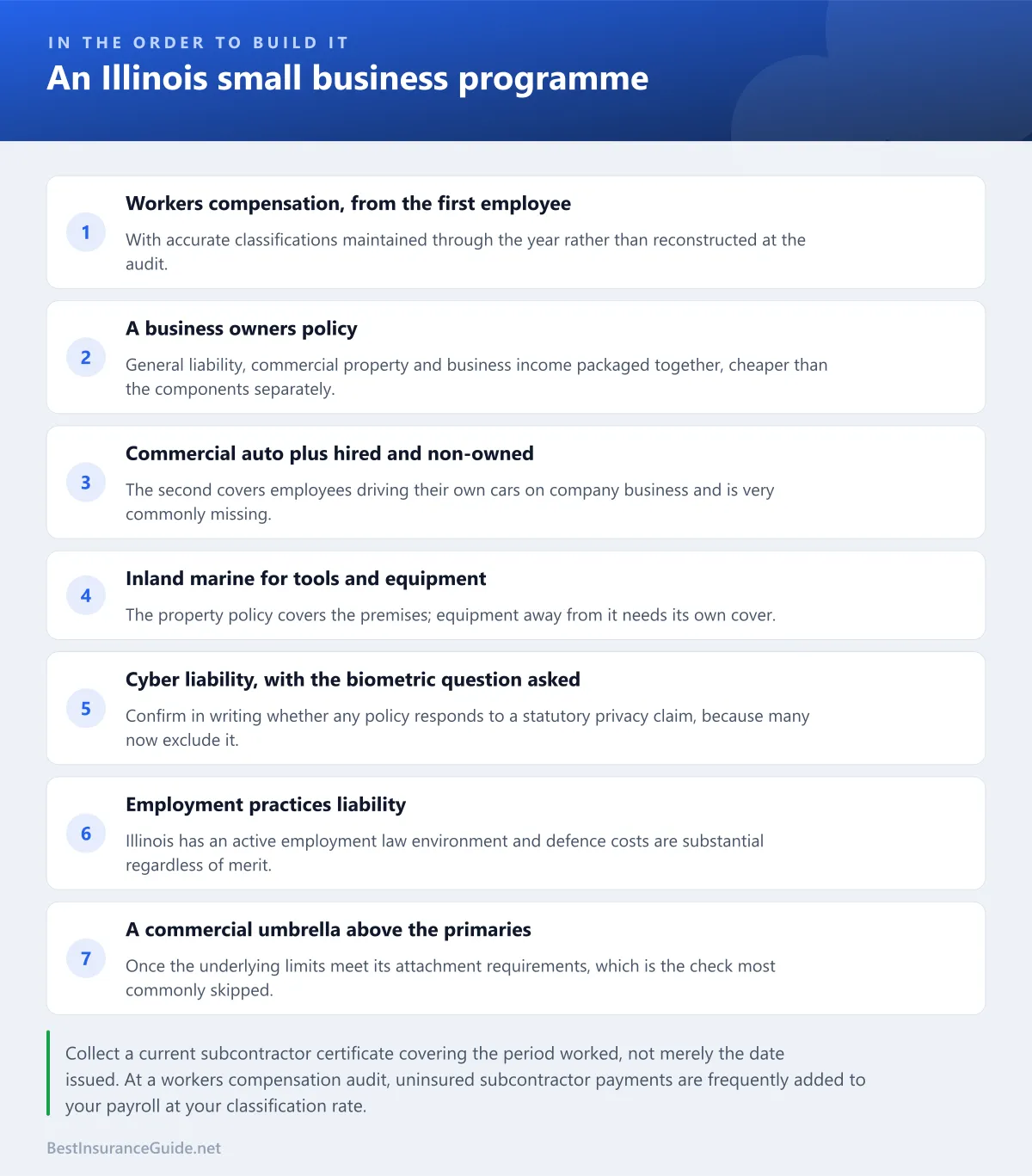
A business owners policy, packaging general liability with commercial property and business income cover, as the starting point.
Workers compensation, per the above.
Commercial auto, plus hired and non-owned auto for employees driving their own vehicles on company business.
Business income and extra expense, which for a single-location business is the difference between a bad quarter and closure.
Inland marine, for tools and equipment away from the premises.
Cyber liability, and specifically ask about biometric and statutory privacy cover within it.
Employment practices liability, once there are employees.
Professional liability, where advice or professional services are provided.
A commercial umbrella, above the liability lines, which our guide to business umbrella insurance covers in detail.
What drives the cost
Industry classification, above everything else.
Payroll by job class, for workers compensation.
Revenue, for general liability.
Location, with Chicago rating well above downstate.
Claims history, and for workers compensation the experience modification factor, which multiplies premium directly and responds to safety performance over time.
Property values, construction and protection class, for the property side.
The experience modification factor is the one a business can genuinely manage. It compares your loss record against your industry’s expectation, applies as a multiplier, and improves over several years of good performance.
Building the programme
Start with workers compensation, and get the classifications right, since misclassified payroll is both a premium problem and an audit problem.
Add a business owners policy for the liability and property base.
List every contract you have signed and extract the insurance requirements from each.
Identify your specific exposures: tools off premises, employee driving, professional advice, customer data, and in Illinois specifically, biometric collection.
Add an umbrella once the primaries are in place at the required limits.
Collect subcontractor certificates before anybody starts work, without exception.
Review annually against payroll, revenue, vehicles, employees and contracts.
The short version
Illinois requires workers compensation from the first employee and applies it broadly. Everything else in a small business programme comes from contracts rather than statute.
The state-specific exposure is the Biometric Information Privacy Act, which allows individuals to sue directly with damages assessed per violation, and which has produced very large claims against ordinary businesses using fingerprint time clocks. Many liability and cyber policies now exclude it explicitly.
If your business collects any biometric data, including through a vendor’s system, confirm the consent and retention requirements with a lawyer and confirm the insurance position with your broker in writing.
Beyond that, the priorities are the ordinary ones: correct workers compensation classifications, hired and non-owned auto, inland marine for tools, business income cover, and an umbrella above it all.
For the umbrella layer, see business umbrella insurance, and for the general programme, the business insurance checklist.
The workers compensation audit
Every workers compensation policy is audited at the end of the term, and in Illinois as elsewhere the audit is where premium is actually settled. Businesses treat it as an administrative event and it is not.
The policy is written on estimated payroll and audited against actual payroll at the end of the year, by classification.
Misclassified payroll produces an adjustment. A clerical worker classified as clerical costs a fraction of a worker classified into a construction code, and getting the split wrong in either direction is corrected at audit.
Uninsured subcontractors are added to your payroll. This is the single largest audit surprise. Where a subcontractor cannot produce a certificate of insurance for the period they worked for you, their payments are frequently treated as your payroll and charged at your classification rate.
Overtime is frequently reportable at straight time, which is a legitimate reduction many businesses fail to claim.
Certain exclusions apply to items such as tips, severance and some benefit payments, and including them inflates the audited premium.
Four habits make the audit painless.
Keep classifications accurate through the year, not reconstructed at the end.
Keep a subcontractor certificate file, current and covering the whole period of work.
Separate overtime in your payroll records, so the reduction can be claimed.
Prepare for the audit rather than handing over a general ledger and accepting the result.
Worked example: two audits, same business
| Prepared | Unprepared | |
|---|---|---|
| Classifications maintained | Accurate | Reconstructed |
| Subcontractor certificates | Complete file | Three missing |
| Overtime separated | Yes, reported at straight time | No |
| Excludable payments identified | Yes | No |
| Audit outcome | Small credit | Substantial additional premium |
Nothing about the underlying business differed. The records did.
The Chicago premises exposure
For any Illinois business the public enters, premises liability is the dominant general liability exposure, and in Chicago it is priced accordingly.
Four claim types account for most of it.
Slip and fall, concentrated sharply in winter. Documented, dated records of clearing and treatment are what defend these, and a business relying on recollection is defending badly.
Trip hazards from maintenance failures, including uneven flooring, loose mats and poor lighting, all of which are inspection and record-keeping matters as much as insurance ones.
Assault and battery claims, which many general liability policies now restrict or exclude, particularly for hospitality and late-night operations. Where that exclusion exists, buy-back cover may be available and should be considered.
Liquor liability, for any business serving alcohol, which general liability excludes for businesses in that trade.
Two habits reduce all four.
A dated inspection log, completed on a schedule, which is the single most useful document in defending a premises claim.
Camera coverage of public areas, retained long enough to matter, since footage of an alleged fall is frequently decisive and most systems overwrite within days.
Two things to do this quarter
Establish whether you collect biometric data, including through any vendor system, and if so take legal advice on the consent and retention requirements and confirm the insurance position in writing.
Audit your subcontractor certificates against the periods worked. This is the largest source of workers compensation audit surprises and the remedy is a folder rather than a policy.
The cost picture
Illinois commercial pricing spans a very wide range and four factors do nearly all the work.
Industry classification. A professional services firm and a roofing contractor are not comparable at any level, and the workers compensation classification alone can differ by an order of magnitude.
Location within the state. Chicago and Cook County rate well above the collar counties, which rate above downstate, on liability, auto and property alike.
Payroll and revenue, which drive workers compensation and general liability respectively.
Loss history, and specifically the workers compensation experience modification factor, which is the one cost a business can genuinely manage over time.
Two further factors that move property specifically: construction type and protection class, meaning how the building is built and how far it is from a fire station and hydrant, and roof age, which in a state with severe convective storm exposure is now a primary underwriting consideration.
The order to build it in
Workers compensation first, from the first employee, with accurate classifications.
A business owners policy next, covering general liability, property and business income together.
Then the exposures your work creates: tools away from premises, employees driving their own cars, professional advice, customer data, and biometric collection if any system in your business captures it.
Then whatever your contracts demand, which is where most of the remaining programme comes from.
Then the umbrella, once the underlying limits meet its attachment requirements.
Two more things worth knowing
The Illinois assigned risk pool exists for employers who cannot obtain workers compensation coverage voluntarily, usually because of loss history or a hazardous classification. It provides coverage at a price, and the route out is improving the underlying loss record rather than shopping.
Employment practices liability matters here. Illinois has an active employment law environment, and the cost of defending a claim is substantial regardless of merit. For any business with more than a handful of employees this moves from optional to sensible.
How other states set the threshold
Illinois attaches from the first employee, as Pennsylvania and New Jersey do.
Michigan is the nearest neighbour with a different structure, applying tests on both headcount and hours worked. Georgia and North Carolina wait until three employees, and Florida varies by industry.
A note on scope
Nothing here is legal advice, and the biometric privacy exposure in particular is a legal question that warrants qualified advice. Illinois statutory requirements, exemptions, penalties and the scope and interpretation of the Biometric Information Privacy Act are set by state law and by courts and change over time.
The Illinois Workers’ Compensation Commission publishes the authoritative coverage requirements, the Illinois Department of Insurance publishes commercial guidance, and your policy wording and endorsement schedule are the authoritative statement of what you hold. This site is independent and not affiliated with any insurer.