Business Liability Insurance in NJ: What the Contracts Actually Demand
New Jersey business liability requirements, workers compensation rules with no employee threshold, contract-driven limits, and what a programme should include.

Table of contents
New Jersey has an unusually strict workers compensation position and an unusually contract-driven liability market. Understanding both determines what a business here actually needs to buy.
What general liability covers
Since the whole programme is built around it, it is worth being precise about what a general liability policy actually does.
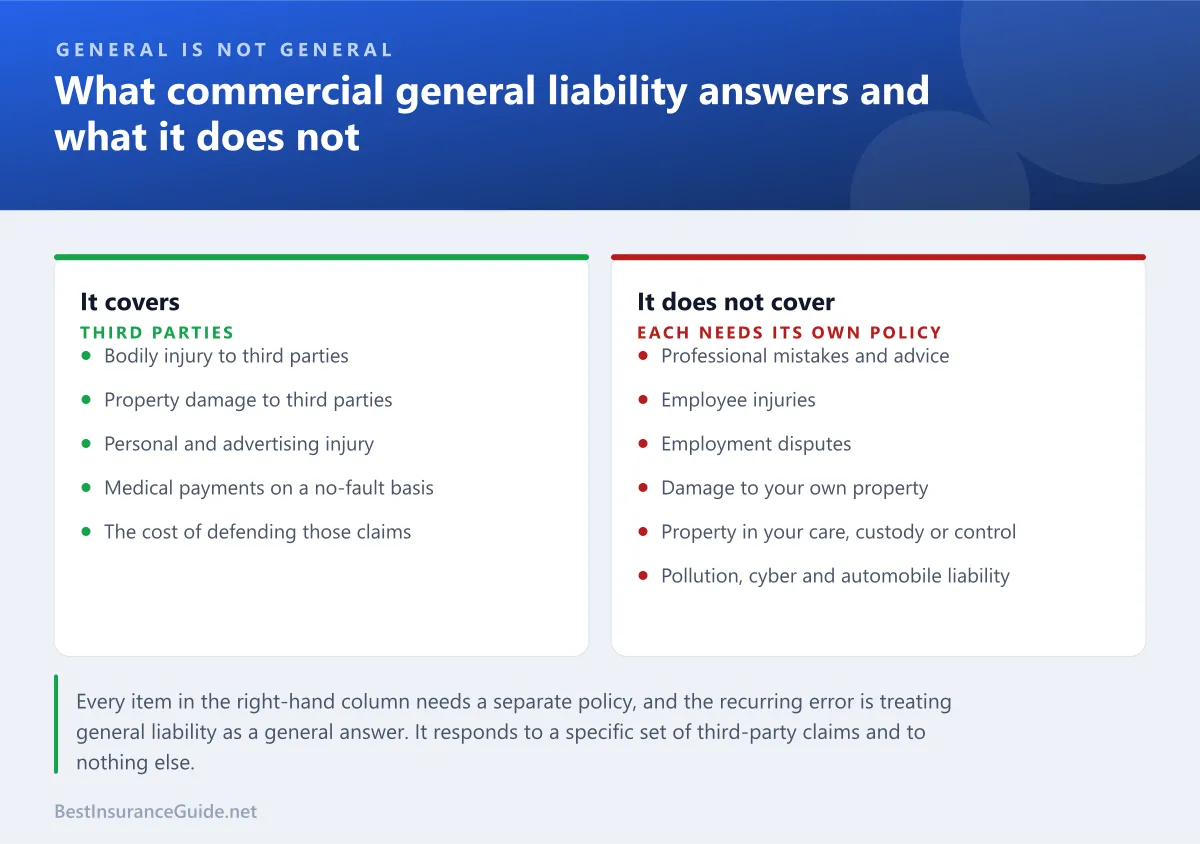
It covers: bodily injury to third parties, property damage to third parties, personal and advertising injury such as libel, slander and copyright infringement in advertising, medical payments on a no-fault basis for minor injuries at your premises, and the cost of defending those claims.
It does not cover: professional mistakes, employee injuries, employment disputes, damage to your own property, damage to property in your care, the cost of correcting your own defective work, pollution, cyber incidents, or automobile liability.
The recurring error is treating general liability as general. It answers a specific set of third-party claims, and every item in the second list needs its own policy.
Workers compensation, with no threshold
New Jersey takes an unusually strict position here and it catches businesses that have moved from other states.
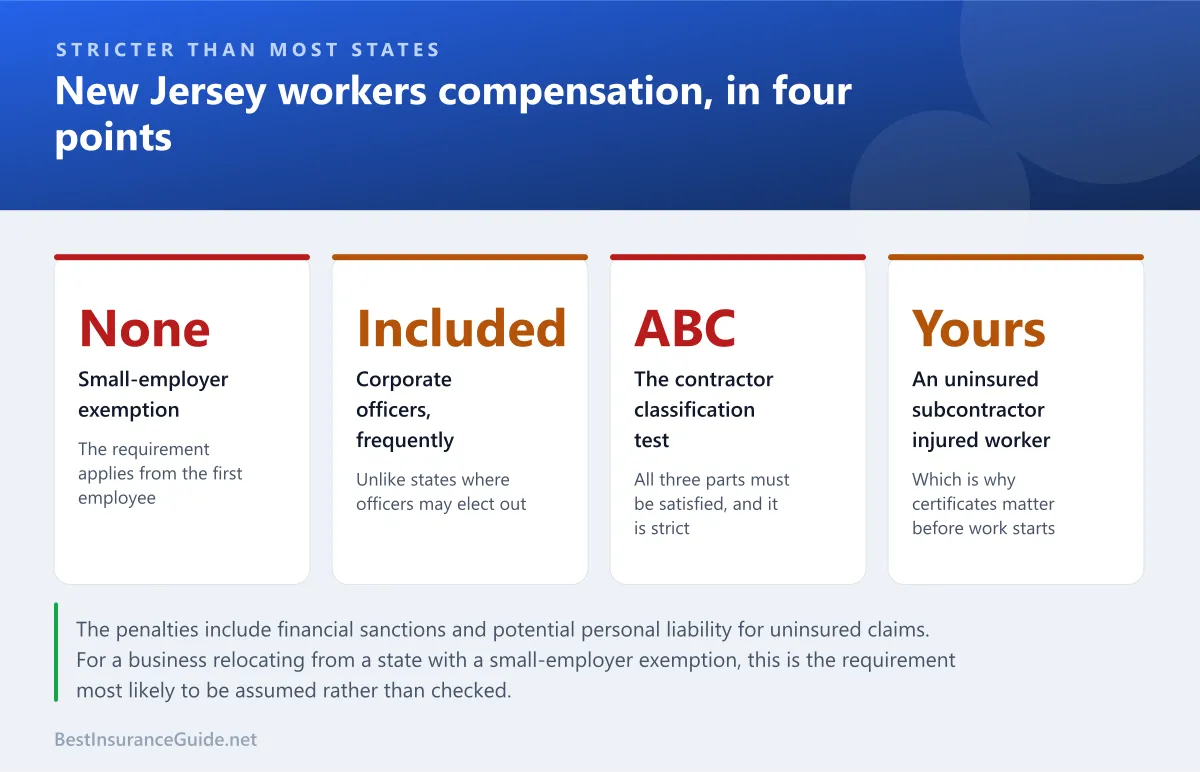
There is no small-employer exemption. Essentially every employer with employees must carry coverage, from the first one.
Corporate officers are frequently included rather than exempt, which differs from many states where officers may elect out.
The penalties are substantial, including financial sanctions and potential personal liability for uninsured claims.
Independent contractor classification is tested strictly. New Jersey applies a three-part test in which all three parts must be satisfied for a worker to be treated as a contractor. It is considerably harder to satisfy than the tests used in most states, and misclassification is enforced.
An uninsured subcontractor’s injured worker can become your responsibility. The protection is a current certificate of insurance from every subcontractor, collected before they start and kept on file.
What the contracts require
Since liability cover is contract-driven rather than statutory, the requirements come from whoever you are working with.
Commercial landlords almost universally require $1,000,000 per occurrence, $2,000,000 aggregate, with the landlord named as additional insured.
General contractors require the same plus an umbrella, commonly $2,000,000 to $5,000,000, plus a waiver of subrogation and frequently primary and non-contributory wording.
Municipalities and public authorities have their own schedules, frequently higher, and their certificates are checked properly rather than filed.
Larger commercial clients increasingly require cyber liability alongside the traditional lines, and professional liability where any advice is given.
Franchisors set their own requirements in the franchise agreement.
Three things worth understanding about these requirements.
Additional insured status is an endorsement with a cost, not an administrative step, and the form used matters: some cover ongoing operations only and some extend to completed operations, which for a contractor is a meaningful difference.
A waiver of subrogation prevents your insurer pursuing the other party, and it is priced accordingly.
A certificate of insurance summarises coverage and proves nothing. The policy and its endorsements are the substance, and a certificate showing a coverage the policy does not actually provide is a problem discovered at claim time.
Read the insurance clause before signing. Meeting a requirement you did not price for is expensive; discovering after signature that you cannot meet it is worse.
Regional differences
New Jersey’s density and geography produce meaningful variation.
The northern urban corridor, running through Newark, Jersey City and the surrounding counties, carries the state’s highest liability and auto rates, driven by frequency, litigation costs and theft.
The shore counties carry coastal property exposure, with named storm deductibles on commercial property and flood as a separate purchase entirely.
Central and southern New Jersey rate lower on frequency while carrying substantial warehousing and logistics activity along the turnpike corridor, which means commercial auto and workers compensation classifications dominate those programmes.
Winter weather matters everywhere for premises liability. Slip and fall claims concentrate sharply in winter, and documented snow and ice procedures are both a defence and an underwriting positive.
Building the programme
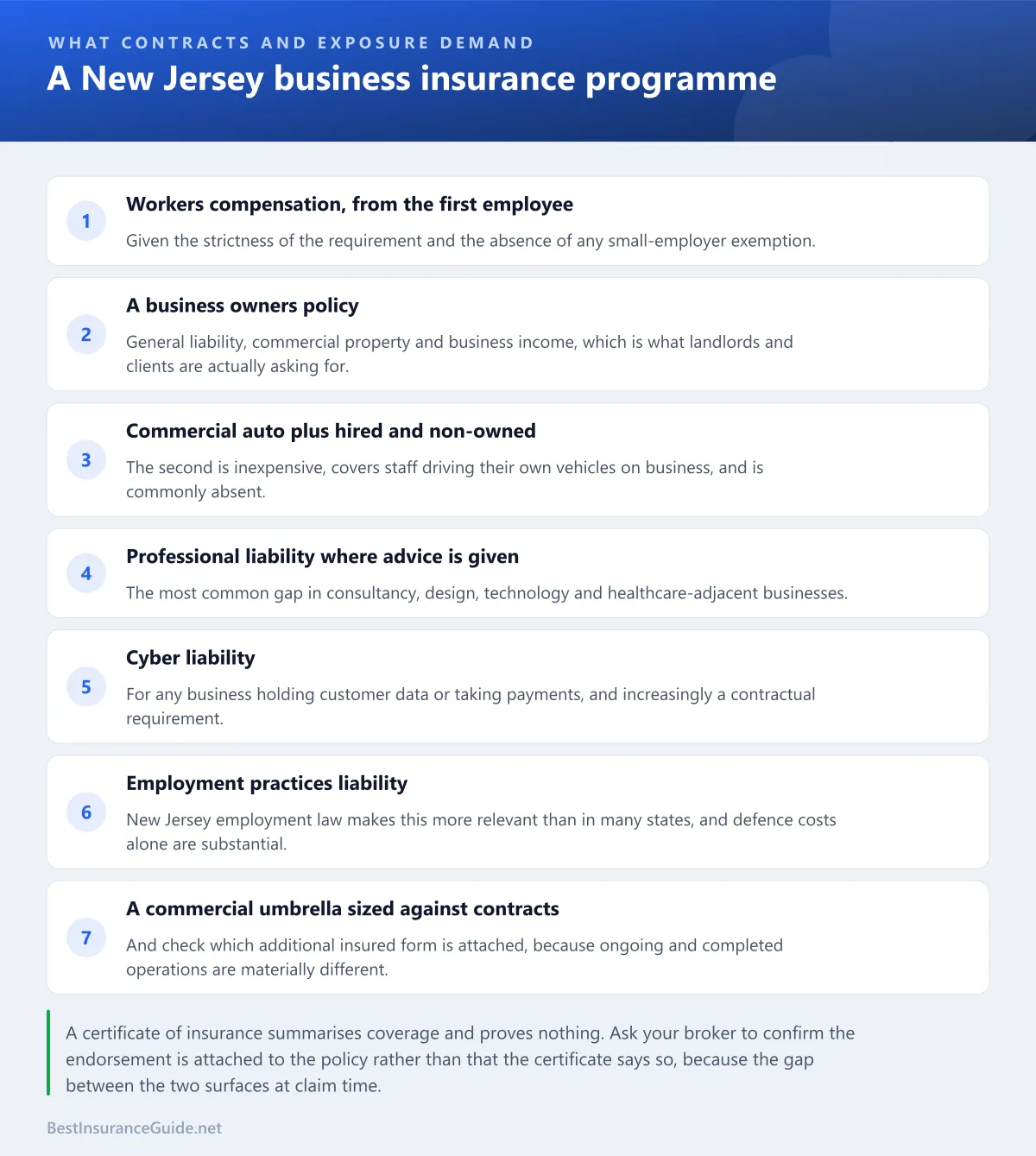
Workers compensation first, given the strictness of the requirement.
A business owners policy, packaging general liability with commercial property and business income.
Commercial auto, plus hired and non-owned auto for employees driving their own cars on business, which is inexpensive and commonly missing.
Business income and extra expense, which for a single-location business is existential rather than optional.
Inland marine, for tools and equipment away from the premises.
Professional liability, for any business providing advice or professional services.
Cyber liability, for any business holding data or taking payments.
Employment practices liability, once there are employees, and New Jersey’s employment law environment makes this more relevant than in many states.
A commercial umbrella, sized against the highest contract requirement you face.
Managing the cost
Get the workers compensation classifications right, since misclassified payroll produces both a premium problem and an audit adjustment.
Manage the experience modification factor, which multiplies workers compensation premium directly and responds to safety performance and claims handling over several years.
Document premises maintenance, particularly winter procedures, which affects both defensibility and underwriting.
Collect subcontractor certificates without exception.
Review limits against contracts annually, since client requirements ratchet upward and businesses frequently discover they have been non-compliant for months.
Use a broker who sees the whole programme, because an umbrella bought in isolation from the underlying policies is how attachment gaps happen.
The short version
New Jersey requires workers compensation from the first employee with no small-employer exemption, frequently includes corporate officers, and applies a strict three-part test to contractor classification. That is the statutory requirement and it is enforced.
General liability is not required by law and is required by essentially every landlord, contractor, municipality and commercial client, which makes your contracts the effective requirements list.
General liability answers third-party injury and property damage and nothing else. Professional mistakes, employee injuries, employment disputes, cyber incidents and damage to your own property each need their own policy.
And collect a certificate of insurance from every subcontractor before they start, because in New Jersey an uninsured subcontractor’s injured worker becomes your problem more readily than in most states.
For the excess layer, see business umbrella insurance, and for what to hold generally, the business insurance checklist.
Reading the endorsements, not the certificate
Because so much of a New Jersey programme is contract-driven, the endorsements attached to a general liability policy do more work than the policy itself. Four of them matter.
Additional insured, ongoing operations. Extends coverage to the named party for claims arising out of your ongoing work. The standard requirement.
Additional insured, completed operations. Extends it to claims arising after the work is complete. For a contractor this is a materially different and considerably more valuable endorsement, and a defect claim can arrive years later.
Primary and non-contributory. Provides that your policy responds first and does not seek contribution from the other party’s insurance. Frequently demanded and separately priced.
Waiver of subrogation. Prevents your insurer pursuing the named party after paying a claim.
Two things follow.
Requirements name specific endorsement forms, and a certificate stating “additional insured as required by written contract” is not the same as the endorsement being attached with the right form.
Ask your broker to confirm the endorsement is on the policy, not that the certificate says so. Certificates are produced quickly and endorsements are added deliberately, and the gap between the two is discovered at claim time.
Worked example: an endorsement that was not there
A contractor completes a project. Two years later a defect claim arrives naming both the contractor and the general contractor.
| Completed operations endorsement in place | Ongoing operations only | |
|---|---|---|
| Your own defence and indemnity | Covered | Covered |
| The general contractor as additional insured | Covered | Not covered |
| Contractual obligation to indemnify them | Met by the policy | Falls on you |
| Practical outcome | The insurer handles it | A dispute and a personal exposure |
The certificate looked identical in both columns.
Where the limits should sit
Contract requirements set the floor. Deciding whether to go above it is a separate judgement, and three factors decide it.
What a serious claim in your sector actually costs. A single injury claim at a commercial premises, a vehicle claim involving a serious injury, or a fire spreading from your operation to a neighbouring property all readily exceed a million dollars in a dense state.
What is at risk. Business assets, receivables, and for an unincorporated business or where personal guarantees exist, personal assets.
The cost of more limit, which falls sharply per million as the umbrella limit rises, making the second and third million far cheaper than the first.
Worked example: matching limits to exposure
A New Jersey contractor with fifteen employees and four vehicles.
| Exposure | Realistic severe claim |
|---|---|
| Serious injury at a job site | $1M to $3M |
| Commercial vehicle claim with injuries | $1M to $5M |
| Fire spreading to an adjoining property | $2M and upward |
| Employment claim from a former employee | Six figures in defence alone |
| Sensible total liability programme | $5M or more, umbrella included |
The primary limits alone do not reach any of the first three rows, which is what the umbrella is for.
Two things to check this year
Confirm which additional insured form is attached to your general liability policy, and specifically whether it covers completed operations as well as ongoing operations. For a contractor that difference is worth more than the endorsement costs.
Reconcile every contract insurance clause against your actual policy. Requirements ratchet upward as clients grow, and businesses routinely discover at renewal that they have been technically non-compliant for months.
The audit, which settles the actual premium
General liability and workers compensation policies in New Jersey, as elsewhere, are written on estimates and audited at the end of the term.
General liability is usually audited on revenue or payroll, depending on the classification.
Workers compensation is audited on payroll by classification, and this is where the adjustments are largest.
Uninsured subcontractors are added to your payroll where certificates cannot be produced for the period they worked, and charged at your classification rate. This is the single largest audit surprise in every state and New Jersey is no exception.
Overtime is frequently reportable at straight time, a legitimate reduction many businesses fail to claim.
Three habits make the audit painless: maintain classifications through the year rather than reconstructing them, keep a complete subcontractor certificate file covering the periods worked, and separate overtime in the payroll records so the reduction can be claimed.
How other states set the threshold
New Jersey has no small-employer exemption at all, which puts it at the strict end alongside Pennsylvania and Illinois, both of which also attach from the first employee.
Georgia and North Carolina attach at three or more, Michigan uses both a headcount and an hours test, and Florida sets thresholds that differ by industry with construction treated most strictly.
A note on scope
Nothing here is legal advice. New Jersey statutory requirements, worker classification tests, penalties and enforcement practice are set by state law and regulation and change over time.
The New Jersey Department of Labor and Workforce Development publishes the authoritative workers compensation requirements, the New Jersey Department of Banking and Insurance publishes commercial insurance guidance, and your contracts and policy documents are the authoritative statement of what you must hold and what you actually hold. This site is independent and not affiliated with any insurer.