How Much Is Commercial Auto Insurance? And Why the Range Is So Wide
What commercial auto insurance costs, the factors that drive the price, why personal auto will not cover business use, and how to compare quotes properly.

Table of contents

Commercial auto is priced on what a vehicle does rather than what it is, which is why the same van costs one figure for a florist and several times that for a courier.
Why the range is so wide
There is no useful single average, and quoting one would be misleading. What is useful is the shape of the range.
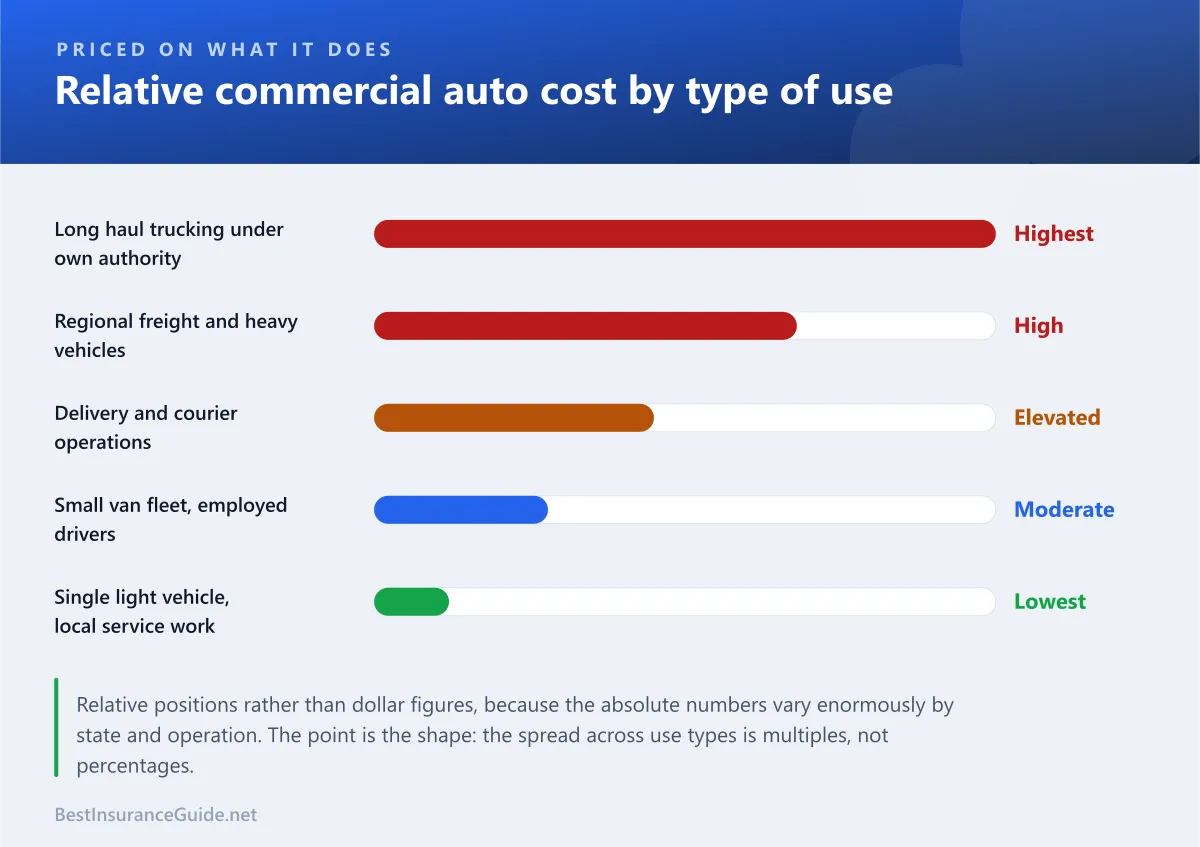
A light vehicle used locally by a service business with an owner-driver and a clean record sits at the bottom.
A small fleet of vans doing regional work with employed drivers sits meaningfully higher.
Delivery and courier operations rate higher again, because mileage, stop frequency and time pressure all raise claim frequency.
Heavy vehicles and trucking sit at the top, particularly under their own operating authority, where liability severity is highest and filing requirements apply. Our guide to box truck insurance covers that end specifically.
The spread across those bands is many multiples, and it is entirely driven by exposure rather than by any inefficiency in the market.
What actually drives the price
Eight factors, roughly in order of weight.
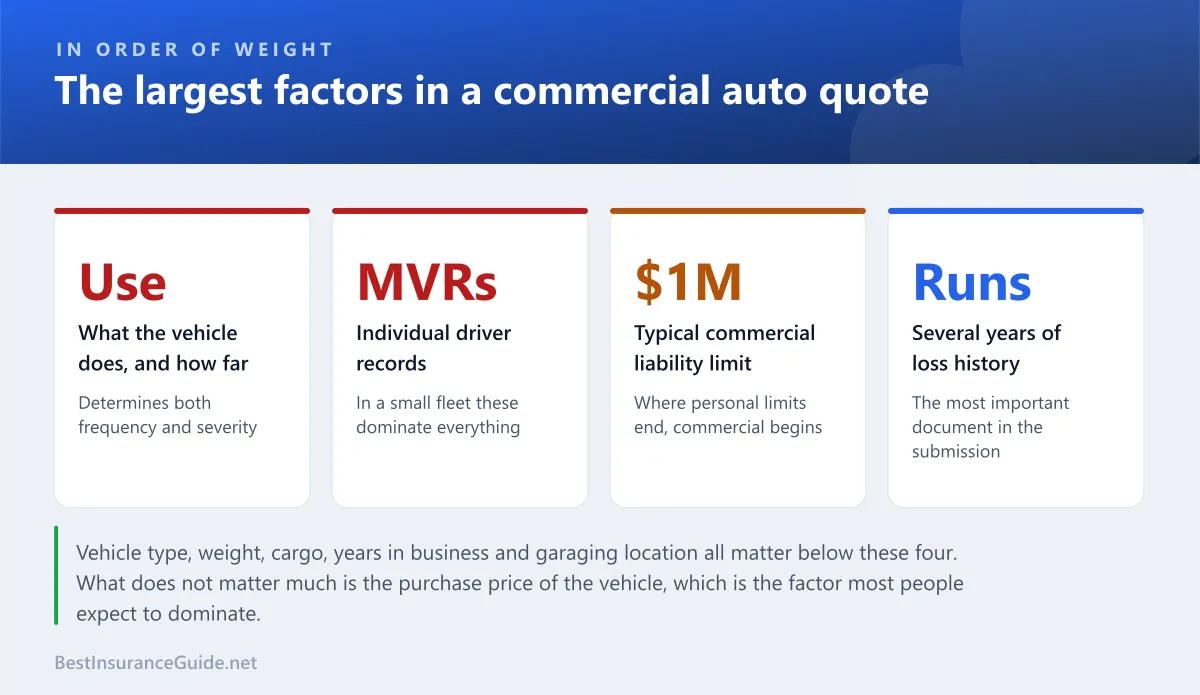
Use and radius. What the vehicle does and how far it goes. The single largest factor, because it determines both frequency and severity.
Driver records. In a small fleet, individual records dominate. One driver with a serious recent violation can reprice the whole account.
Liability limits. Commercial limits start where personal limits end. $1,000,000 combined single limit is the common starting point, and it is a substantial part of why commercial costs more.
Vehicle type and weight. Not the purchase price so much as the damage it can do and the cost to repair it.
Cargo or contents, where applicable, and whether the business carries goods for others.
Loss history. Carriers want several years of loss runs, and a clean history is worth a great deal.
Years in business. New ventures pay substantially more, and this improves reliably with time.
Location, including garaging address, the states you operate in and the roads you use.
Why the personal policy will not do
This is the most expensive misunderstanding in small business, and it is worth stating plainly.
Personal auto policies exclude business use beyond ordinary commuting. The wording varies, and delivery and ride-hail work are commonly excluded by name.
Three situations that catch people.
A sole trader using their own car for jobs. Visiting clients occasionally is usually fine; carrying tools and stock between jobs all day is business use.
An employee running an errand in their own car. The employer can be liable for what happens, and the employee’s personal policy may respond to their liability while leaving the business exposed. Hired and non-owned auto cover is the answer and it is inexpensive.
A van registered personally and used commercially, which is the clearest case and the one most likely to produce a denied claim.
The consequence of getting this wrong is not a higher premium. It is a claim denial on the largest exposure the business has.
The coverages a business actually needs
Commercial auto liability, at $1,000,000 combined single limit as a normal starting point.
Physical damage, comprehensive and collision on owned vehicles, generally required by any lender or lessor.
Hired and non-owned auto, for rented vehicles and employees’ own cars used on company business. The most commonly missing coverage in small businesses.
Medical payments or uninsured motorist cover, depending on the state and the structure of the operation.
Inland marine or contractors equipment for tools and equipment carried in the vehicle, which the auto policy does not cover. In a trade business the tools are frequently worth more than the van.
A commercial umbrella above the auto liability, which is the cheapest way to buy large limits and is frequently required by contracts.
Workers compensation, wherever there are employees.
Worked example: the gap in a trade business
A van is broken into overnight. The van is damaged and the tools are taken.
| Loss | Answered by |
|---|---|
| Damage to the van, $2,400 | Commercial auto, comprehensive |
| Tools and equipment, $18,600 | Inland marine, if carried. Nothing if not |
| Lost work while re-equipping | Business income, if carried |
| Customer materials in the van | Cargo or bailee cover, if carried |
Only the first row is on the auto policy, and it is the smallest number in the table. This is the most common uninsured loss in the trades.
Contracts, and the limits they demand
For many businesses the limit is not chosen so much as specified.
General contractors, landlords, municipalities and larger clients routinely require $1,000,000 auto liability, frequently with additional insured status and sometimes with a waiver of subrogation.
Three practical points.
Read the insurance clause before you sign, not after. Meeting a requirement you did not price for is expensive, and discovering you cannot meet it after signing is worse.
Additional insured status and waivers of subrogation are endorsements with real cost implications, not administrative formalities.
Certificates of insurance prove nothing about coverage; they summarise it. The policy and the endorsements are the substance.
Reducing what you pay
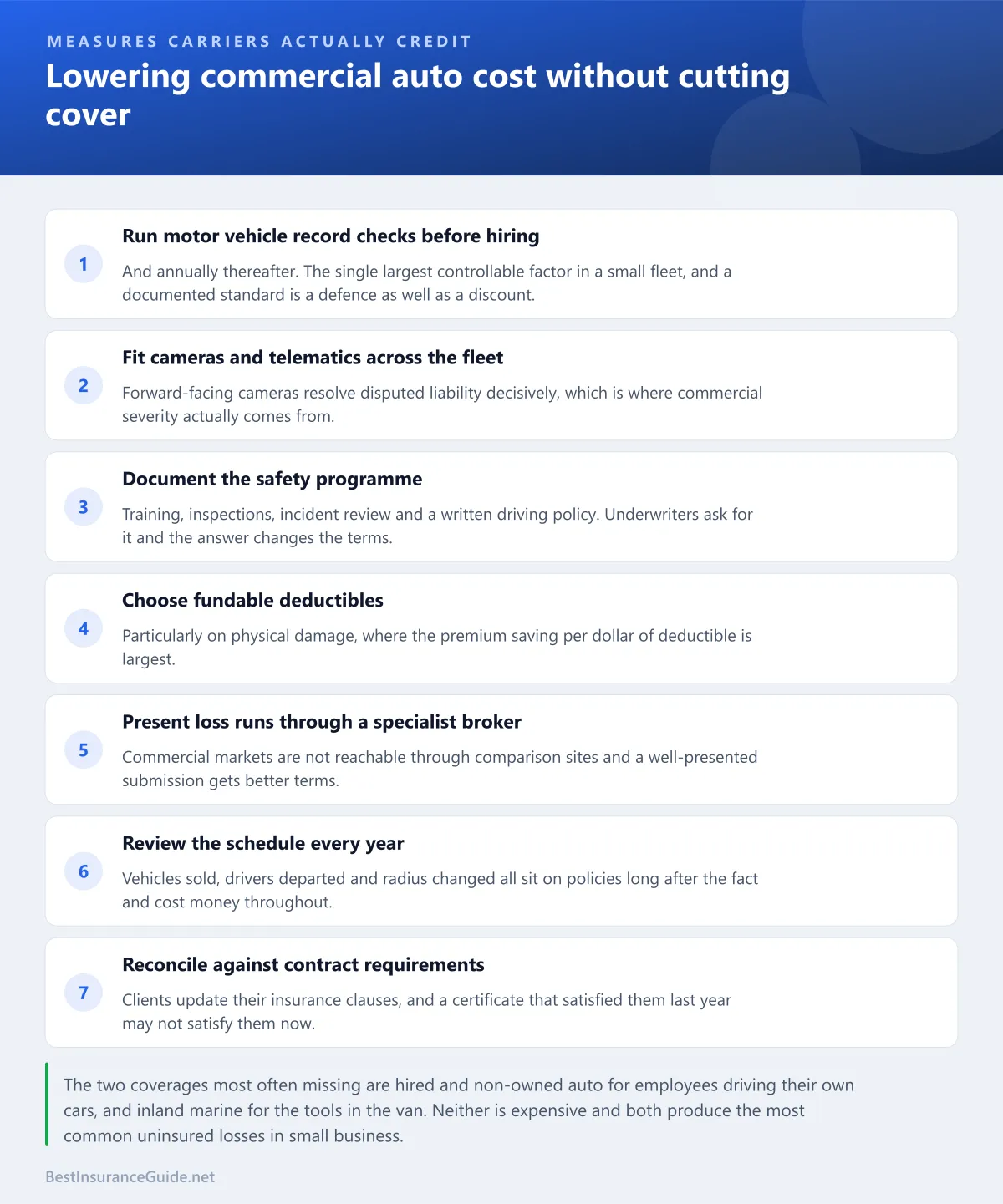
Check motor vehicle records before hiring, and re-check annually. This is the largest single controllable factor in a small fleet.
Fit forward-facing cameras and telematics. Widely credited by carriers now, and decisive in the disputed liability claims that drive commercial severity.
Write down the safety programme. Documented training, inspections, incident review and a written driving policy. Underwriters ask, and the answer changes the terms.
Choose deductibles you can genuinely fund, particularly on physical damage, where the saving is largest.
Keep several years of loss runs available and present them properly through a broker rather than filling in bare applications.
Review the schedule annually. Vehicles sold, drivers gone and radius changed all sit on policies long after the fact and all cost money.
Use a broker who knows your industry. Commercial markets are not reachable through comparison sites, and placement quality matters more here than in personal lines.
The short version
Commercial auto is priced on what the vehicle does, not what it is, and the spread across use types is many multiples rather than a few percent.
Radius, driver records and liability limits do most of the work. A personal auto policy will not substitute, and the failure mode there is a denied claim rather than a higher premium.
The two coverages small businesses most often miss are hired and non-owned auto, for employees driving their own cars on company business, and inland marine for the tools in the van, which are frequently worth more than the van.
Cameras, hiring standards and a written safety programme are the measures that genuinely move the price.
For the trucking end of the market, see box truck insurance, and for what a business should hold generally, the business insurance checklist.
Getting a quote that means something
Commercial auto quotes vary more than personal ones because the inputs are more open to interpretation, so specifying the risk properly matters.
Describe the actual operations. What the vehicles do, what they carry, how far they go and who drives them. An operation described as “local delivery” and actually running regional routes is misrated, and the correction arrives at claim time.
List every driver, with licence numbers, and expect the carrier to pull records.
State the radius honestly, including occasional longer trips. Ask how the carrier treats exceptions rather than hoping.
Value the vehicles correctly, and separately value the equipment inside them, because those sit on different policies.
Specify the limits before quoting. $1,000,000 combined single limit is the usual commercial starting point, and comparing a quote at that limit against one at a state minimum is not a comparison at all.
Ask what is excluded. Radius exclusions, driver age restrictions, commodity exclusions and named-driver restrictions all appear in commercial forms and all change what you are buying.
Worked example: two quotes that are not comparable
| Quote A | Quote B | |
|---|---|---|
| Auto liability limit | $500,000 CSL | $1,000,000 CSL |
| Hired and non-owned auto | Not included | Included |
| Radius stated | 50 miles | 200 miles |
| Driver restriction | Named drivers only | Any qualified driver |
| Physical damage deductible | $2,500 | $1,000 |
| Premium | Lower | Higher |
Quote A is cheaper because it is a smaller policy with tighter conditions. Whether it is a better buy depends entirely on whether those conditions match how the business actually operates, which is a question the price cannot answer.
Reviewing the policy each year
Remove vehicles you have sold and drivers who have left, both of which sit on schedules long after the fact.
Update the radius if the operation has changed.
Revalue the vehicles, since insuring an older van at its purchase price wastes premium and insuring a new one at last year’s value leaves a shortfall.
Recheck contract requirements, since clients update their insurance clauses and a certificate that satisfied them last year may not now.
Reconfirm the tools and equipment schedule, which in a trade business is the most frequently outdated document on the file.
The three most common uninsured losses
Across small commercial accounts, the same three gaps recur.
Tools and equipment in the vehicle. Covered by inland marine, not by commercial auto. In a trade business the contents of the van frequently exceed the value of the van itself, and the loss usually happens through an overnight break-in rather than a collision.
Employees driving their own cars on company business. Covered by hired and non-owned auto, which is inexpensive and frequently absent. The employee’s personal policy responds to their own liability; the business is exposed separately and the personal policy does nothing for it.
Business income while a vehicle is off the road. For a single-vehicle operation the vehicle is the business, and a six-week repair is six weeks without revenue. Commercial auto pays for the repair and nothing for the interruption.
Worked example: what each policy answers
A van is stolen from outside an employee’s home overnight, with tools inside.
| Loss | Answered by |
|---|---|
| The van itself | Commercial auto, comprehensive |
| Tools and equipment inside | Inland marine, if carried |
| Customer materials in the van | Cargo or bailee cover, if carried |
| Revenue lost while re-equipping | Business income, if carried |
| Replacement vehicle hire | Rental reimbursement, if carried |
One event, five coverages, and only the first is on the policy most small operators think of as their insurance.
Two questions before you buy
Does every vehicle and every driver on the schedule still exist? Sold vans and departed drivers sit on commercial schedules for years, and removing them is an immediate saving with no downside.
Does the policy match how the business actually operates today? Radius, commodities, garaging and use all drift as a business grows, and a description written at inception is frequently what a later coverage dispute turns on.
Both take a phone call, and between them they are worth more than most of the shopping people do instead.
A note on scope
Commercial pricing varies enormously by industry, use, geography, fleet size and loss history, and the figures and comparisons here are illustrative rather than quotes. Coverage forms, endorsements and regulatory requirements vary by state and by carrier and change over time.
Your state insurance department publishes consumer and commercial guidance, and the Federal Motor Carrier Safety Administration publishes federal requirements for regulated motor carriers. Your policy wording and endorsement schedule are the authoritative statement of what you hold. This site is independent and not affiliated with any insurer.