Collision Deductible Waiver: The Cheapest Endorsement Nobody Buys
How a collision deductible waiver works, when it applies, what it costs, how it differs from uninsured motorist property damage, and whether to buy it.

Table of contents
This is one of the cheapest useful endorsements available on a car policy and one of the least offered. It answers a specific and common situation: somebody with no insurance hits you.
What it does
Without it, the sequence after an uninsured driver hits you is this. You claim on your collision coverage, you pay your deductible, your insurer repairs the car, and your insurer then pursues the at-fault driver through subrogation. If they recover, your deductible is refunded. If the driver has nothing, which is usually why they were uninsured, they recover nothing and you do not get it back.
A collision deductible waiver removes your deductible from that sequence entirely.
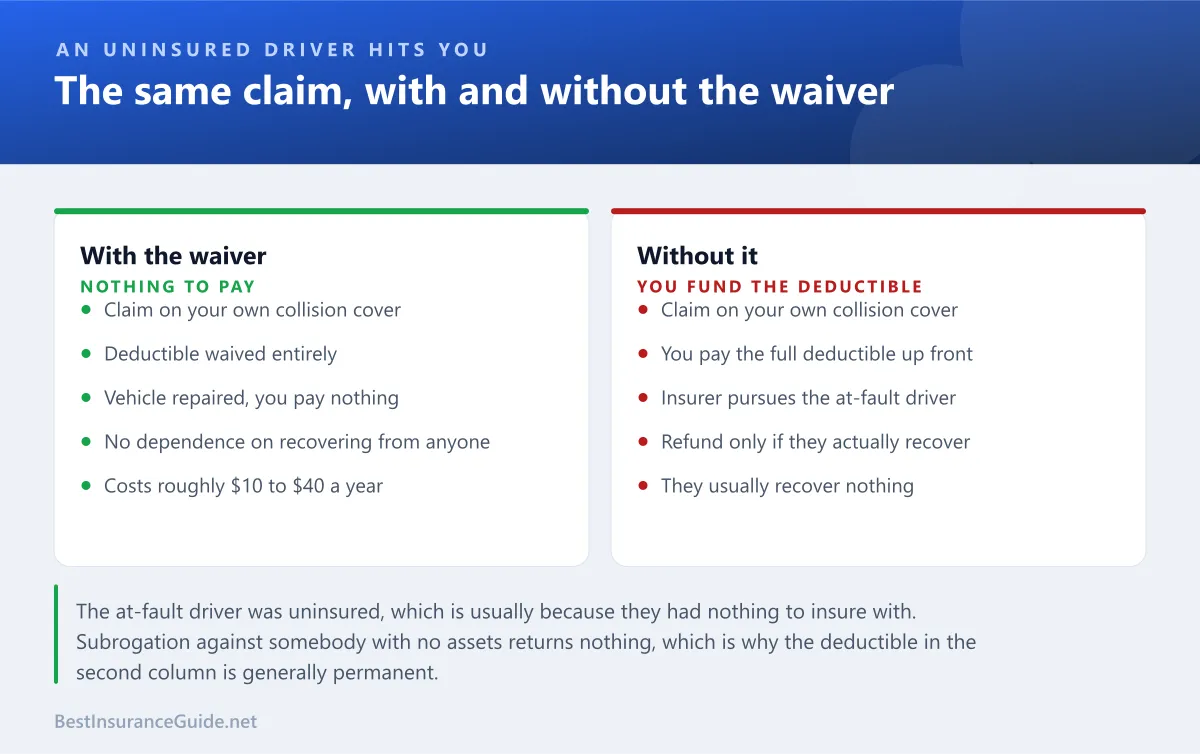
You claim, the vehicle is repaired, and you pay nothing.
Worked example: an uninsured driver, both ways
A $6,800 repair, $1,000 collision deductible, at-fault driver uninsured and identified.
| With the waiver | Without | |
|---|---|---|
| Repair cost | $6,800 | $6,800 |
| Your deductible | $0 | $1,000 |
| Insurer pays the shop | $6,800 | $5,800 |
| Deductible recovered by subrogation | n/a | Unlikely |
| Out of pocket | $0 | $1,000 |
| Annual cost of the endorsement | $10 to $40 | — |
One qualifying claim funds the endorsement for the rest of your driving life.
When it applies, and the wording that matters
The trigger is narrower than the name suggests, and three conditions are typical.
The at-fault driver was uninsured.
You were not at fault.
The at-fault driver is identified, which is where the important variation lies.
That third condition is the one to read. Some wordings require the other driver to be identified, which means an unidentified hit-and-run does not qualify. Others extend the waiver to hit-and-run provided a police report is filed promptly.
Given that a hit-and-run is one of the more likely scenarios in which you cannot recover from anybody, that distinction is worth checking before you need it.
Two further points on wording.
Some policies require contact. A driver who runs you off the road without touching you may not trigger the coverage, which is the same issue that arises with uninsured motorist property damage in several states.
The prompt reporting requirement is real. Where a police report is needed, filing it the same day is the difference between a qualifying and a non-qualifying claim.
How it differs from uninsured motorist property damage
These two coverages answer the same situation through different routes, and which one is available depends on your state.
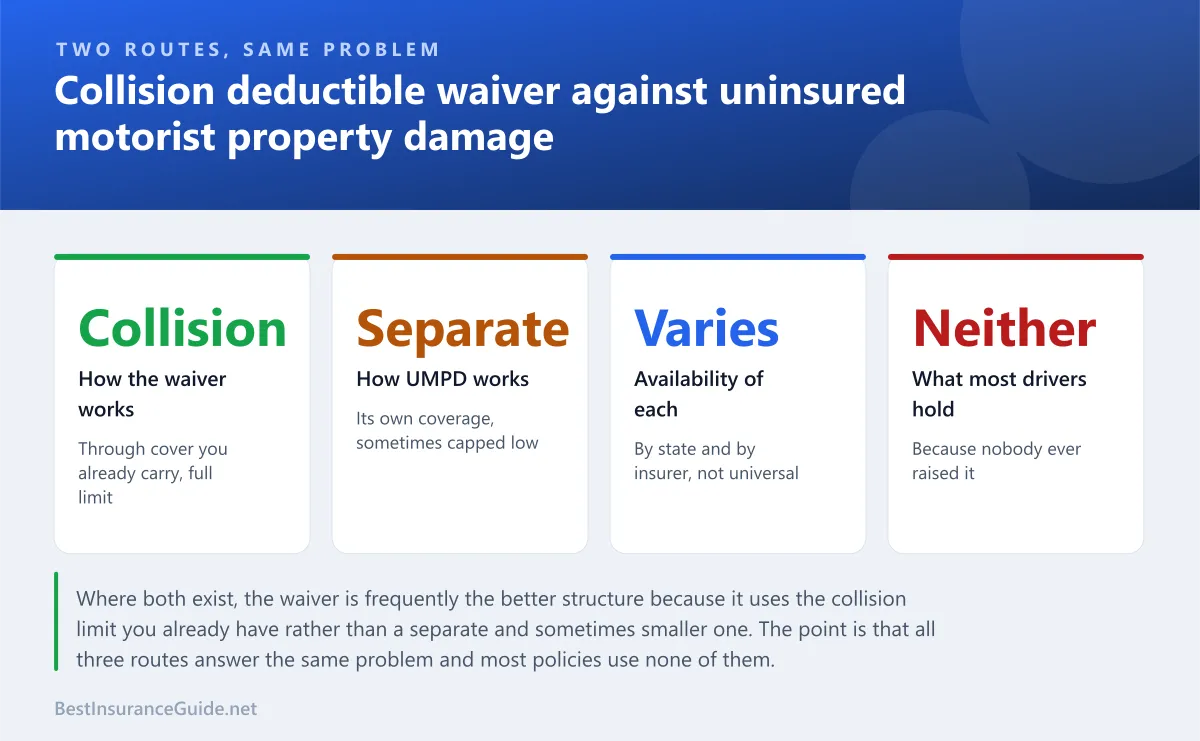
Uninsured motorist property damage is a separate coverage that pays for the damage to your vehicle directly, usually with a low or zero deductible of its own. It is available in some states and not others, and where it exists it is sometimes capped below the vehicle’s value.
A collision deductible waiver works through your existing collision coverage, so the full collision limit applies, and it simply removes the deductible.
Where both are available, the waiver is frequently the better structure because it uses the collision coverage you already carry and is not separately capped.
Where neither is offered, some states permit a reduced uninsured motorist deductible instead, and the practical effect is similar.
The point is not which one is theoretically superior. It is that all three answer the same problem, availability varies, and most drivers have none of them because nobody raised it.
Who should carry it
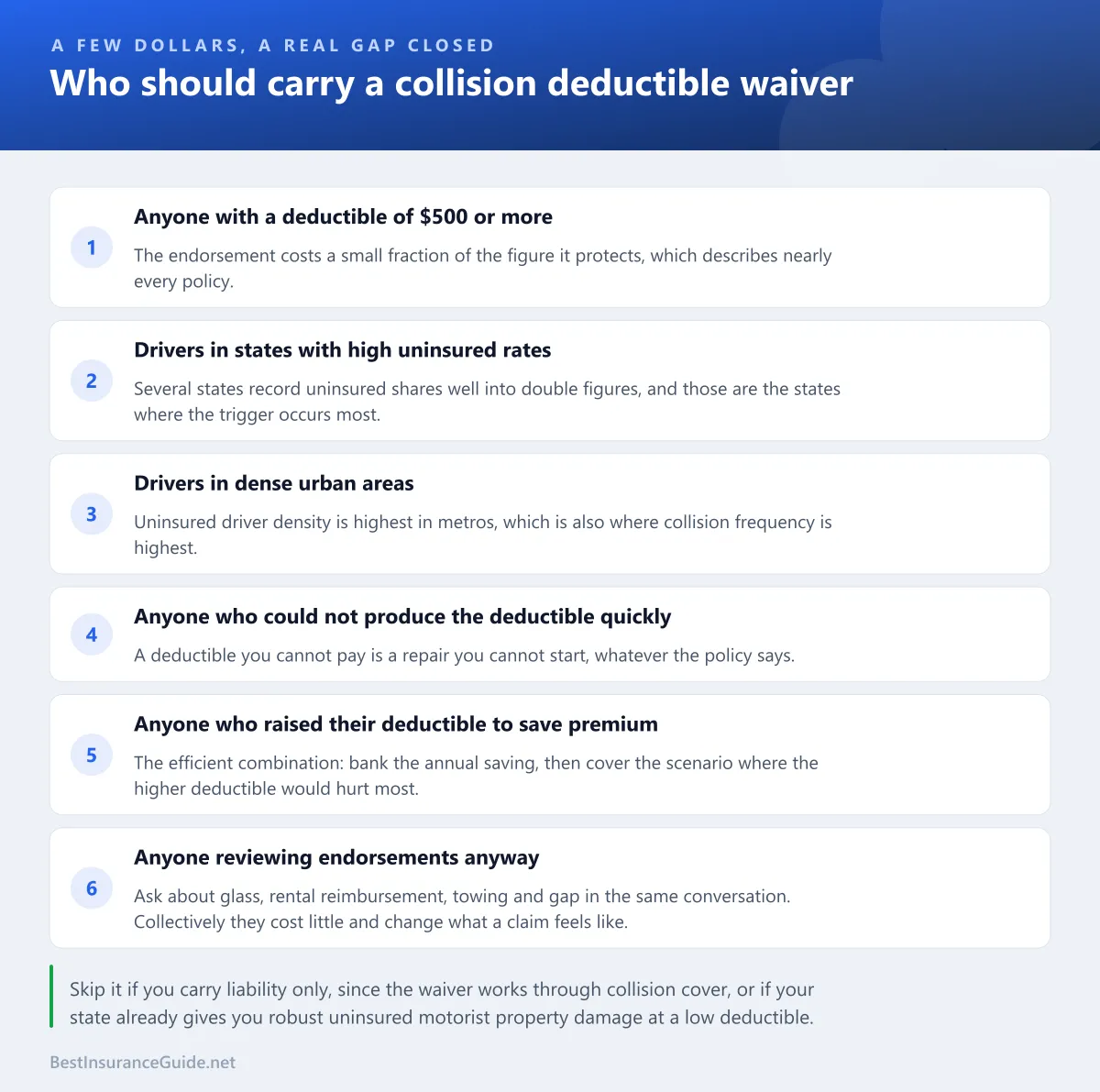
Anyone with a deductible of $500 or more, which is nearly everybody, since the endorsement costs a small fraction of the deductible it protects.
Anyone in a state with a high uninsured driver rate, and several states record uninsured shares well into double figures.
Anyone in a dense urban area, where uninsured driver density is highest.
Anyone who could not comfortably produce the deductible at short notice, which is the practical argument. A deductible you cannot pay is a repair you cannot start.
Anyone who raised their deductible to reduce the premium, because the waiver restores the protection for the uninsured-driver scenario at a fraction of what the higher deductible saved.
That last combination is the efficient one. Raising a deductible from $500 to $1,000 saves real money annually; adding a waiver for a few dollars covers the scenario where the higher deductible would hurt most.
Who can skip it
Drivers with a very low deductible, where the amount protected is small.
Drivers who carry liability only, since the waiver works through collision coverage and there is none.
Drivers in states where robust uninsured motorist property damage cover is standard, and where it is already on the policy at a low deductible.
How to buy it
Ask by name. It is rarely presented in an online quote flow and is frequently not mentioned by an agent unless raised. Ask specifically whether a collision deductible waiver, an uninsured motorist deductible waiver, or uninsured motorist property damage is available in your state.
Read the trigger. Specifically whether hit-and-run qualifies and whether physical contact is required.
Check the reporting requirement, and comply with it on the day of the incident rather than the week after.
Confirm it appears on the declarations page after you add it. Endorsements are added by request and are occasionally not applied.
Re-check it after any policy change, since endorsements can drop off when a vehicle is added or a policy is rewritten.
The wider point
The reason this endorsement is worth an article is not the endorsement. It is that a car policy contains a number of small, cheap, specific coverages that materially improve what happens after a claim, and almost none of them are offered by default.
Glass cover with a reduced deductible, rental reimbursement, towing and labour, gap coverage, an OEM parts endorsement, and this waiver all fall into that category. Individually each costs very little; collectively they are the difference between a policy that technically responds and one that actually helps.
The habit worth adopting is asking your insurer once a year: what endorsements are available that I do not currently have, and what does each cost? That conversation takes ten minutes and is more productive than most comparison shopping.
The short version
A collision deductible waiver removes your collision deductible when an uninsured driver is at fault. It costs somewhere in the region of $10 to $40 a year and protects a deductible of $500 or $1,000.
The wording that matters is whether an unidentified hit-and-run qualifies, because that is one of the scenarios you are most likely to face and one of the ones you can least recover from otherwise.
It is not the same as uninsured motorist property damage, availability of both varies by state, and most drivers carry neither because nobody offered them.
Ask by name, check the trigger, and confirm it appears on your declarations page afterwards.
For what a deductible does generally, see your homeowners insurance deductible, and for the wider list of endorsements, auto insurance discounts.
The related endorsements worth asking about at the same time
Since the conversation with your insurer is the same conversation, four other small endorsements belong in it.
Glass coverage with a reduced or waived deductible. Windscreen damage is common, glass claims are treated very gently at renewal, and a full deductible on a $450 windscreen makes the coverage useless. Where a reduced glass deductible is available it is inexpensive and it is used.
Rental reimbursement. Check the daily limit rather than just the presence of the coverage, because a limit set years ago may no longer rent a comparable vehicle. Check the total cap too, since repair queues are longer than they were.
Gap coverage, if the vehicle is financed and the loan exceeds its value. Usually far cheaper as an endorsement from your own insurer than from a dealer. Our guide to gap insurance sets out when it applies.
An OEM parts endorsement, which requires original manufacturer parts on a repair. Worth considering on a newer vehicle, a leased vehicle, or anything with advanced driver assistance systems that need precise calibration.
None of these are large purchases. Collectively they are the difference between a policy that technically responds and one that leaves you no worse off.
Worked example: the annual cost of the small endorsements
| Endorsement | Typical annual cost |
|---|---|
| Collision deductible waiver | $10 to $40 |
| Reduced glass deductible | $15 to $50 |
| Rental reimbursement | $30 to $70 |
| Towing and labour | $12 to $30 |
| Gap coverage, where applicable | $20 to $60 |
| Combined | Under $250 for most drivers |
Against a policy costing well over a thousand dollars a year, that is a small proportion for a substantial improvement in what actually happens after a claim.
Two checks worth doing this month
Look at your declarations page and find your collision deductible. If it is $500 or more, the waiver protects a figure large enough to be worth the small annual cost.
Ask your insurer, by name, what they offer for the uninsured-driver scenario. In some states that will be a collision deductible waiver, in others uninsured motorist property damage, and in others a reduced uninsured motorist deductible. All three answer the same problem and most drivers hold none of them because nobody raised it.
When the waiver does not apply
Worth knowing so the expectation is right.
When you were partly at fault, which is why the wording specifies a not-at-fault loss.
When the at-fault driver had insurance, even at very low limits, because they are underinsured rather than uninsured. Underinsured motorist cover is the line that answers that, and it is a separate purchase.
When the driver cannot be identified, under wordings requiring identification, which is the hit-and-run gap discussed above.
When you carry no collision coverage, since the waiver works through it.
When the claim is comprehensive rather than collision, for example a vehicle damaged by an uninsured driver in a car park with no contact recorded.
The habit worth adopting
The reason this endorsement is worth knowing about is not the endorsement itself. It is what its obscurity says about how personal auto policies are actually sold.
A car policy contains a set of small, specific, inexpensive coverages that materially change what happens after a claim, and almost none of them appear in a quote flow or get raised by an agent working through a standard script.
So the useful habit is an annual question, asked directly: what endorsements are available on this policy that I do not currently have, and what does each one cost?
That question routinely surfaces a collision deductible waiver, a reduced glass deductible, rental reimbursement at a realistic daily limit, towing and labour, gap cover and an original parts endorsement. Collectively they cost a small fraction of the premium and they are the difference between a policy that pays and a policy that leaves you whole.
Ten minutes once a year, and it is more productive than most comparison shopping.
Related reading
Comprehensive deductible explained covers the other deductible on the policy and why it deserves to be set lower than collision. Does car insurance cover repairs covers what the deductible is actually being applied to once a repair begins.
A note on scope
Availability, wording, triggers and pricing for collision deductible waivers and uninsured motorist property damage vary considerably by state and by insurer and change over time. Figures here are illustrative rather than quotes.
Your state insurance department publishes consumer guidance on uninsured motorist coverages, and your own policy wording and declarations page are the authoritative statement of what you hold. This site is independent and not affiliated with any insurer.