Does Renters Insurance Cover Appliances? Only When They Break Suddenly
Renters insurance covers your appliances against covered perils, not mechanical breakdown or repair. Who pays when the landlord's appliance floods your flat.

Table of contents
Appliances produce two very different renters insurance questions, and people usually ask the wrong one first.
The question that gets asked is whether the policy will replace a broken washing machine. The question that matters is who pays when an appliance causes water damage, because that claim is twenty times larger.
What is actually covered
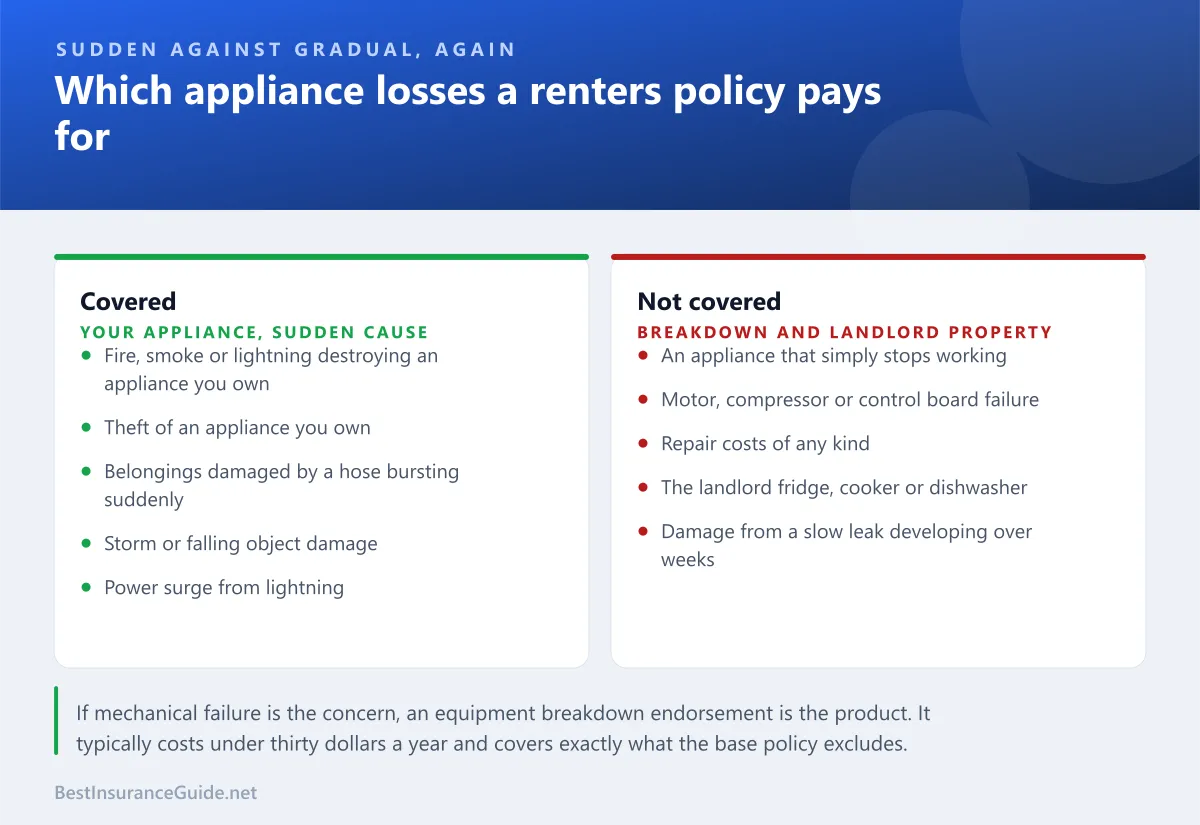
Your renters policy covers appliances you own against the named perils on the policy: fire, smoke, lightning, theft, vandalism, windstorm, falling objects and sudden water discharge.
So a fire destroys your microwave, a lightning strike kills your television, a burst pipe ruins a washing machine you bought: all claims.
What is not covered
Mechanical and electrical breakdown. This is the answer to the question most people are asking. An appliance that simply stops working is not covered. A motor burning out, a compressor failing, a control board dying, a drum bearing going: all excluded, regardless of how sudden it felt.
Insurance covers sudden accidental damage from an external cause, not the end of a service life. A fifteen-year-old fridge that dies is a maintenance event.
Wear, rust and deterioration.
Manufacturer defects, which are a warranty question rather than an insurance one.
Appliances belonging to the landlord. The fridge, cooker, dishwasher and washer that came with the flat are the landlord’s property. If the landlord’s dishwasher dies, that is a maintenance request, not a claim.
Repair costs generally, whether or not the appliance is yours.
The endorsement that fills the gap
If the mechanical failure question is what brought you here, there is a product for it.
Equipment breakdown coverage is an optional endorsement covering mechanical and electrical breakdown of appliances and electronics, which the base policy excludes. It typically covers motor burnout, control board failure, compressor failure and power surge damage.
It usually costs a small amount per year, frequently under $30, and in a flat where you own most of your own appliances it is reasonable value. Our guide to whether renters insurance covers electronics covers the same endorsement from the electronics side, since it addresses both.
Two things it is not. It is not a home warranty, which is a service contract rather than insurance and works differently. And it does not cover wear and tear, only breakdown.
The claim that actually matters: water
Here is where appliances produce serious money, and it has nothing to do with replacing the appliance.
A sudden appliance failure that releases water is a covered peril. The classic is a washing machine supply hose bursting, which is one of the most common water losses in rented homes. Dishwasher supply lines, refrigerator ice maker lines and water heaters produce the same claim.
Gradual leaking is not covered. A hose that has been weeping for months, a seal that has been failing slowly, a connection that has been dripping behind a unit. That is treated as maintenance, exactly as our guide to whether renters insurance covers mold describes for the mould that follows.
The distinction is sudden against gradual, and it decides the claim.
Worked example: a supply hose failure
A washing machine hose bursts while the tenant is at work. Water runs for around six hours.
| Item | Cost | Which coverage |
|---|---|---|
| Tenant’s own damaged belongings | $3,400 | Personal property |
| Emergency water extraction and drying | $1,850 | Personal property or loss of use |
| Hotel for six nights while drying ran | $940 | Loss of use |
| Tenant’s own claim | $6,190 | |
| Less deductible | $500 | |
| Paid to tenant | $5,690 |
That is the small half of the event.
The liability half
Water travels downward, and in a multi-storey building that is where the real exposure sits.
Worked example: the same hose failure, three floors up
| Claim against the tenant | Amount |
|---|---|
| Flat below: flooring, ceiling, plastering | $16,400 |
| Flat below: damaged furniture and electronics | $7,900 |
| Second flat below: ceiling and light fittings | $5,100 |
| Landlord: structural drying and remediation | $11,200 |
| Landlord: lost rental income during repairs | $6,800 |
| Total claimed against the tenant | $47,400 |
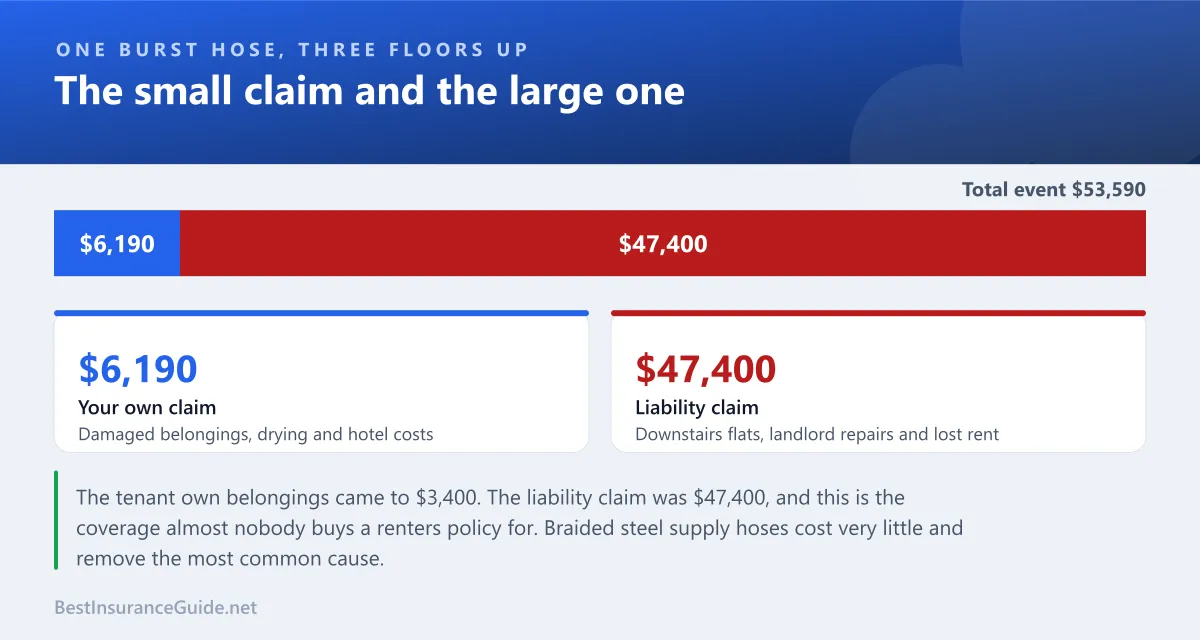
The tenant’s own belongings were $3,400. The liability claim was $47,400, and a $100,000 liability limit absorbed it comfortably.
Without a renters policy, that is $47,400 owed personally because a rubber hose failed.
This is the strongest argument for renters insurance generally, and it is the coverage nobody buys the policy for.
Two practical points. Replace washing machine supply hoses every five years or so, and use braided stainless steel rather than rubber. It costs very little and it removes the single most common cause of this claim. And turn the supply valves off if you are away for an extended period.
When the landlord’s appliance causes the damage
The mirror image, and the sequence surprises people.
Their appliance is their property, so its failure is their maintenance problem.
Your damaged belongings are your claim. You claim on your own renters policy for your contents and loss of use, subject to your deductible.
Your insurer may then pursue the landlord through subrogation, on the basis that their failure to maintain the appliance caused your loss. If they recover, they normally refund your deductible.
That is the correct order. Claiming on your own policy first gets you paid quickly; waiting for the landlord’s insurer to accept liability can take months.
Report it to the landlord in writing immediately regardless, both because your lease probably requires it and because that written record supports the subrogation claim.
Replacement cost matters here too
Appliances depreciate, and the settlement basis decides what you get.
Actual cash value pays the depreciated value. An eight-year-old washing machine that cost $700 might settle at $150, which will not replace it.
Replacement cost pays what a comparable new appliance costs, subject to limits and deductible.
The premium difference between the two settings is typically a couple of dollars a month across the whole policy, and it applies to everything you own rather than just appliances. Check the declarations page.
Tenant improvements
One situation worth flagging, because it falls between policies.
If you have installed something yourself — a new dishwasher, an air conditioning unit, built-in shelving — the position depends on whether it has become part of the building.
Freestanding items you own are personal property and are covered normally.
Fixtures you installed and cannot remove may be treated as improvements to the landlord’s property, and some renters policies carry a small tenant improvements limit while others exclude them.
If you have spent real money improving a rented property, ask your insurer how they treat it and get the answer in writing before you need it.
Making a water damage claim
Appliance water losses are among the more complex renters claims, because they frequently involve your contents, your liability and the landlord simultaneously.
Stop the water first. Know where your shutoff valves are before you need them, and photograph the failure point before anything is moved or repaired.
Report to the landlord in writing immediately, dated. This is both a lease obligation in most agreements and the record that later separates a promptly reported loss from a neglected one.
Report to your insurer the same day. Water damage escalates quickly and insurers frequently arrange emergency drying, which is cheaper than the damage that follows from delay.
Mitigate, but do not repair. You are obliged to prevent further damage, so move belongings clear and start drying. You are not obliged to arrange remediation before the adjuster has seen it, and doing so can destroy the evidence that the loss was sudden rather than gradual.
Document the failed component. The burst hose, the split connection, the failed seal. That physical evidence is what establishes the loss was sudden, which is the whole basis of the claim.
Keep every receipt, including dehumidifier hire, fans, additional electricity and hotel nights.
Expect a subrogation conversation if the appliance was the landlord’s. Your insurer pays you, then pursues them, and your deductible is normally refunded if they recover.
Worked example: the claim sequence
| Stage | What happens |
|---|---|
| Day 0 | Hose fails, water stopped, landlord notified in writing, insurer called |
| Day 1 | Emergency drying arranged, belongings photographed and moved |
| Day 2-4 | Adjuster inspects, failed hose retained as evidence |
| Week 2 | Contents claim settled, loss of use receipts submitted |
| Week 3+ | Downstairs neighbours’ liability claims received and passed to insurer |
| Month 2-6 | Liability claims settled, subrogation pursued where applicable |
The liability portion runs long after the contents claim closes, which is why the liability limit matters more than the contents figure in this category.
Comparing quotes on appliance and water cover
The liability limit, for the reasons above. In a multi-storey building this is the number that matters.
Replacement cost against actual cash value, which decides whether a depreciated appliance settlement replaces anything.
Whether water backup from sewers and drains is included, which it is not by default on any standard policy. That is a separate endorsement, it is inexpensive, and it matters in older buildings and basement flats.
Whether equipment breakdown is available, and what it costs.
The loss of use limit, since drying out a flooded flat routinely takes weeks.
A note on scope
Endorsement availability, sublimits and the treatment of tenant improvements vary between insurers and change over time. The figures here are illustrative rather than any particular policy’s schedule.
Confirm your own liability limit and settlement basis on your declarations page, and ask specifically about water backup cover if you are in an older building or below ground level. This site is independent and not affiliated with any insurer.
Renters improvements, briefly
If you have installed appliances yourself in a rented property, ask your insurer how they treat them before you need to.
Freestanding items you own are personal property and covered normally. Things you installed that have become part of the building may be treated as tenant improvements, and policies differ on whether those are covered, sublimited or excluded.
Where you have spent meaningful money improving a rental, that answer is worth having in writing, because it falls exactly between your contents cover and the landlord’s building policy and neither party assumes it is theirs.
The short version
Renters insurance covers appliances you own against fire, theft, lightning and sudden water damage. It does not cover an appliance that simply fails, it does not cover repairs, and it does not cover the landlord’s appliances at all.
If mechanical breakdown is your concern, an equipment breakdown endorsement is the product, and it usually costs under $30 a year.
But the claim that matters is water. A sudden appliance failure that floods downstairs flats produces a liability claim in the tens of thousands, and that is what a renters policy genuinely protects you against.
Replace rubber supply hoses with braided steel, check your liability limit is at least $300,000 in a multi-unit building, and confirm you are on replacement cost rather than actual cash value.
For the full list of named perils, see what renters insurance covers, and for the sudden-versus-gradual test that decides water claims, does renters insurance cover mold.