Does Renters Insurance Cover Theft and Robbery? Yes, Within Limits
Renters insurance covers theft, burglary and robbery at home and away. Category sublimits, the tiny cash limit, and why theft by a roommate is often excluded.

Table of contents

Theft is one of the broadest coverages on a renters policy and one of the most frequently disappointing, and the gap between those two things is entirely about sublimits.
What is covered
Theft, burglary and robbery are all named perils, and the policy does not usually distinguish between them.
For clarity, since the words get used interchangeably: burglary is entering to steal, robbery involves force or the threat of it against a person, and theft is the general term. All three are covered.
Three features are broader than people expect.
Forced entry is usually not required. Most wordings cover theft regardless of how the thief got in. A door left unlocked, a window left open, or someone let in and then stealing are generally all covered.
Coverage follows you off-premises. A bag taken in a café, a phone lifted at a station, luggage stolen abroad, a laptop from your car. Off-premises theft is normally covered subject to your deductible.
It covers attempted theft damage. A forced door, a broken window, a damaged lock: property damage caused during a theft or attempt is covered alongside what was taken.

What is not covered
Mysterious disappearance. Property that has simply gone missing, with no indication a theft occurred, is excluded by most policies. A ring that vanished somewhere in the flat is not a theft claim.
Theft by an insured, which is standard and obvious.
Theft by a household member or roommate, which is not obvious and catches people. Many policies exclude theft by anyone regularly residing in the household, whether or not they are named on the policy. A roommate who takes your laptop is generally a police matter rather than a claim.
That is one more argument for roommates holding separate policies rather than sharing one, as the renters insurance guide explains.
Property in a vehicle in some limited wordings, though most policies do cover it. Worth checking if you regularly leave things in a car.
Business property, beyond a small limit.
Anything you cannot evidence, in practice. A claim is settled against what you can show you owned.
The sublimits are the real story
This is where theft claims fall short of expectations, and the figures surprise people.
Even on a policy with a $40,000 contents limit, specific categories carry much lower caps for theft specifically.
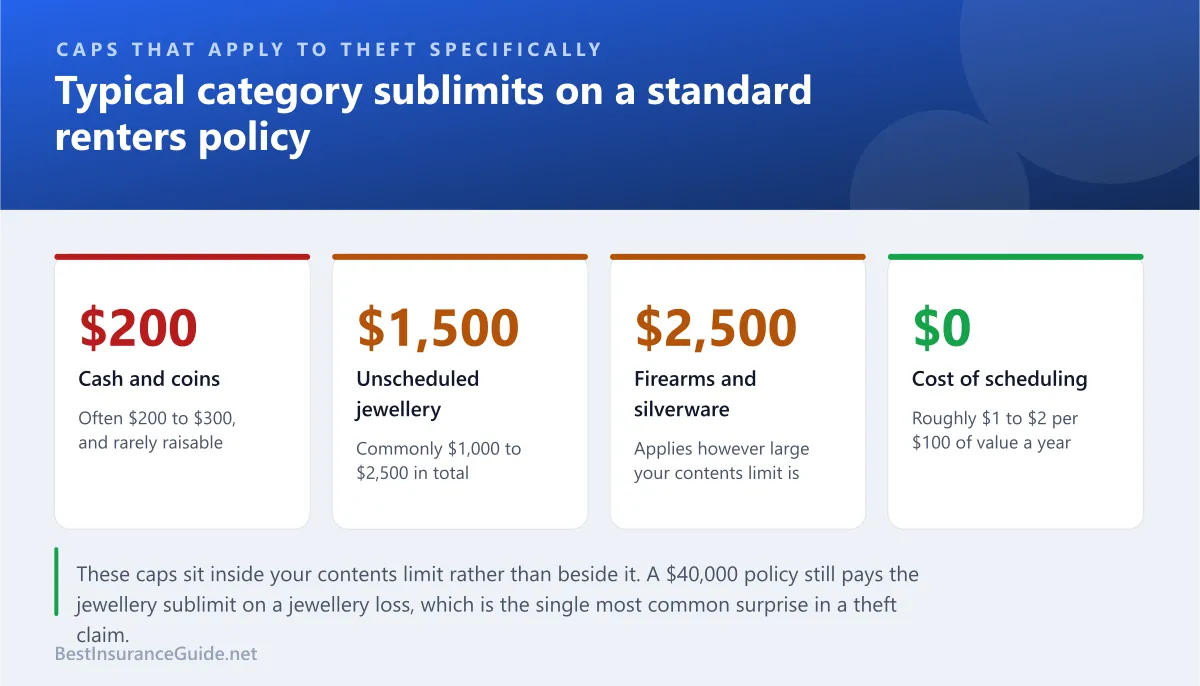
Typical figures, which vary by insurer:
| Category | Typical theft sublimit |
|---|---|
| Cash, bank notes, coins, precious metals | $200 to $300 |
| Jewellery, watches and precious stones | $1,000 to $2,500 |
| Silverware, goldware and pewterware | $2,500 |
| Firearms | $2,000 to $2,500 |
| Furs | $1,000 to $2,500 |
| Collectibles, stamps and trading cards | Varies, often $1,000 to $2,500 |
Note what that means in practice. If a burglar takes $6,000 of jewellery from a flat insured for $40,000 of contents, the policy pays the jewellery sublimit, not the loss.
The cash limit is the one to internalise. Around $200 to $300, and it generally cannot be raised meaningfully. Cash kept at home is effectively uninsured, and that is a reason to keep less of it there.
Worked example: a burglary against the sublimits
$40,000 contents cover, $500 deductible, replacement cost.
| Item taken | Value | Sublimit | Paid |
|---|---|---|---|
| Laptop and tablet | $2,400 | None | $2,400 |
| Television | $800 | None | $800 |
| Engagement ring and two watches | $7,200 | $1,500 | $1,500 |
| Cash from a drawer | $900 | $250 | $250 |
| Grandfather’s shotgun | $3,100 | $2,500 | $2,500 |
| Clothing and misc | $1,900 | None | $1,900 |
| Total | $16,300 | $9,350 | |
| Less deductible | $500 | ||
| Settled | $8,850 |
A $16,300 loss on a $40,000 policy settled at $8,850, and nothing about that is a coverage failure. The sublimits did exactly what the policy says they do.
Scheduling, which fixes it
For anything above a category sublimit, scheduling is the answer and it is inexpensive.
Scheduling lists an item individually with an agreed value, established when you add it. Three things change:
It comes out of the category sublimit. A $7,000 ring scheduled at $7,000 is covered at $7,000.
It is settled at agreed value, so you are not arguing about condition or depreciation after the loss.
The deductible is frequently waived on scheduled items.
Scheduled items are also usually covered on an all-risks basis rather than named perils, which means a ring that is simply lost, rather than stolen, may be covered. That is a genuine upgrade, because mysterious disappearance is otherwise excluded.
You will typically need a recent appraisal for jewellery above a threshold, and a receipt or valuation for other categories. The cost is usually a small annual amount per thousand dollars of value.
The police report, and why timing matters
Almost every insurer requires a police report for a theft claim. File it the same day.
A report filed three days later invites questions about whether the theft happened when you say it did, and delay is the most common reason a legitimate theft claim gets scrutinised.
Get the reference number and keep it. It is what links everything together later.
For an off-premises theft, report to the local police force where it happened, not your home one. For a theft abroad, the local report is what your insurer will want, and obtaining one after you have flown home is close to impossible.
Proving what you owned
Theft claims are settled entirely against evidence, and the evidence is easy to gather in advance and nearly impossible afterwards.
A room-by-room video is the single most effective thing you can do. Walk each room narrating what things are and roughly when you bought them. Open wardrobes and cupboards. Twenty minutes of work.
Photograph serial numbers on electronics, and the hallmarks or certificates on jewellery.
Keep receipts for anything significant, or at least the order confirmation emails.
Store it off-site. An inventory that was stolen along with the laptop it lived on is not an inventory.
Without evidence, an adjuster is settling a total loss against your memory, and memory settles low. Our guide to what renters insurance covers sets out the wider list of perils this applies to.
Reducing the risk
Insurance pays afterwards. These reduce the loss and several attract discounts.
Deadbolts and window locks, which most insurers give a protective device discount for.
A monitored alarm, which attracts a larger discount and genuinely deters.
A safe for jewellery and documents, bolted down. Some insurers raise the jewellery sublimit for items kept in a qualifying safe.
Do not keep significant cash at home, since it is effectively uninsured.
Be careful about social media. Publicly announcing you are away for two weeks is a genuine risk factor.
The short version
Renters insurance covers theft, burglary and robbery, at home and away, and usually without requiring forced entry. Damage caused during a break-in is covered too.
The disappointment comes from category sublimits: cash at around $200 to $300, jewellery frequently $1,000 to $2,500, firearms and silverware similar. Those caps apply regardless of your overall contents limit.
Schedule anything above those caps. It removes the sublimit, fixes the value in advance, frequently waives the deductible and often upgrades the item to all-risks cover including simple loss.
File the police report the same day, and video your contents before you ever need to.
For the full list of named perils, see what renters insurance covers.
Making a theft claim well
Theft claims are settled almost entirely on documentation, and the difference between a well-evidenced claim and a described one is routinely thousands of dollars.
File the police report the same day, and get the reference number. Every insurer asks for it.
Report to the insurer promptly, ideally the same day. Policies require notice within a reasonable time and delay is the most common reason a legitimate claim is scrutinised.
Do not clean up before photographing. The forced door, the disturbed drawers, the point of entry. That evidence supports the account of what happened.
Submit an itemised list, not a summary. Item, approximate purchase date, approximate price, and where you bought it. Adjusters settle vague lists conservatively.
Provide proof for anything significant. Receipts, order confirmation emails, credit card statements, photographs of the item in your home, serial numbers, appraisals for jewellery. Something is dramatically better than nothing.
Expect a recoverable depreciation holdback on a replacement cost policy. Many insurers pay actual cash value first and release the balance once you have actually replaced the item and sent the receipt. That is normal, and it means you need cash flow to buy replacements before the full settlement arrives.
Ask about a sublimit before you assume a shortfall is an error. A jewellery claim settled at $1,500 against a $7,000 loss is usually the sublimit working as written rather than a mistake.
Worked example: two identical burglaries
| Documented | Undocumented | |
|---|---|---|
| Police report | Same day | Two days later |
| Evidence provided | Video inventory, receipts, serials | Verbal list from memory |
| Claimed | $11,400 | $11,400 |
| Settled | $9,800 | $4,600 |
Both were covered. Both were within limits. The difference was entirely what could be proven.
Comparing quotes on theft cover
Four questions separate two renters quotes at the same premium.
Is this replacement cost or actual cash value? Worth more than everything else combined.
What are the category sublimits for jewellery, cash, firearms and collectibles?
Can items be scheduled, and at what cost per thousand dollars of value?
Are scheduled items covered on an all-risks basis, including simple loss rather than only theft?
Ask those before comparing price, and read the special limits section of the wording rather than the summary page.
Proving what you owned
Theft claims are settled against evidence, and this is the part tenants are least prepared for.
An insurer is not being difficult when it asks what you owned. It has no other way of knowing, and a burglary removes the very items you would otherwise photograph. Whatever you can show becomes the claim; whatever you cannot show becomes an argument you will usually lose.
Three things carry real weight with an adjuster.
A dated video inventory, filmed on a phone, walking every room slowly with drawers and wardrobes open. Ten minutes of footage stored somewhere off the property is worth more than any written list, and it is the single most useful thing you can do before a loss rather than after one.
Receipts and order histories. Email confirmations from online retailers are as good as paper receipts and are already archived in your inbox. Card statements establish that a purchase happened even where the item is not itemised.
Serial numbers, for anything that has one. A laptop claimed as “a laptop” settles conservatively. The same laptop claimed with a model number and a serial settles against a current replacement price, and it also gives the police something to work with.
Two further points that come up repeatedly.
Photograph the scene before you tidy. A forced door, a jemmied window, disturbed drawers. The claim will be handled faster where the file already contains evidence a theft occurred.
File the police report the same day. Delay is the single most common reason a theft claim runs into difficulty, because a report filed a week later invites the question of why. Get the reference number and give it to the insurer at first notification.
Worked example: the same loss, documented and undocumented
| Item | Claimed with evidence | Claimed without |
|---|---|---|
| Laptop, serial and receipt | $1,850 | $900 |
| Camera and two lenses, photos and receipts | $2,400 | $1,100 |
| Winter coats and boots, video inventory | $1,600 | $600 |
| Bicycle, receipt and frame number | $1,300 | $500 |
| Settled | $7,150 | $3,100 |
Nothing changed about what was taken. The difference is entirely what could be shown, and it is the reason the video inventory is worth the ten minutes.
A note on scope
Category sublimits, scheduling terms and the treatment of theft by household members vary between insurers and change over time. The figures here are typical ranges rather than any particular policy’s schedule.
Your own declarations page and the special limits section of the policy wording are the authority. This site is independent and not affiliated with any insurer.