Does Travel Insurance Cover Cancelled Flights? Only the Costs the Airline Will Not Pay
What travel insurance pays when a flight is cancelled, the difference between trip cancellation, delay and interruption, and what the airline owes you first.

Table of contents
Travel insurance and airline obligations are two different systems answering two different parts of the same problem, and most disappointment comes from confusing them.
What the airline owes you first
The airline is responsible for the ticket. A cancelled flight generally entitles you to a refund or a rebooking, and depending on the jurisdiction and the circumstances, to meals and accommodation during a delay.
Those obligations vary considerably. Some jurisdictions impose substantial statutory passenger rights including cash compensation for cancellations within the airline’s control; others rely largely on the airline’s own conditions of carriage.
Travel insurance is generally secondary to that. It does not duplicate what the airline owes; it fills what the airline does not cover.
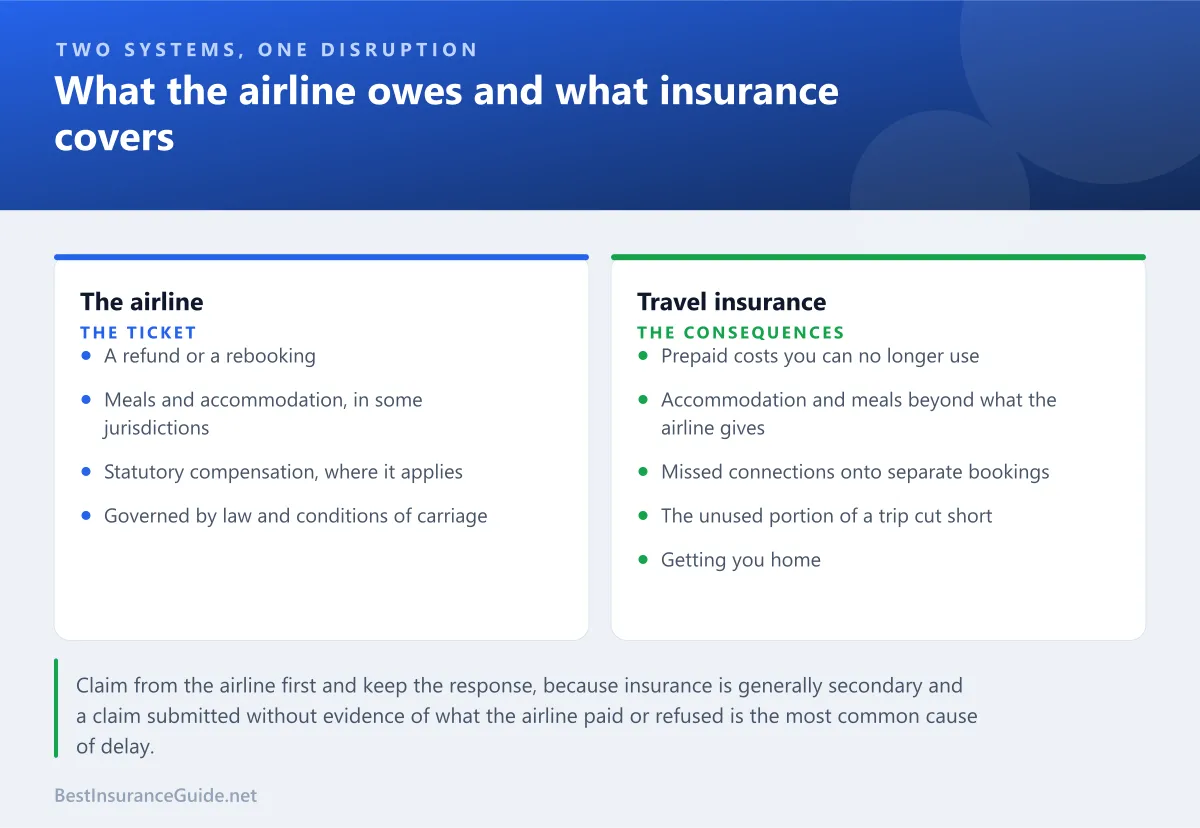
The airline covers: the ticket, through refund or rebooking, and in some jurisdictions and circumstances meals, accommodation and statutory compensation.
Travel insurance covers: prepaid costs you cannot use, additional accommodation and meals beyond what the airline provides, missed connections onto separately booked travel, the unused portion of a trip cut short, and getting you home.
The practical instruction: claim from the airline first, keep everything, and then claim the balance from the insurer. Submitting an insurance claim without evidence of what the airline paid or refused is the most common cause of delay.
The three coverages
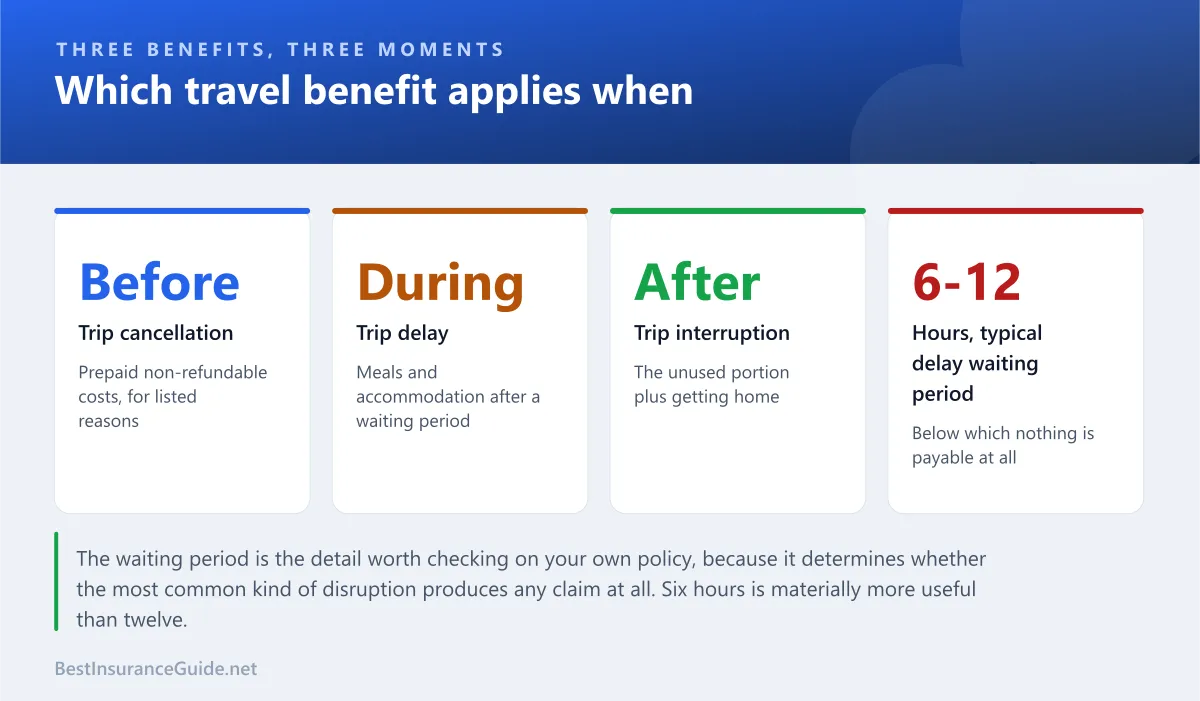
Travel policies handle disruption through three distinct benefits, and knowing which applies determines what you can claim.
Trip cancellation. Applies before departure. Reimburses prepaid, non-refundable costs when the trip is cancelled for a covered reason.
Trip delay. Applies during the journey. Reimburses reasonable additional expenses once a delay exceeds a waiting period, commonly six to twelve hours, up to a daily limit and a total cap.
Trip interruption. Applies after departure. Covers the unused portion of the trip plus the additional cost of returning home or rejoining the itinerary.
Worked example: a cancelled outbound flight
A trip with $4,200 of prepaid costs. The outbound flight is cancelled for weather and you depart a day late.
| Who pays | |
|---|---|
| The airline ticket, rebooked | Airline |
| Hotel night at the departure city | Trip delay, above the waiting period |
| Meals during the delay | Trip delay, to the daily limit |
| First night of the destination hotel, unused | Trip cancellation or interruption, depending on wording |
| A non-refundable tour missed on day one | The same |
| Airport parking extended | Trip delay, usually |
Six lines, one event, and only the first is the airline’s.
The covered reasons
This is where policies are narrower than people expect.
Standard trip cancellation and interruption cover a listed set of reasons, typically including:
Severe weather preventing travel.
Mechanical breakdown of the carrier.
Strikes affecting the carrier, subject to conditions.
Illness, injury or death of the traveller, a travelling companion or a close family member, subject to definitions.
Jury duty or a court summons.
A home made uninhabitable by fire, flood or storm.
Certain employment events, such as an involuntary job loss, with conditions.
Terrorism at the destination, within a stated period before travel.
What is generally not covered:
Changing your mind, or a change of circumstances outside the list.
A pre-existing medical condition, unless a waiver was obtained by buying within a short window of the first payment.
Fear of travel, including anxiety about conditions at the destination.
Foreseeable events, including a named storm already identified when you bought the policy.
Financial default of a supplier, unless specifically covered.
Pandemic and epidemic, on many policies, though treatment varies considerably.
Cancel for any reason
The upgrade that removes the list, at a price.
It reimburses a percentage, commonly 50% to 75%, of prepaid non-refundable costs, for any reason at all.
It must usually be bought within a short window of the first trip payment, commonly ten to twenty-one days.
It usually requires insuring the full trip cost.
It has a cancellation deadline, commonly 48 hours before departure.
For a trip with large non-refundable costs and uncertain plans, it is the only coverage that answers “I decided not to go”. For a trip that is refundable anyway, it is unnecessary.
Making the claim
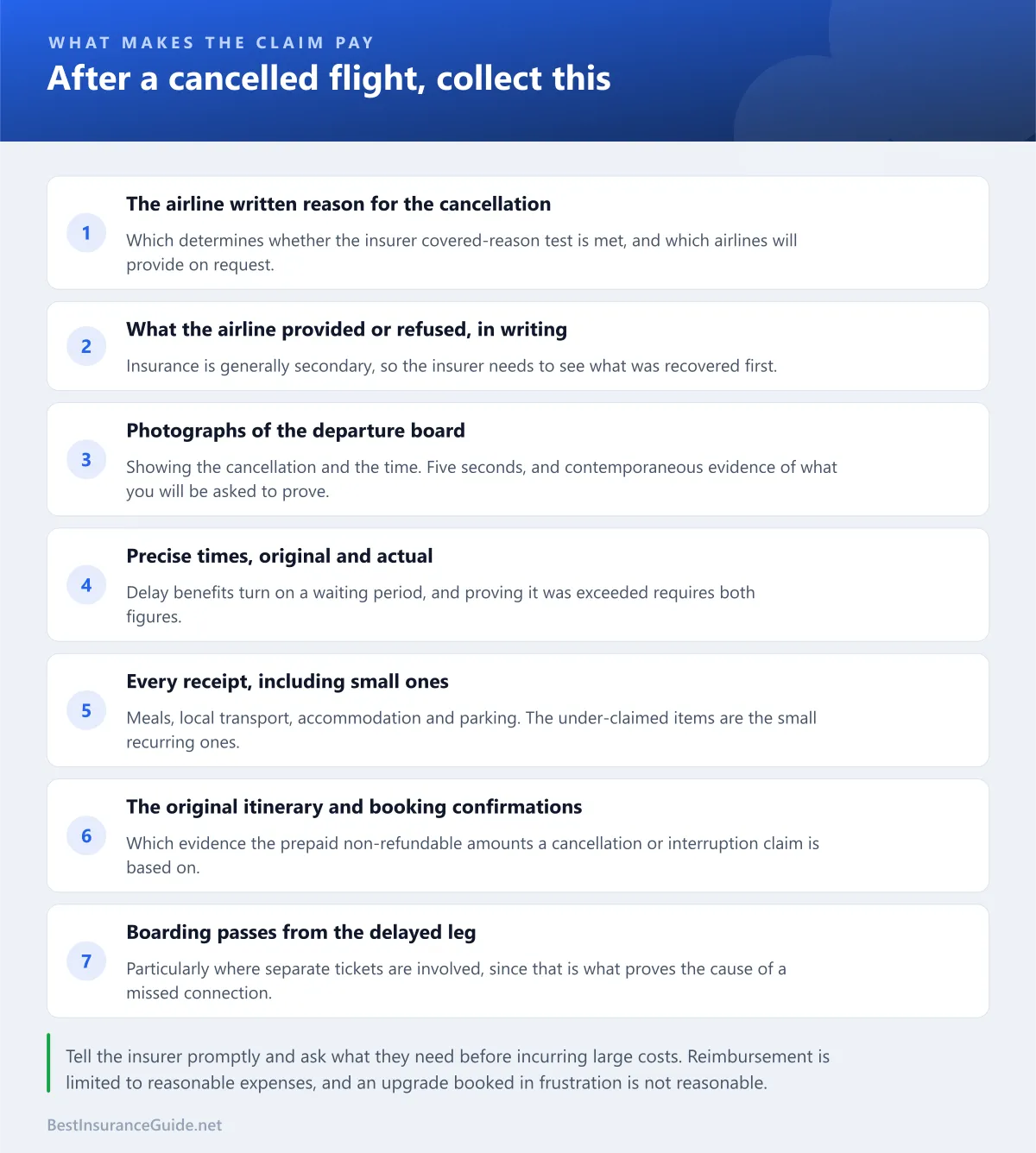
Get the airline’s written reason for the cancellation. This determines whether the insurer’s covered-reason test is met, and airlines will provide it on request.
Ask the airline for what they owe and record what they provided or refused, in writing.
Keep every receipt, including meals, local transport, accommodation and any additional bookings.
Photograph departure boards showing the cancellation and the time.
Note times precisely. Delay benefits turn on a waiting period, and proving the delay exceeded it requires the original and actual times.
Tell the insurer promptly, and ask what they need before you incur large costs where possible.
Do not book expensive alternatives without checking, since reimbursement is limited to reasonable costs and an upgrade is not.
Keep the original itinerary and booking confirmations, which evidence the prepaid non-refundable amounts.
Where the coverage falls short
Three honest limitations.
Daily limits on delay benefits are modest, commonly a couple of hundred dollars a day, which in an expensive city covers a hotel and little else.
Waiting periods exclude short delays, which are the most common kind. A four-hour delay on a policy with a six-hour waiting period pays nothing.
Separately booked travel is where the real exposure sits, because a missed connection between two separate tickets is nobody’s responsibility but yours. Travel insurance frequently helps here where the airline will not, which is one of the stronger arguments for holding it.
The short version
Travel insurance does not replace what the airline owes you. The ticket is the airline’s responsibility through refund or rebooking, plus whatever statutory obligations apply in the jurisdiction.
Insurance covers the consequences: prepaid costs you cannot use, additional accommodation and meals beyond what the airline provides, missed separately booked connections, and the unused portion of a trip cut short.
It does so only for listed reasons, and the list is narrower than most travellers assume. Cancel for any reason is the upgrade that removes the list, at a percentage of cost, bought within a short window of the first payment.
Claim from the airline first, get the cancellation reason in writing, keep every receipt, and note the times precisely, because delay benefits turn on a waiting period you have to evidence.
For when to buy, see when to buy travel insurance, and for what a policy should include, travel insurance essentials.
Separate tickets, which is where the real risk sits
The scenario travellers most underestimate is a missed connection between two separately booked flights.
On a single ticket, the airline is responsible for getting you to the destination, and a missed connection is their problem to solve.
On separate tickets, nobody is responsible. The first airline delivered you late; the second airline sold you a seat on a flight you did not board. Neither owes you anything, and the second ticket is simply lost.
That gap is one of the strongest arguments for travel insurance, because it is one of the few situations where the airline genuinely owes nothing and the loss is entirely yours.
Missed connection coverage exists on many policies as a specific benefit, typically requiring a minimum delay and covering the cost of catching up with the itinerary. It is worth checking for specifically if your trip involves separate bookings.
Three practical points.
Leave a realistic buffer between separate tickets, which is the cheapest protection available.
Check whether your policy has a missed connection benefit and what minimum delay triggers it.
Keep the boarding pass and the delay evidence from the first flight, since that is what proves the cause.
Worked example: the same delay, two booking structures
| One ticket | Two separate tickets | |
|---|---|---|
| First flight delayed three hours | Airline rebooks you | Airline delivers you late |
| Connection missed | Airline responsibility | Nobody responsibility |
| Cost of a new onward ticket | $0 | Full price, same day |
| Insurance position | Trip delay expenses only | Missed connection benefit, if held |
The delay was identical. The booking structure decided everything that followed.
Two things to check on your own policy
The trip delay waiting period, which is commonly six or twelve hours and which determines whether the most likely disruption produces any claim at all. A policy with a six-hour waiting period is materially more useful than one with twelve for ordinary flight delays.
Whether a missed connection benefit exists, and what minimum delay triggers it. This matters enormously for any itinerary involving separately booked flights, which is where the largest uninsured losses in air travel actually sit.
Both are stated in the policy summary and both take a minute to find.
The claim, summarised
Claim from the airline first. The ticket is theirs, and in some jurisdictions meals, accommodation and compensation are too.
Get the cancellation reason in writing, because the insurer’s covered-reason test turns on it.
Note the times precisely, because delay benefits turn on a waiting period you have to evidence.
Keep every receipt, including meals, local transport and accommodation.
Claim the balance from the insurer, with the airline’s response attached.
Do not book expensive alternatives without checking, since reimbursement is limited to reasonable costs.
That sequence is what turns a disrupted trip into a paid claim rather than a disputed one.
What a comprehensive policy should include
Since flight disruption is only one of several things that go wrong, the benefits worth having on any policy are consistent.
Emergency medical cover abroad, at a meaningful limit, which for most travellers is the most important benefit on the policy.
Medical evacuation and repatriation, at a limit realistic for the destination.
Trip cancellation, covering prepaid non-refundable costs for a listed set of reasons.
Trip interruption, covering the unused portion and the cost of getting home.
Trip delay, with a waiting period as short as you can get and a realistic daily limit.
Missed connection, which matters for any itinerary with separate bookings.
Baggage and personal effects, with attention to the sublimits on electronics.
Travel assistance services, which is the phone number you actually use when something goes wrong.
Two optional additions worth pricing: cancel for any reason, within its purchase window, and an adventure activities extension if the trip involves anything the standard exclusions would catch.
Two habits that make claims straightforward
Photograph the departure board and the gate information at the moment of the cancellation, with the time visible. It costs nothing, it takes five seconds, and it is contemporaneous evidence of exactly what an insurer will ask you to prove weeks later.
Keep everything in one place as you go, rather than gathering it on return. A folder on your phone with the boarding passes, the airline correspondence, the receipts and the photographs turns a fiddly claim into a simple submission, and the difference in what actually gets recovered is substantial.
Related reading
Two situations change the answer. Does travel insurance cover hurricanes covers weather disruption specifically, where the purchase date matters more than the wording. Is Airbnb travel insurance worth it covers whether a policy bought at checkout would have answered any of this.
A note on scope
Nothing here is legal advice. Airline obligations after a cancellation vary substantially by jurisdiction, route and carrier, and travel insurance covered reasons, waiting periods, limits and exclusions vary between policies and change over time.
Your national aviation or consumer authority publishes passenger rights for the routes you fly, your airline’s conditions of carriage state its own obligations, and your policy wording is the authoritative statement of what is covered. This site is independent and not affiliated with any insurer.