Is Airbnb Travel Insurance Worth It? Read What It Actually Covers
How platform-sold travel insurance compares with a standalone policy, what a host cancellation actually entitles you to, and when each option makes sense.

Table of contents
Platform-sold travel insurance is a genuine product answering a genuine need, and the question is whether it answers yours. That depends almost entirely on what else you booked.
What platform-sold insurance is
When a booking platform offers insurance at checkout, it is generally an insurance product underwritten by an insurer and distributed by the platform, and its scope is typically built around that booking.
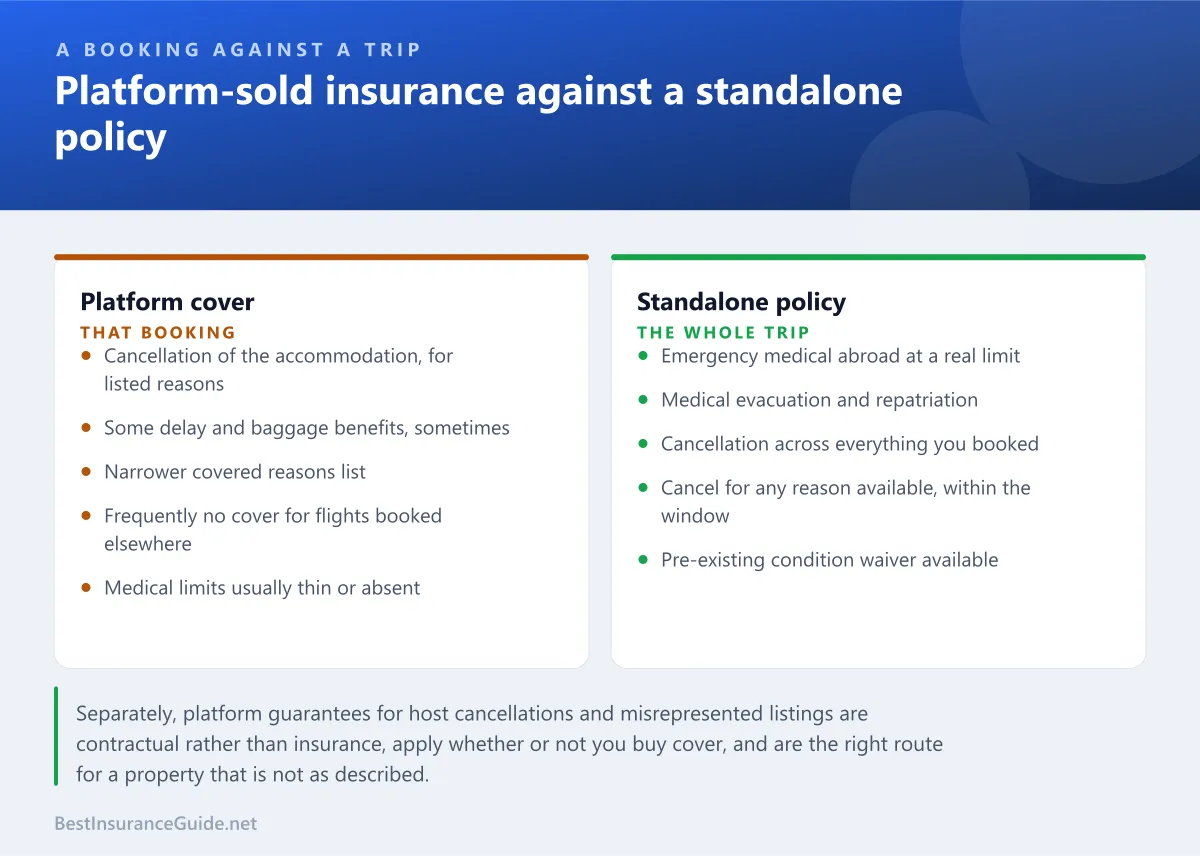
Typically included: cancellation of that booking for listed reasons, and depending on the product, some travel delay, baggage and emergency medical benefits.
Typically narrower: the covered reasons list, the medical limits, and whether costs beyond that booking are covered at all.
Frequently absent: cover for flights and tours booked elsewhere, medical evacuation at a meaningful limit, and cancel for any reason as an option.
Scope varies by platform, by country and over time, and the marketing summary is not the policy. The document is what matters, and it is available before you buy.
The platform guarantee is not insurance
An important distinction that changes the arithmetic.
Booking platforms generally operate their own policies for host cancellations, misrepresented listings and uninhabitable accommodation, providing refunds and rebooking assistance through a resolution process.
That is a contractual guarantee from the platform, not an insurance benefit, and it applies whether or not you bought insurance.
Two consequences.
Do not buy insurance to cover something the platform already guarantees. A host cancelling is generally handled by the platform.
Do not expect insurance to cover disappointment. A property that is not as described is a platform resolution matter. Insurance covers defined events, and “the flat was worse than the photographs” is not one.
The question that decides it
What else have you booked, and what would you lose?
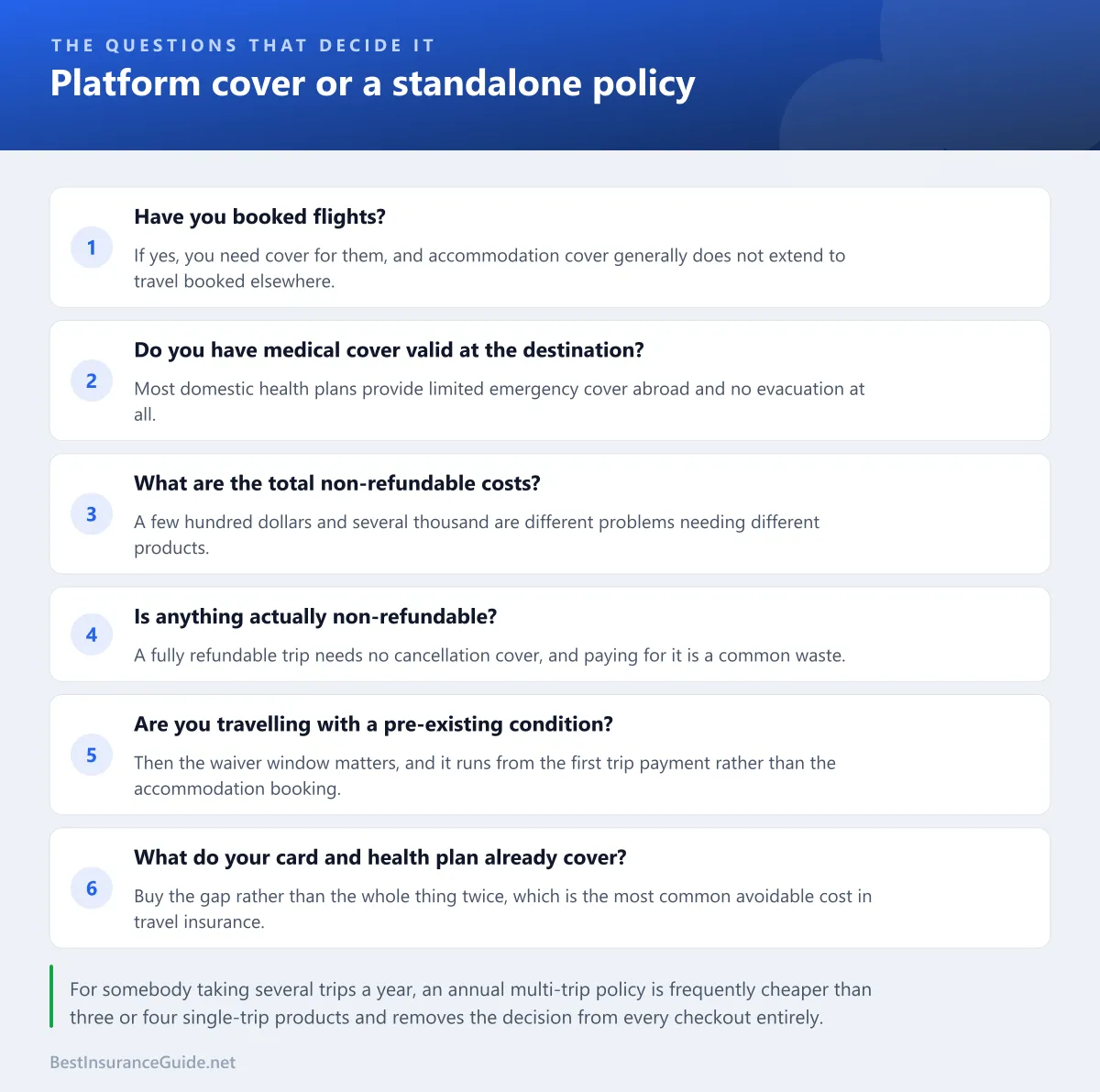
Have you booked flights? If yes, you need cover for them, and platform accommodation cover generally does not extend to them.
Have you booked tours, events or transport separately? Same question.
Do you have medical cover valid at the destination? Domestic health insurance frequently provides limited or no cover abroad, and medical evacuation is expensive and rarely included in a narrow product.
Is the trip a single accommodation booking near home? Then the exposure is small and a narrow policy may be proportionate.
Are the costs refundable anyway? A fully refundable booking needs no cancellation cover at all.
Are you travelling with a pre-existing condition? Then the purchase window for a waiver matters, and it runs from the first trip payment rather than from the accommodation booking.
Worked example: two trips, two answers
| Trip A | Trip B | |
|---|---|---|
| What is booked | One rental, two nights, driving distance | Flights, rental, tours, international |
| Prepaid non-refundable cost | $340 | $6,800 |
| Medical cover at destination | Domestic plan applies | Limited or none |
| Evacuation exposure | Minimal | Substantial |
| Sensible answer | Platform cover or nothing | A standalone policy |
The trips differ by an order of magnitude in exposure, and buying the same product for both is how travellers end up either overpaying or underinsured.
What a standalone policy adds
For anything beyond a simple domestic booking, a standalone comprehensive policy typically provides five things platform cover does not.

Emergency medical cover abroad, at a meaningful limit, which for many travellers is the single most important benefit.
Medical evacuation and repatriation, which is genuinely expensive and is the coverage nobody expects to need.
Trip cancellation and interruption across the whole trip, including flights, tours and transport booked anywhere.
Cancel for any reason as an option, subject to a purchase window and a percentage payout.
A pre-existing condition waiver, available where the policy is bought within a short window of the first trip payment.
The last two are time-sensitive and are the reason the timing of the purchase matters more than the choice of product. Our guide to when to buy travel insurance covers those windows.
Checking what you already hold
Before buying anything, three things may already cover part of it.
Credit card benefits. Some cards provide trip cancellation, delay and baggage cover where the trip is paid with the card, and some provide rental car damage cover. Limits are usually lower and covered reasons narrower, and medical cover is frequently absent. Read the benefit guide rather than assuming.
Health insurance. Check whether it provides any cover abroad and whether it includes evacuation. Most domestic plans provide limited emergency cover at best and no evacuation.
Home or renters insurance. Personal property is generally covered away from home, including abroad, subject to sublimits. That may cover baggage adequately without a separate benefit.
Buying a product that duplicates all three is common and avoidable.
When platform cover is the right answer
Being fair to it, three situations.
A single accommodation booking with no other prepaid costs, where the accommodation is the whole exposure.
A domestic trip where your existing medical cover applies and evacuation is not a realistic concern.
A last-minute booking where the purchase windows for waivers and upgrades have already closed and something is better than nothing.
In each, the product is proportionate to the risk, which is the whole test.
The short version
Platform-sold travel insurance covers the booking it was sold with. A standalone policy covers the trip. That difference decides the question for most travellers.
Separately, the platform’s own guarantees for host cancellations and misrepresented listings are contractual rather than insurance, apply whether or not you buy cover, and are the right route for a property that is not as described.
If you have booked flights, tours or international travel, or if you have no medical cover valid at the destination, a standalone comprehensive policy is the right purchase. If the trip is a single domestic accommodation booking, the platform product may be proportionate.
And check what your credit card, health plan and home insurance already provide before buying anything, because duplicating cover you already hold is the most common waste in travel insurance.
For the purchase timing, see when to buy travel insurance, and for what a comprehensive policy should include, travel insurance essentials.
Reading a policy before buying it
Whatever product you are considering, five checks separate a suitable policy from an unsuitable one, and all five take ten minutes.
The medical limit and whether evacuation is included. For international travel this is the most important benefit and the one most likely to be thin on a narrow product.
The covered reasons list for cancellation. Compare it against what could realistically disrupt your trip.
The exclusions, particularly pre-existing conditions, adventure activities, and anything the destination involves.
The limits and sublimits, including baggage sublimits for electronics and the daily cap on delay benefits, which are frequently much lower than the headline figure suggests.
Whether it covers the whole trip or one booking, which is the question this article is really about.
Worked example: a checklist against two products
| Narrow product | Comprehensive policy | |
|---|---|---|
| Emergency medical abroad | Low or absent | Meaningful limit |
| Medical evacuation | Frequently absent | Included, at a real limit |
| Cancellation of flights booked elsewhere | No | Yes |
| Cancel for any reason available | Rarely | Yes, within the window |
| Pre-existing condition waiver | Rarely | Yes, within the window |
| Cost | Low | Higher, and proportionate |
Neither column is wrong. The second is what a trip with flights and international travel needs, and the first is what a two-night domestic booking needs.
Two things to do before booking anything
Check what your credit card and health plan already cover, so you buy the gap rather than the whole thing twice.
Note the date of your first trip payment, because the purchase windows for a pre-existing condition waiver and a cancel for any reason upgrade both run from it, and both close within a few weeks.
Two things to do before your next booking
Establish what you already hold. Credit card benefits, your health plan’s position abroad, and your home or renters policy’s off-premises property cover. Between them they frequently cover part of what a travel policy would, and buying the gap is cheaper than buying the whole.
Note the date of your first trip payment. The purchase windows for a pre-existing condition waiver and a cancel for any reason upgrade both run from it, and both close within a few weeks. That single date determines which options remain available, regardless of which product you eventually choose.
The answer, summarised
A single domestic accommodation booking with no flights and valid medical cover: platform cover is proportionate, or nothing at all if the booking is refundable.
A trip with flights, tours or international travel: a standalone comprehensive policy, because platform cover is built around the booking rather than the journey.
Any trip where medical cover at the destination is uncertain: a standalone policy, for the medical and evacuation benefits rather than the cancellation ones.
Any trip with substantial non-refundable costs and uncertain plans: a standalone policy bought within the window, so cancel for any reason remains available.
And in every case, check the platform’s own guarantees for host cancellations and misrepresented listings first, because those apply whether or not you buy insurance and they answer a different problem.
The habit worth building
The most useful thing a traveller can do is decide once, for their own circumstances, rather than at each checkout under time pressure.
Work out what your existing cover provides, once, and write it down: what your health plan does abroad, what your credit card covers, and what your home policy does for property away from home.
Decide your default position, which for most people who travel internationally is an annual multi-trip policy rather than a decision at each booking.
Then treat each checkout offer against that default, which turns a pressured question into a simple one: does this add anything my policy does not already provide?
For somebody taking several trips a year, an annual policy is frequently cheaper than three or four single-trip products and removes the decision entirely. For somebody taking one trip, buying at the first payment keeps the windows open.
Either way the decision is made calmly and once, rather than in the last fifteen seconds of a booking flow.
Two things the marketing will not tell you
Insurance offered at checkout is designed to be easy to buy, which is a legitimate commercial goal and not the same as being designed for your trip. The product summary is written to be reassuring; the policy document is written to be accurate, and it is available before purchase.
A low price on a narrow product is not a saving if the exposure it leaves open is the one that matters. For international travel that is almost always the medical and evacuation side, which is invisible at checkout and expensive in reality.
Related reading
Two questions test whether a narrow product is enough. Does travel insurance cover cancelled flights covers what happens when the travel rather than the accommodation goes wrong. What international health insurance costs covers the medical side, which is where narrow products are thinnest.
A note on scope
Platform insurance products, their underwriters, benefits and availability vary by platform, by country and over time, and platform guarantee policies are contractual terms that also change. Nothing here describes any particular product.
The policy document offered at the point of purchase is the authoritative statement of what any insurance covers, and the platform’s published policies are the authoritative statement of its own guarantees. Your state insurance department publishes consumer guidance on travel insurance. This site is independent and not affiliated with any insurer or booking platform.