Connecticut Car Insurance: The Conversion Coverage Nobody Explains
Connecticut car insurance requirements, what it costs, underinsured motorist conversion coverage, and the coverage decisions that matter most in the state.

Table of contents

Connecticut is an expensive state to insure a car in and it offers one option that materially improves what you recover after a serious crash. Most drivers here pay the first part and never hear about the second.
What the state requires
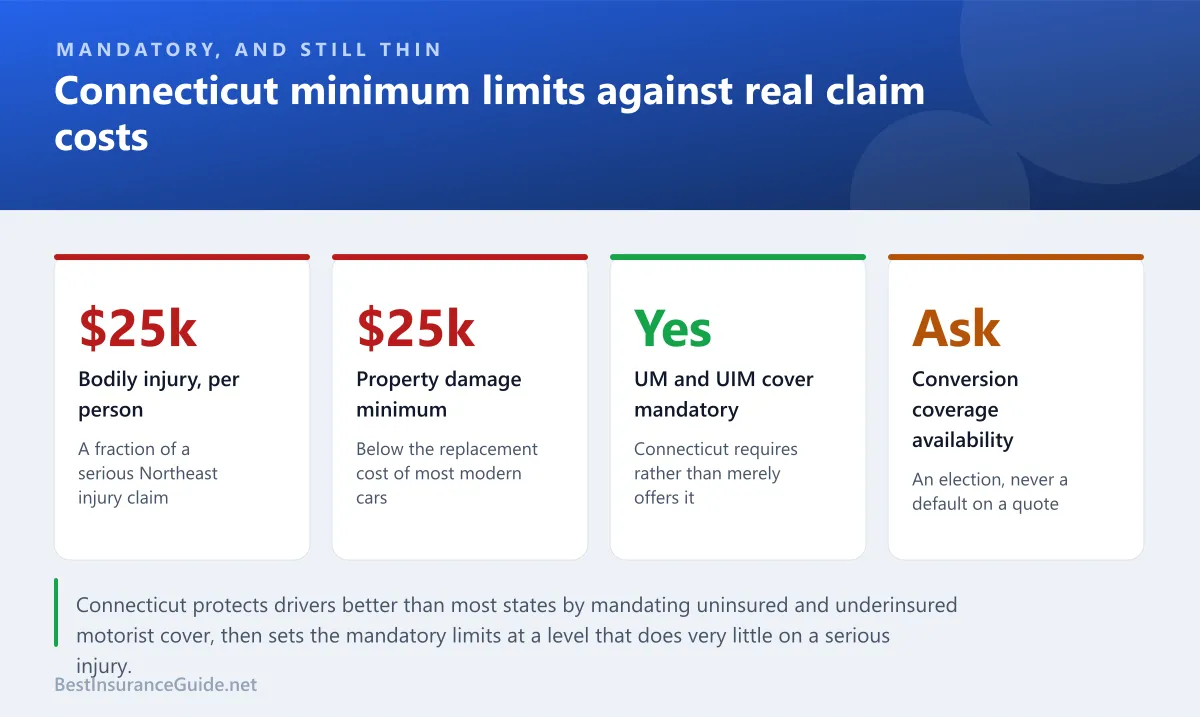
| Coverage | Connecticut minimum |
|---|---|
| Bodily injury liability, per person | $25,000 |
| Bodily injury liability, per accident | $50,000 |
| Property damage liability | $25,000 |
| Uninsured and underinsured motorist, per person | $25,000 |
| Uninsured and underinsured motorist, per accident | $50,000 |
Connecticut is in the minority of states that mandate uninsured and underinsured motorist cover rather than merely requiring insurers to offer it. That is a genuine consumer protection and it is set at limits too low to do much on a serious injury.
Conversion coverage, which is the point of this article
This is the Connecticut-specific option, and understanding it is worth more than any amount of shopping.
Standard underinsured motorist cover in Connecticut, like in most states, is offset. Your limit is reduced by whatever the at-fault driver’s insurer pays.
Underinsured motorist conversion coverage removes the offset. Your limit stays available in full, on top of what the at-fault driver’s insurer paid.
The arithmetic is easier than the wording.
Worked example: a $200,000 injury claim
The at-fault driver carries Connecticut minimum limits of 25/50. You carry $100,000 of underinsured motorist cover.
| Standard UIM, offset | Conversion coverage | |
|---|---|---|
| At-fault driver’s insurer pays | $25,000 | $25,000 |
| Your UIM limit | $100,000 | $100,000 |
| Offset applied | $25,000 | None |
| Your insurer pays | $75,000 | $100,000 |
| Total recovered | $100,000 | $125,000 |
| Shortfall on a $200,000 claim | $100,000 | $75,000 |
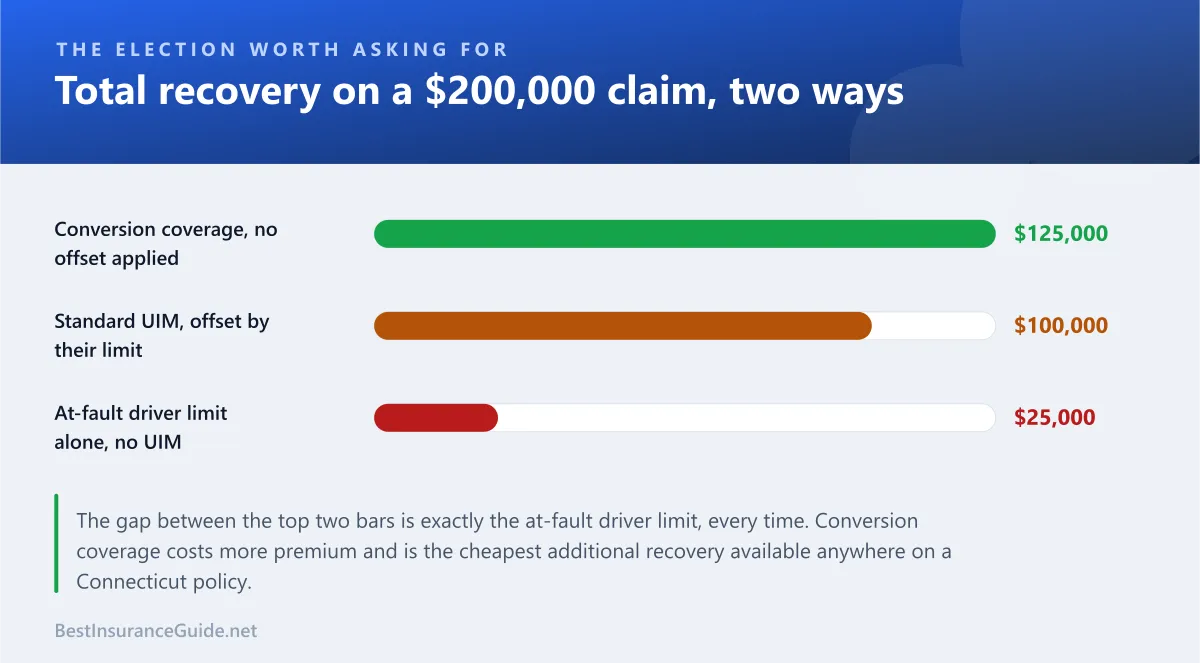
The difference is exactly the at-fault driver’s limit, every time. Conversion coverage costs more, and on a serious claim it is the cheapest additional recovery available anywhere on the policy.
Two practical notes. You have to ask for it, because it is an election rather than a default. And it is worth raising the underlying limit at the same time, since conversion coverage on a $25,000 limit is a small improvement on a small number.
Why Connecticut is expensive
Four things push the state above the national average, and none of them are within an individual driver’s control.
Density. Connecticut’s traffic density and short trip distances produce high claim frequency, particularly in the Hartford, Bridgeport, New Haven and Waterbury corridors.
Repair cost. Labour rates and parts costs in the Northeast run high, and modern vehicles with sensors in bumpers and windscreens have made routine repairs substantially more expensive everywhere.
Claim severity. Medical costs and litigation costs in the Northeast run above the national picture, which flows into bodily injury liability pricing.
Weather-driven comprehensive losses. Nor’easters, coastal storms, falling trees, winter weather and flooding all produce vehicle claims here.
Within the state the spread is significant. The urban corridor rates well above the shoreline towns and the rural northwest, and the difference across a short distance can be large.
The comprehensive case in Connecticut
Comprehensive is optional and it earns its place here more than in many states.
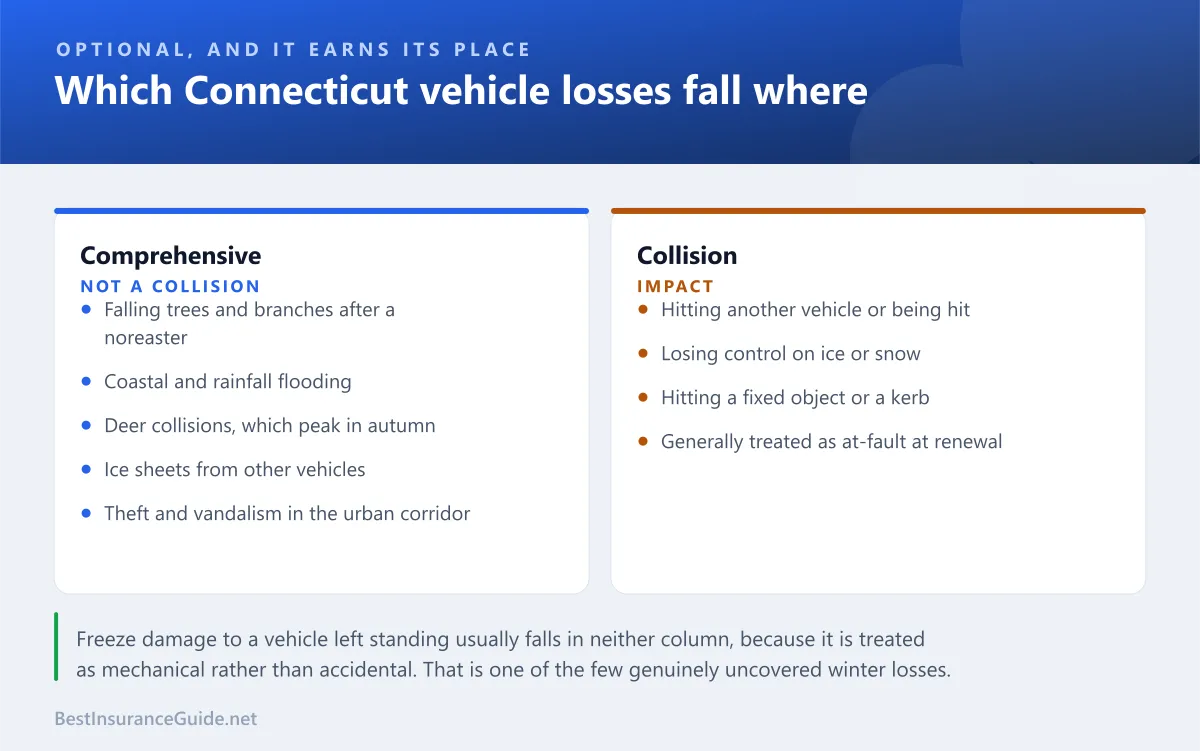
Falling trees and branches, which in a heavily wooded state after a nor’easter is a routine claim rather than an unusual one.
Flooding, both coastal and from heavy rainfall. A flooded vehicle is almost always a total loss, and it is a comprehensive claim.
Deer collisions, which in Connecticut concentrate in autumn and which are comprehensive rather than collision in most wordings, meaning they generally do not carry the same surcharge as an at-fault collision.
Winter losses including ice damage and objects falling from other vehicles.
Theft and vandalism, concentrated in the urban corridor.
On any vehicle worth keeping, comprehensive at a sensible deductible is one of the better value lines on a Connecticut policy.
What moves a Connecticut quote
Your record, dominating everything else, for three to five years.
Your town, and within the larger cities your specific address.
Continuous coverage. A lapse is the most expensive avoidable item on a quote.
Annual mileage and commute, where Connecticut’s commuting patterns into New York and within the Hartford corridor matter.
The vehicle, specifically its repair cost, theft rate and safety record.
Credit-based insurance score, permitted in Connecticut with restrictions on how it may be used.
Coverage choices, including limits, deductibles and whether you take conversion coverage.
Household composition, particularly the addition of a young driver, which is the largest single premium event most families experience. Our guide to car insurance for young drivers covers how to manage it.
What to carry
Liability at 100/300/100 or higher, not the state minimum. In a state with Connecticut’s medical and litigation costs, the minimum is thin.
Uninsured and underinsured motorist at matching limits, and on the conversion basis.
Comprehensive, for the reasons above.
Collision, on any vehicle you could not comfortably replace.
A deductible you could produce this week.
An umbrella policy above the auto liability if you have assets, which in Connecticut is the cheapest meaningful protection available.
Shopping it
Set the coverage first, then quote that exact package. Conversion coverage in particular will not appear on a comparison site by default, so ask for it explicitly.
Three quotes minimum, including an independent agent with access to regional carriers that do not advertise nationally.
Ask for every discount: multi-policy, multi-vehicle, safe driver, telematics, paid in full, paperless, defensive driving, good student, away at school, and anti-theft.
Re-shop every two years and after any life event.
Check complaint records with the Connecticut Insurance Department before binding, since claims handling is the product.
The short version
Connecticut mandates uninsured and underinsured motorist cover, sets the minimum limits low, and offers one option almost nobody is told about.
Underinsured motorist conversion coverage removes the offset against the at-fault driver’s limits, which means your full limit stays available on top of theirs. On a serious claim that is worth exactly the at-fault driver’s limit, and it is the best-value election on a Connecticut policy.
Raise the liability limits well above the state floor, take conversion coverage on the underinsured motorist line, carry comprehensive for the trees and the water, and re-shop every couple of years at matched coverage.
For what happens when a crash was not your fault, see car accident not your fault, and for switching cleanly, how to switch car insurance.
How Connecticut fault rules affect a claim
Connecticut uses modified comparative negligence with a 51% bar. You may recover if you were 50% or less responsible, and your recovery is reduced by your share of fault. At 51% you recover nothing.
That threshold means fault allocation is decided at a hard line rather than on a sliding scale, and it makes the evidence collected in the first ten minutes disproportionately valuable.
Connecticut also sets statutory time limits that differ for property damage and personal injury, and missing one ends a claim regardless of merit.
At the scene
Call the police and obtain a report number, on any collision involving injury or meaningful damage.
Photograph before anything moves: positions, damage on both vehicles, road markings, signals, skid marks, debris, weather and light.
Photograph the other driver’s documents rather than transcribing them.
Collect witness contact details, which is what actually decides contested fault.
Say nothing about fault at the scene or to the other insurer afterwards.
Report to your own insurer promptly, even where you do not intend to claim.
Seek medical attention the same day if there is any question of injury, because a gap between the crash and the first medical record is the most common argument against an injury claim.
Winter, and the claims it produces
Connecticut’s winter produces a predictable set of losses and a few avoidable arguments.
Ice and snow damage to a parked vehicle from falling branches or ice sheets is comprehensive.
Losing control on ice is a collision claim and is generally treated as at-fault, which is worth knowing before deciding whether to file on a modest repair.
Damage from another vehicle’s snow or ice — a sheet coming off a lorry roof — is comprehensive on your policy and potentially a liability claim against the other operator.
Freeze damage to a vehicle left standing is usually treated as mechanical rather than accidental and is frequently not covered at all.
Two practical points. Clear the whole vehicle before driving, which is both a legal requirement in Connecticut and the source of a great many third-party claims. And think carefully before filing a small at-fault winter collision claim, because the surcharge over three years frequently exceeds the recovery.
The general test that holds across every line of insurance applies here too: below roughly one and a half times the deductible, absorb it.
Where Connecticut drivers overpay
Carrying state minimum liability in one of the more expensive states in the country for medical and repair costs.
Taking standard offset underinsured motorist cover when conversion coverage was available for a modest additional premium.
Keeping collision on a vehicle whose actual cash value no longer justifies it, where the annual premium plus the deductible approaches what the car is worth.
Never re-shopping, in a state where the spread between carriers on an identical driver is frequently several hundred dollars a year.
Missing the discounts nobody applies automatically: defensive driving courses, anti-theft devices, good student and away-at-school credits, and telematics for genuinely low-mileage drivers.
Connecticut towns, and what changes between them
Bridgeport, Hartford, New Haven and Waterbury carry the state’s highest rates. Density, claim frequency, theft and repair cost all sit well above the state average, and within each city the spread by address is meaningful.
The Fairfield County commuter belt rates high for a different reason: long commutes, high vehicle values and expensive repairs rather than urban claim frequency.
The shoreline towns rate lower on frequency and carry meaningful comprehensive exposure from coastal storms and flooding.
The rural northwest and northeast rate lowest on frequency and highest on deer collisions, which are comprehensive rather than collision claims and are therefore generally treated more gently at renewal.
When to re-shop
Every two years as a baseline, and immediately after any of these:
A move, especially between the urban corridor and the shoreline or rural areas.
A young driver joining or leaving the household, which is the largest single premium event most families experience in either direction.
A vehicle change, where repair cost and theft rate drive the rating rather than the purchase price.
A violation or at-fault accident falling off the record, typically at three to five years, which your current insurer will not necessarily reprice for automatically.
A renewal that arrived materially higher with no obvious cause.
Each time, specify the coverage first: the liability limits, the underinsured motorist limits, the conversion election and the deductibles. Then quote that exact package with three carriers including one independent agent. A cheaper number produced by dropping back to standard offset underinsured motorist cover is not a saving; it is a reduction in what a serious claim will pay, sold at a discount.
How other states compare
Connecticut mandates uninsured and underinsured motorist cover and offers conversion coverage, which removes the offset against the at-fault driver’s limits. That combination is unusual.
Pennsylvania permits stacking instead, which multiplies the limit across vehicles rather than removing an offset. Georgia offers an added-on election achieving a similar effect by a different route. Missouri mandates the cover without offering either mechanism.
A note on scope
Premium figures here are illustrative rather than quotes, and Connecticut pricing varies substantially by town, driving record, vehicle, coverage selected and individual insurer. Statutory minimums, uninsured motorist rules and the availability of conversion coverage are set by Connecticut law and can change.
The Connecticut Insurance Department publishes the current requirements, consumer guidance and complaint records for licensed insurers, and the NAIC publishes comparative data by state. Nothing here is legal advice. This site is independent and not affiliated with any insurer.