Car Insurance Quotes in Missouri: What Actually Moves the Number
How Missouri car insurance is priced, the state minimum limits, why uninsured motorist cover matters here, and how to compare quotes properly.

Table of contents

Missouri requires every driver to carry uninsured motorist coverage and still records one of the higher uninsured driving rates in the country. That is not a contradiction so much as a warning, and it should shape what a Missouri driver buys.
What the state requires
Missouri’s mandatory minimums are:
| Coverage | Minimum |
|---|---|
| Bodily injury liability, per person | $25,000 |
| Bodily injury liability, per accident | $50,000 |
| Property damage liability | $25,000 |
| Uninsured motorist bodily injury, per person | $25,000 |
| Uninsured motorist bodily injury, per accident | $50,000 |
Two observations about that table.
Missouri is unusual in mandating uninsured motorist cover. Most states offer it and require insurers to offer it; Missouri requires you to carry it.
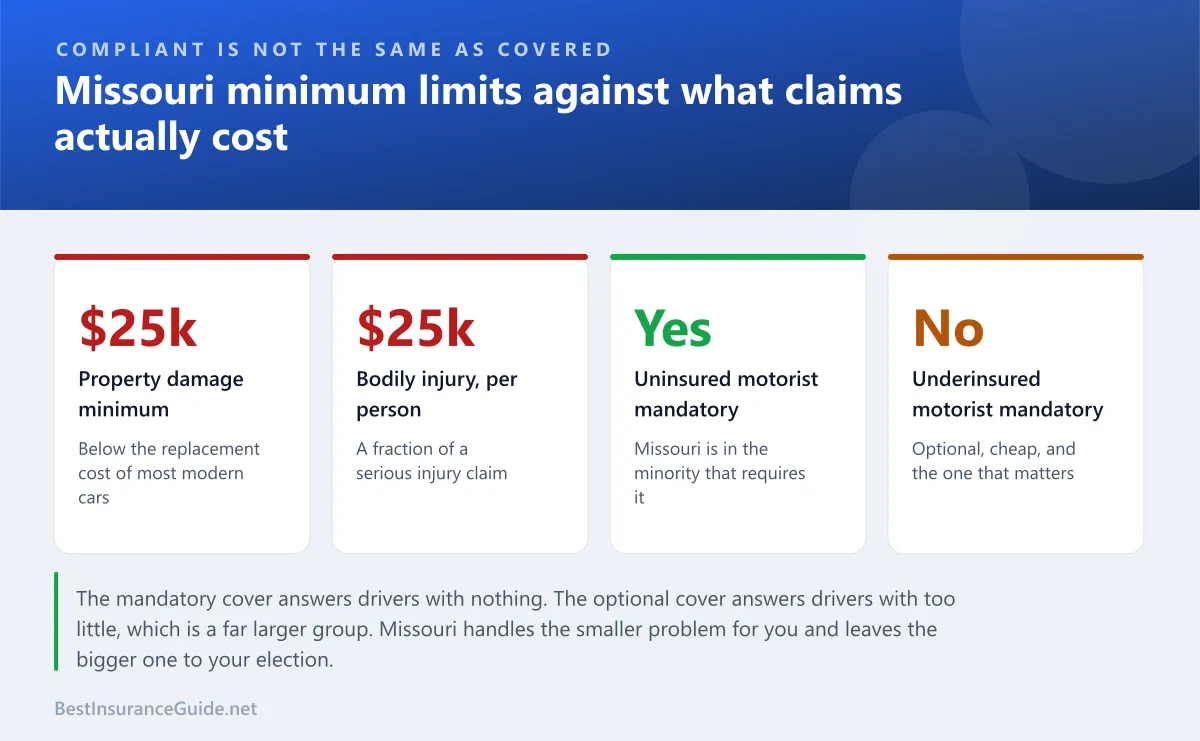
The minimums are low. $25,000 of property damage does not replace a modern vehicle, and $25,000 per person of bodily injury does not fund a serious injury. A driver carrying only the minimum is not protected; they are compliant.
The uninsured driver problem
This is the Missouri-specific issue and it changes the calculation.
A meaningful share of drivers on Missouri roads carry no insurance at all, and a larger share carry only the state minimum. Both are your problem rather than theirs when they hit you.
Uninsured motorist bodily injury covers your injuries when the at-fault driver has no insurance. Mandatory in Missouri at 25/50.
Underinsured motorist bodily injury covers the gap when the at-fault driver has insurance but not enough. This is not mandatory in Missouri and it is the coverage that actually does the work, because the far larger group is not uninsured drivers but minimum-limit ones.
Uninsured motorist property damage is available in Missouri and covers your vehicle when an uninsured driver damages it. It is an alternative to collision cover for that specific scenario, usually with a lower deductible.
Worked example: a minimum-limit driver hits you
Injuries and lost income totalling $140,000. The at-fault driver carries Missouri minimum limits.
| With UIM at $100,000 | Without UIM | |
|---|---|---|
| At-fault driver’s bodily injury limit | $25,000 | $25,000 |
| Their insurer pays | $25,000 | $25,000 |
| Your underinsured motorist cover pays | $75,000 | $0 |
| Recovered | $100,000 | $25,000 |
| You absorb or pursue personally | $40,000 | $115,000 |
Underinsured motorist coverage at a useful limit typically costs a modest amount relative to the rest of the policy. It is the single best-value line on a Missouri auto policy and it is routinely declined.
The hail exposure
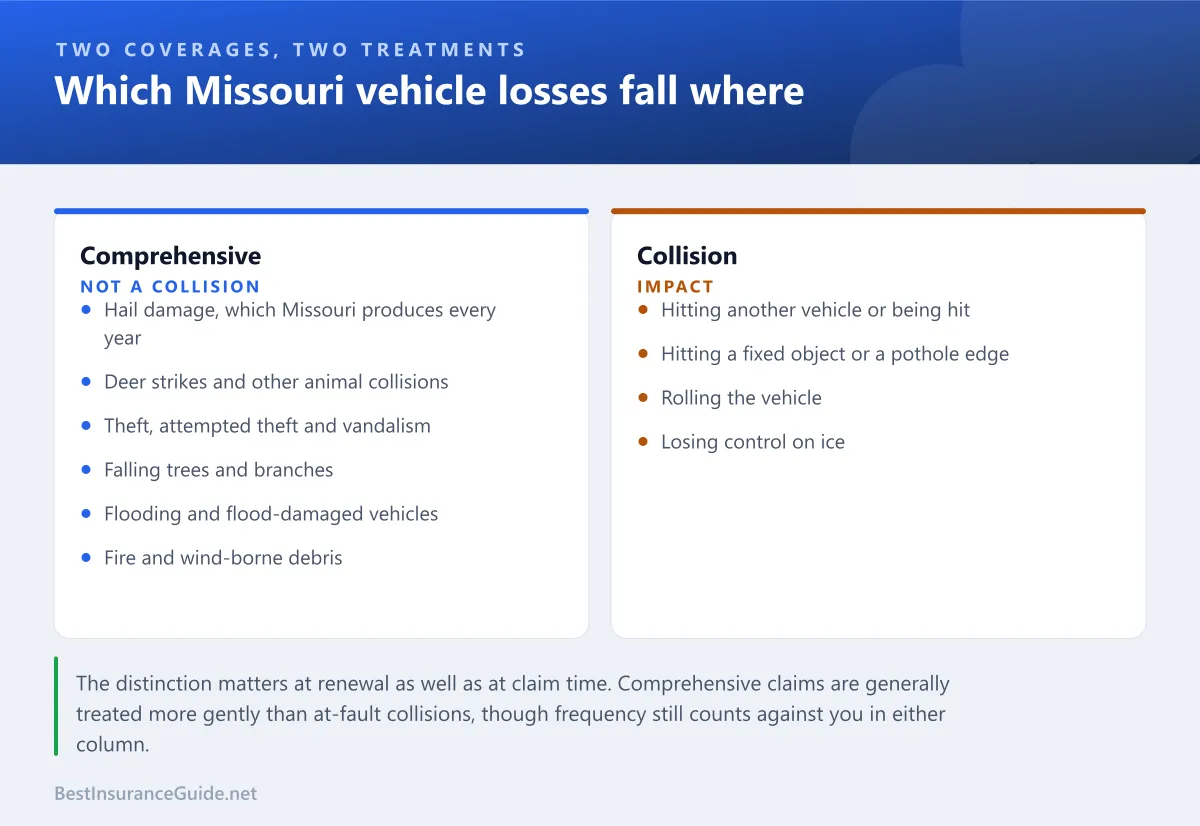
Missouri sits in the severe convective storm corridor, and hail is a vehicle problem here in a way it is not in most of the country.
Hail damage to a car is a comprehensive claim, not collision. If you carry liability only, hail damage is entirely yours.
Three practical points.
Comprehensive is cheap relative to what it does, particularly on an older vehicle where the premium is low and a hail write-off is total.
A hail claim is generally not surchargeable in the way an at-fault collision is, because it is not a fault-based loss, though frequency still matters.
Total loss thresholds matter. A severe hail event can write off a vehicle that drives perfectly well, and the settlement is actual cash value. Knowing what your car is actually worth before that happens prevents an unpleasant conversation.
What moves a Missouri quote
Your record, above everything else. At-fault accidents and moving violations dominate, and they stay on the rating for three to five years.
Where you park it. St. Louis and Kansas City rate materially higher than the rest of the state, driven by theft, vandalism, claim frequency and litigation cost. The rural-to-urban spread within Missouri is large.
Your credit-based insurance score, which Missouri permits as a rating factor. Two drivers with identical records can receive quite different quotes for this reason alone.
Annual mileage and use. Commute distance and whether the car is used for work.
The vehicle itself, specifically its repair cost, theft rate and safety record rather than its purchase price.
Coverage choices, including limits, deductibles, and whether you carry comprehensive and collision at all.
Continuous coverage history. A lapse, even a short one, is one of the most expensive things on a quote, and it is entirely avoidable.
How to compare quotes properly
The mistake is comparing prices rather than policies.
Fix your coverage first, then quote it. Same liability limits, same UM and UIM limits, same deductibles, same comprehensive and collision decision on each vehicle. A quote that is cheaper because it silently dropped UIM is not cheaper.
Quote at least three insurers, including at least one you have not heard advertised, because the spread between carriers on the same driver is frequently several hundred dollars a year.
Ask for the full discount schedule rather than accepting the first number: multi-policy, multi-vehicle, safe driver, telematics, paid in full, paperless, defensive driving course, good student and away-at-school.
Consider telematics carefully. For a genuinely low-mileage, low-risk driver the discount is real and substantial. For anyone with a long commute or a habit of hard braking, it can raise the price.
Check the insurer’s complaint record with the Missouri Department of Commerce and Insurance before binding, since claims handling is what you are actually buying.
The coverage most Missouri drivers should carry
Liability well above 25/50/25. Something in the region of 100/300/100 is the usual sensible starting point, and the premium difference from the minimum is far smaller than people expect.
Underinsured motorist at limits matching your liability. The most important optional coverage in this state.
Comprehensive, for hail, deer and theft, on any vehicle worth keeping.
Collision, on any vehicle you could not comfortably replace out of pocket.
A deductible you could pay this week, which is the same test that applies to every deductible.
Rental reimbursement and roadside assistance if you have one car and no fallback, since both are inexpensive.
An umbrella policy above the auto liability if you have assets, which is one of the cheapest coverages in personal insurance per dollar of protection.
The short version
Missouri requires uninsured motorist cover and sets its liability minimums low, which leaves the average minimum-limit policy compliant and inadequate at the same time.
The coverage that actually matters here is underinsured motorist, which is optional, cheap, and answers the far more common scenario of being hit by someone carrying too little rather than nothing at all.
Add comprehensive for hail, raise the liability limits well above the state floor, and compare quotes only after fixing the coverage so the numbers mean something.
For how insurance follows a vehicle or a driver, see does insurance follow the car or the driver, and for the discount list in full, auto insurance discounts.
Missouri claim mechanics worth knowing
Two features of Missouri law affect what a claim is worth, and neither appears on a quote.
Pure comparative fault. Missouri reduces your recovery by your share of responsibility and does not bar it. A driver found 70% at fault can still recover 30% of their damages. That is more generous than the modified comparative systems used in most neighbouring states, where recovery stops at 50% or 51%.
The practical consequence is that fault allocation is argued more finely here, and that the evidence you collect at the scene has more effect on the outcome than it would in a state with a hard bar.
The direct action rules and time limits. Missouri sets statutory time limits for bringing a claim, and they differ for property damage and personal injury. Missing one ends the claim regardless of its merits, which is why reporting promptly and getting proper advice on anything involving injury matters more than the paperwork suggests.
At the scene, in order
Call the police and get a report number, even on what looks like a minor collision. A report is the single most useful document in any later dispute.
Photograph everything before the vehicles move: positions, damage on both vehicles, road markings, signage, skid marks, weather and light conditions, and the wider scene from several angles.
Get the other driver’s insurance details and photograph their documents rather than transcribing them.
Get contact details for witnesses, which nobody does and which decides contested claims.
Do not discuss fault, with the other driver or with their insurer. Pure comparative fault means every admission has a price.
Report to your own insurer promptly, even if you do not intend to claim, because late notice can prejudice cover on a claim that arrives later.
Seek medical attention the same day if there is any question of injury, since a gap between the crash and the first medical record is the most common argument against an injury claim.
Where Missouri drivers overpay
Four patterns account for most of it.
Carrying minimum liability limits. The saving between 25/50/25 and 100/300/100 is usually modest, and the protection difference is enormous. Drivers who buy the minimum to save money are making the worst trade available on the policy.
Declining underinsured motorist cover. Covered above, and the single most consequential cheap decision on a Missouri policy.
Keeping collision on a vehicle that no longer justifies it. Once the annual collision premium plus the deductible approaches the vehicle’s actual cash value, the coverage has stopped being worth carrying. Comprehensive usually still is, because it is cheap and hail is real.
Never re-shopping. Insurers do not reward loyalty in the way people assume, and the spread between carriers on the same driver is frequently several hundred dollars a year. Re-shopping every two years at matched coverage is the least glamorous and most reliable saving available.
Missouri cities, and what changes between them
St. Louis carries the state’s highest rates, driven by claim frequency, vehicle theft, uninsured driver density and repair costs. Within the metro the spread by ZIP code is itself substantial, and moving a short distance can change a premium meaningfully.
Kansas City sits close behind, with the additional complication that the metro spans two states. A driver moving across the state line will see the rating change entirely, because Kansas and Missouri set different requirements and are rated separately.
Springfield, Columbia and Jefferson City rate below the two large metros, with Columbia’s student population affecting the young driver market specifically.
Rural Missouri rates lowest on frequency and carries higher severity, because deer collisions are common and emergency response distances are longer.
Across all of them the same pattern holds: the address matters, and it matters less than your record and your continuous coverage history.
Two things worth doing this year
Check your declarations page for the underinsured motorist line. If it is absent or set at the state floor, that is the single most valuable change available to you and it costs less than most people assume.
Re-shop at matched coverage if you have not in two years. Insurers reprice their books continually and loyalty is not rewarded the way people expect. Quote the same limits, the same deductibles and the same UM and UIM elections across three carriers, and take the best number on identical terms rather than the best number on unknown ones.
How neighbouring states differ
Missouri’s pure comparative fault rule is the most generous approach to shared blame, and its neighbours vary considerably.
Kansas is a no-fault state, which matters for anybody in the Kansas City metro because the state line changes the structure of the policy rather than just the price. Arkansas and Oklahoma apply bars at roughly half responsibility, and Alabama bars recovery at any fault at all.
A note on scope
Premium figures and cost comparisons here are illustrative rather than quotes, and Missouri pricing varies substantially by city, driving record, vehicle, coverage selected and individual insurer. Minimum limits and statutory requirements change over time.
The Missouri Department of Commerce and Insurance publishes the current minimum requirements, consumer guidance and complaint records for licensed insurers, and the NAIC publishes comparative data by state. This site is independent and not affiliated with any insurer.