Car Insurance Quotes in Philadelphia: Limited Tort Is the Real Decision
Why Philadelphia car insurance costs more, how the Pennsylvania limited tort election works, what it saves and what it costs, and how to compare quotes.

Table of contents

Philadelphia is the most expensive place in Pennsylvania to insure a car, and the cheapest quotes here almost always reach their price the same way: by selling you limited tort. Understanding what that means is worth more than any amount of shopping.
What Pennsylvania requires
| Coverage | Pennsylvania minimum |
|---|---|
| Bodily injury liability, per person | $15,000 |
| Bodily injury liability, per accident | $30,000 |
| Property damage liability | $5,000 |
| Medical benefits | $5,000 |
Those are among the lowest minimums in the country. $5,000 of property damage liability does not repair a modern vehicle, let alone replace one, and $15,000 per person of bodily injury is a fraction of what a Philadelphia injury claim costs.
A driver carrying Pennsylvania minimums in Philadelphia is carrying almost nothing.
Limited tort against full tort
This is the Pennsylvania election, and in Philadelphia it is the single most consequential line on the policy.
Full tort preserves your unrestricted right to claim against an at-fault driver for pain and suffering, in addition to medical costs and lost income.
Limited tort gives that right up unless your injury meets a serious injury threshold. Medical costs and lost income are still recoverable; pain and suffering is not, below the threshold.
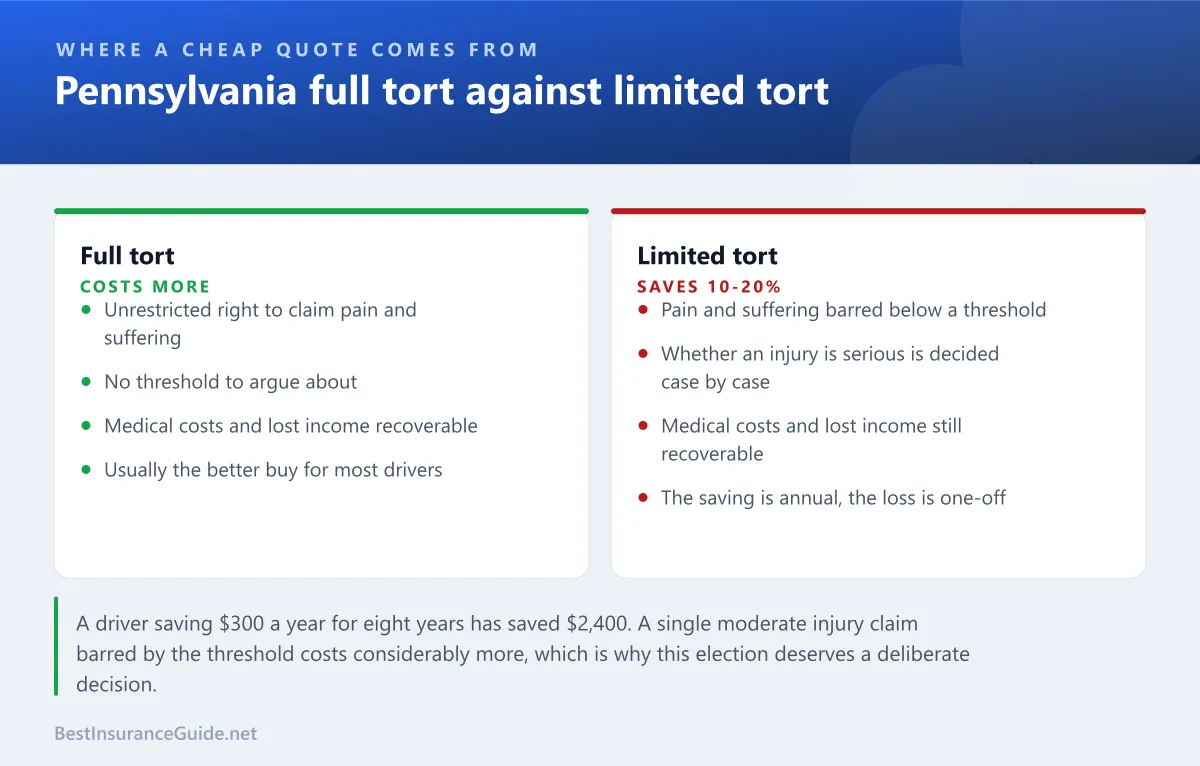
The premium saving from limited tort is commonly in the region of 10% to 20%. What it buys away is typically the largest component of an injury claim.
Worked example: a moderate injury under each election
Soft tissue injuries from a rear-end collision, $19,000 of medical treatment, six weeks of restricted activity, no permanent impairment.
| Full tort | Limited tort | |
|---|---|---|
| Medical benefits paid | $19,000 | $19,000 |
| Lost income recoverable | Yes | Yes |
| Pain and suffering claim | Available | Barred, threshold not met |
| Typical additional recovery | Substantial | $0 |
| Annual premium saving | — | Roughly $200 to $400 |
Two things about that table.
The threshold is where the argument happens. Whether an injury is “serious” is a legal question decided case by case, and the outcome is not predictable at the time you choose.
The saving is annual and the loss is one-off. A driver who saves $300 a year for eight years has saved $2,400. A single moderate injury claim under limited tort can cost considerably more than that.
For most Philadelphia drivers full tort is the better buy. It is not universal, and it is a decision worth putting to a licensed agent rather than deciding from a comparison page. What matters is that you make it deliberately, because a cheap quote will have made it for you.
Why Philadelphia rates highest in the state
Five factors, compounding.
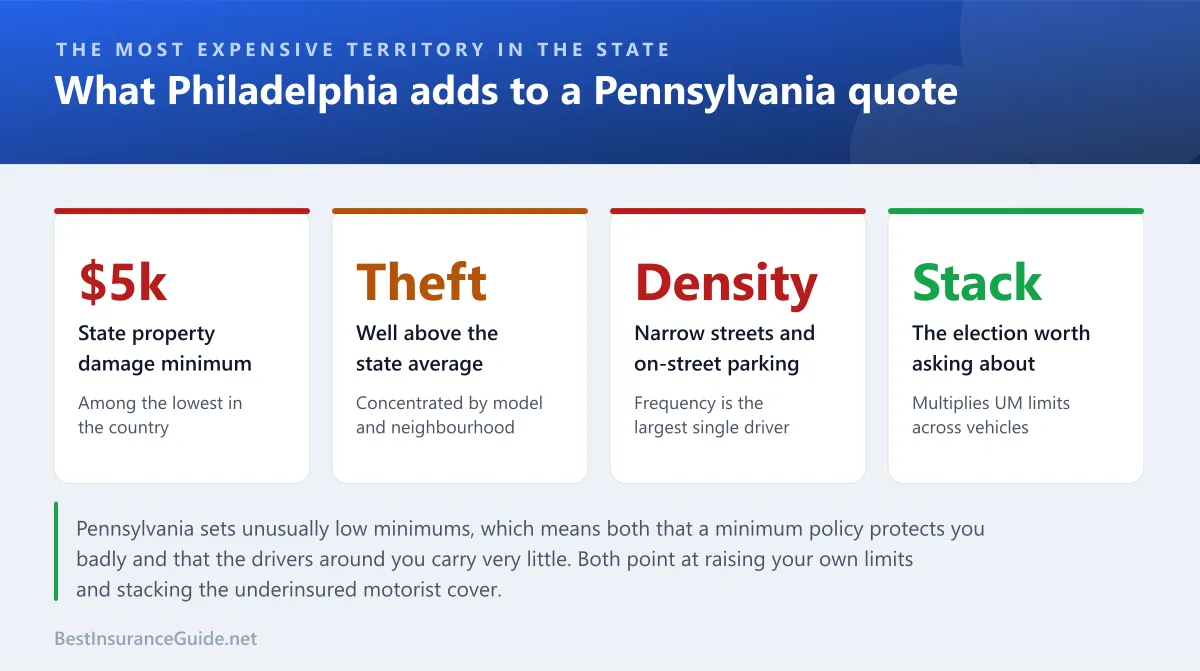
Claim frequency, driven by density, narrow streets, on-street parking and heavy pedestrian and cyclist traffic.
Vehicle theft and vandalism, at rates well above the state average in parts of the city, and concentrated on certain models.
Uninsured drivers, whose density in the city raises what everybody else’s uninsured motorist cover has to absorb.
Repair cost and repair time, with metro labour rates and long body shop queues.
Injury claim costs and litigation, which run above the state average.
Inside the city the ZIP code spread is itself large. Insurers rate at territory level, and the difference between neighbourhoods can exceed the difference between carriers.
What to carry in Philadelphia
Full tort, unless you have a specific reason and have discussed it with a licensed professional.
Liability far above 15/30/5. Something around 100/300/100 is the sensible floor. The step up from the Pennsylvania minimum is one of the largest protection improvements available for a modest premium anywhere in the country, because the starting point is so low.
Uninsured and underinsured motorist, at limits matching the liability. In a city with this much uninsured density this is doing real work, and Pennsylvania allows stacking across multiple vehicles, which multiplies the available limit and is worth asking about explicitly.
Medical benefits above the $5,000 minimum, which is inexpensive and which meets the bills that arrive first.
Comprehensive, for theft, vandalism, flooding, hail and falling trees.
Collision, on any vehicle you could not comfortably replace.
Rental reimbursement, because a city household without a car and a long repair queue is a genuine problem.
An umbrella policy above the auto liability if you have assets.
What actually lowers the number
Continuous coverage with no lapse, the most expensive avoidable item on any quote.
Bundling renters or homeowners with auto, which in a city of renters is the most commonly missed discount available.
Off-street parking, where you have it, which affects both theft and vandalism rating.
Accurate, low mileage. Philadelphia has genuine alternatives to driving, and a household that drives 4,000 miles a year and is rated on 12,000 is overpaying. Correcting it is immediate.
Telematics, which suits a light city driver and penalises a heavy one.
Deductible steps and coverage fit, including dropping collision on a vehicle whose value no longer justifies it.
Re-shopping three carriers every two years at matched coverage, which in Philadelphia means matching the tort election as well as the limits.
The short version
Philadelphia is the most expensive car insurance market in Pennsylvania, and the state’s minimum limits are among the lowest in the country. Those two facts together mean a minimum-limit Philadelphia policy protects almost nobody.
The decision that matters most is limited tort against full tort. Limited tort saves roughly 10% to 20% and gives up the right to claim for pain and suffering below a threshold you cannot predict. For most drivers full tort is worth the difference, and either way the choice should be made deliberately rather than absorbed from a cheap quote.
Then raise the liability limits well above the state floor, carry stacked uninsured and underinsured motorist cover, and keep comprehensive in a city with this much theft.
For the statewide requirements, the tort election and stacking in full, see car insurance in PA. For the full discount list, see auto insurance discounts, and for switching cleanly, how to switch car insurance.
Stacking, which almost nobody asks about
Pennsylvania allows stacked uninsured and underinsured motorist coverage, and in a household with more than one vehicle it multiplies the available limit.
Unstacked cover applies the per-vehicle limit once, whichever vehicle was involved.
Stacked cover multiplies the limit by the number of vehicles on the policy. A household with three vehicles and $100,000 of stacked underinsured motorist cover has $300,000 available.
Stacking costs additional premium and, in a city where the at-fault driver frequently carries Pennsylvania’s very low minimum limits, it is one of the highest-value elections available.
Like the tort election, it is a written choice and the cheaper quote will have made it for you.
Worked example: a serious injury in the city
Injuries and lost income of $260,000, at-fault driver carrying Pennsylvania minimum 15/30 limits.
| Stacked UIM, three vehicles | Unstacked UIM | UIM rejected | |
|---|---|---|---|
| At-fault driver’s insurer pays | $15,000 | $15,000 | $15,000 |
| Your underinsured motorist cover | Up to $300,000 | Up to $100,000 | $0 |
| Recovered | $260,000 | $115,000 | $15,000 |
The premium difference across those three columns is a few hundred dollars a year. The recovery difference is a quarter of a million.
City neighbourhoods, and the rating spread
Philadelphia is rated at territory level and the spread inside the city is wide.
Centre City and the river wards carry high density, heavy on-street parking and meaningful theft and vandalism rates.
North and West Philadelphia territories carry the city’s highest frequency and theft experience, and rate accordingly.
Northeast Philadelphia rates below the core while remaining above the state average.
The near suburbs, across the county line, rate substantially below the city, which is why a short move can change a premium more than switching carriers would.
The garaging address is the input. A policy still rated at an old address is misrated, which is a problem at claim time rather than a saving.
What to do after a crash in Philadelphia
Call the police and get the report number, on anything beyond the most trivial contact.
Photograph before anything moves: positions, damage to both vehicles, road markings, signals, parked cars, weather and light.
Photograph the other driver’s licence and insurance card rather than transcribing.
Collect witness details, which decides contested fault.
Say nothing about fault at the scene or to the other insurer.
Report to your own insurer promptly, even where you do not intend to claim.
Get medical attention the same day if there is any question of injury. Under a limited tort election this matters more still, because the serious injury threshold is assessed on the medical record and a gap in it is the most common argument against meeting the threshold.
Two Philadelphia checks worth doing this month
Find the tort election on your declarations page. It is stated explicitly, and a great many drivers discover they are on limited tort without having chosen it. Switching to full tort is a phone call and a premium adjustment, and the change takes effect prospectively rather than retroactively, which is why doing it now rather than after a crash is the entire point.
Check whether your uninsured and underinsured motorist cover is stacked. In a multi-vehicle household this multiplies the available limit, and in a city where the at-fault driver frequently carries Pennsylvania’s very low minimums it is one of the highest-value elections on the policy.
Where Philadelphia drivers overpay, and where they underinsure
The overpaying is ordinary: a stale garaging address, a mileage figure from a commute that no longer exists, no bundling with a renters policy, and never re-shopping.
The underinsuring is specific to Pennsylvania and it is more consequential.
Pennsylvania’s minimum limits are among the lowest in the country, which means both that a minimum-limit policy protects you badly and that the drivers around you are frequently carrying very little. Those two facts point at the same solution: raise your own liability limits, and carry stacked underinsured motorist cover so your policy answers what theirs cannot.
Medical benefits at the $5,000 statutory minimum is thin, and increasing it is inexpensive. It is the coverage that meets the first bills, and under a limited tort election it is doing more of the work than the driver realises.
Comprehensive is the coverage most often dropped in the city and the one most likely to be needed, given theft and vandalism rates in parts of Philadelphia.
When to re-quote
Every two years as a baseline, and immediately after a move, including within the city, a household change, a vehicle change, a violation ageing off the record at three to five years, or any renewal that arrived materially higher without an obvious cause.
Each time, write the whole package down first: the tort election, the liability limits, whether uninsured and underinsured motorist cover is stacked, the medical benefits level and the deductibles. Then quote that exact specification with three carriers including an independent agent. In Pennsylvania the tort election in particular has to be matched explicitly, because a quote that quietly assumed limited tort is not pricing the same product.
How other metros compare
Philadelphia is the most expensive territory in Pennsylvania, and the pattern is recognisable elsewhere.
Atlanta is the closest comparison: the dominant metro in its state, rated on frequency, theft and repair cost, though sitting on Georgia’s 25/50/25 minimums rather than Pennsylvania’s 15/30/5.
For the statewide rules, see car insurance in PA, and for another state where an election rather than a limit decides what a serious claim pays, Connecticut car insurance.
A note on scope
Premium figures and savings percentages here are illustrative rather than quotes, and Philadelphia pricing varies substantially by ZIP code, driving record, vehicle, coverage selected and individual insurer. The tort election, stacking rules and statutory minimums are set by Pennsylvania law and change over time.
The Pennsylvania Insurance Department publishes the current requirements, consumer guidance on the tort election and complaint records for licensed insurers, and the NAIC publishes comparative data by state. Nothing here is legal advice, and the tort election in particular is a decision to take with a licensed professional. This site is independent and not affiliated with any insurer.