Car Insurance in South Carolina: The State Where You Can Pay to Go Uninsured
South Carolina car insurance requirements, the uninsured motorist fee, why UM cover is mandatory here, deer and coastal risks, and how to compare quotes.

Table of contents

South Carolina has an unusual pair of rules working against each other, and understanding both explains why the coverage advice here differs from most states.
What the state requires
| Coverage | South Carolina minimum |
|---|---|
| Bodily injury liability, per person | $25,000 |
| Bodily injury liability, per accident | $50,000 |
| Property damage liability | $25,000 |
| Uninsured motorist bodily injury | $25,000 / $50,000 |
| Uninsured motorist property damage | $25,000 |
Two things stand out.
Uninsured motorist cover is mandatory, both bodily injury and property damage, at limits matching your liability. Most states only require it to be offered.
Underinsured motorist cover is not mandatory. It must be offered to you, and it is the coverage that answers the far more common problem.
The fee that lets a driver go uninsured
Here is the rule that makes South Carolina genuinely different.
An owner may register a vehicle in South Carolina without carrying insurance, on payment of a substantial annual fee to the state. The fee makes the registration lawful.
What it does not do is provide any coverage. An owner who pays it and then causes a crash is personally liable for every dollar of the other party’s injuries and property damage, with nothing standing behind them.
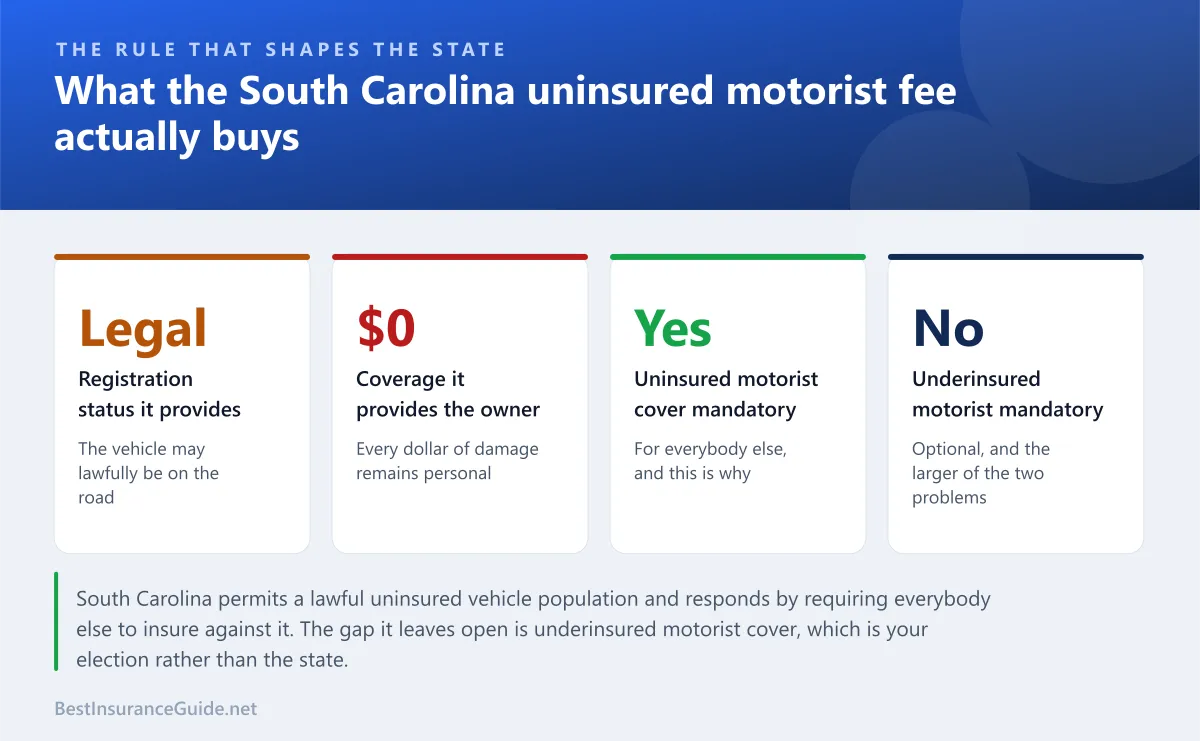
For everybody else on the road, the consequence is simple: there is a lawful population of uninsured vehicles on South Carolina roads, and that is precisely why the state made uninsured motorist cover mandatory rather than optional.
It also explains why underinsured motorist cover, which is not mandatory, deserves more attention here than in most states.
Uninsured against underinsured
These are two different coverages answering two different problems, and the names do them no favours.
Uninsured motorist responds when the at-fault driver has no insurance. Mandatory in South Carolina.
Underinsured motorist responds when the at-fault driver has insurance but not enough. Optional in South Carolina, and the more commonly needed of the two, because the population carrying only 25/50 limits is far larger than the population carrying nothing.
Worked example: hit by a minimum-limit driver
Injuries and lost income of $160,000.
| With $100,000 UIM | Without UIM | |
|---|---|---|
| At-fault driver’s bodily injury limit | $25,000 | $25,000 |
| Their insurer pays | $25,000 | $25,000 |
| Your underinsured motorist cover pays | Up to $100,000 | $0 |
| Recovered | $125,000 | $25,000 |
| You absorb or pursue personally | $35,000 | $135,000 |
Underinsured motorist cover at a useful limit is inexpensive relative to the rest of a South Carolina policy, and declining it is the most consequential cheap decision available on the quote.
The comprehensive case
South Carolina stacks several comprehensive exposures on top of each other, and comprehensive is where they all land.
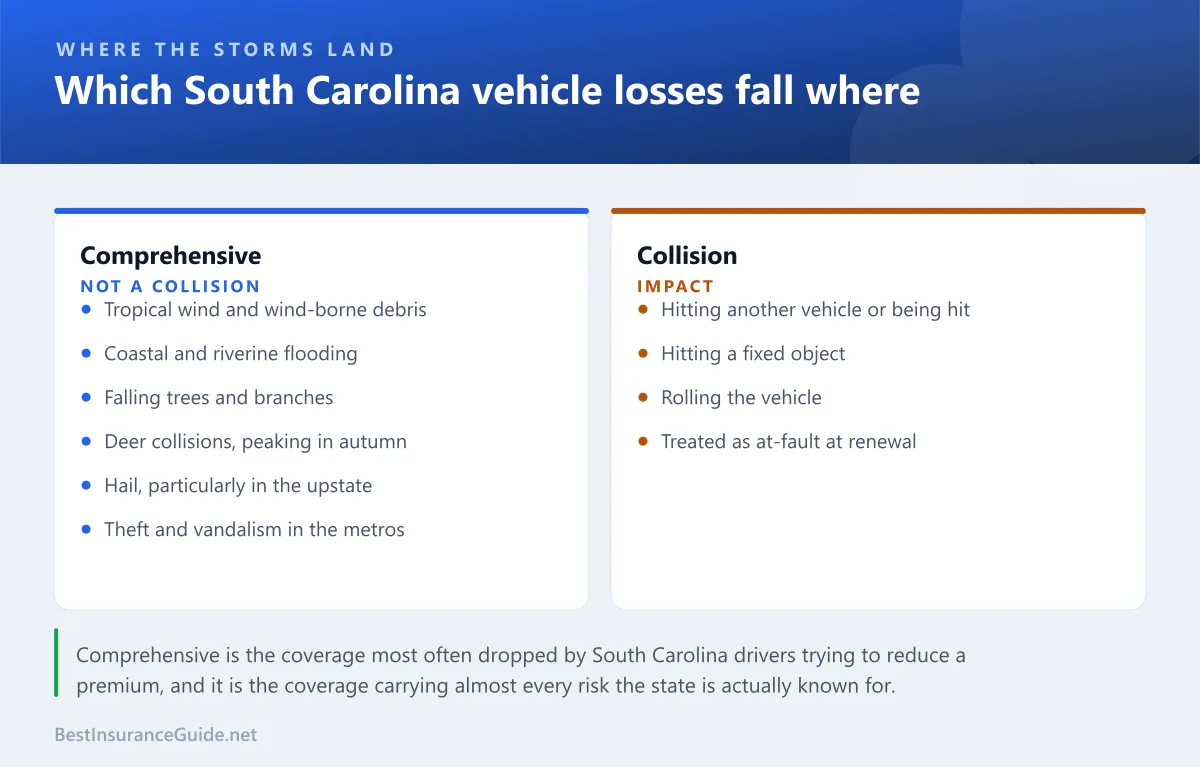
Tropical systems. Wind damage, wind-borne debris and falling trees, and inland flooding from systems that made landfall elsewhere and stalled.
Flooding, both coastal and riverine. A flooded vehicle is almost always a total loss and it is a comprehensive claim, not a collision one.
Deer collisions, which South Carolina records at a high rate and which peak in autumn. In most wordings a deer strike is comprehensive rather than collision, which matters because comprehensive claims are generally treated more gently at renewal.
Hail, particularly in the upstate.
Theft and vandalism, concentrated in the larger metros.
On any vehicle worth keeping, comprehensive is one of the better-value lines on a South Carolina policy, and it is the coverage most often dropped by drivers trying to reduce the premium.
What moves a South Carolina quote
Your record. At-fault accidents and moving violations dominate the rating for three to five years.
Your county and ZIP code. Charleston, Columbia and Greenville rate above rural counties on frequency; coastal counties rate above inland ones on comprehensive.
Continuous coverage, where a lapse is the most expensive avoidable item on any quote.
The vehicle, specifically repair cost, theft rate and safety record rather than purchase price.
Annual mileage, and whether the vehicle is used for work.
Coverage choices: limits, deductibles, and whether you carry comprehensive, collision and underinsured motorist at all.
Household composition, particularly a young driver, which is the largest single premium event most families see.
What to carry in South Carolina
Liability at 100/300/100 or higher. The state minimum does not replace a modern vehicle, let alone fund a serious injury.
Uninsured motorist, which you must carry, at limits matching your liability rather than at the floor.
Underinsured motorist, which you do not have to carry and should. This is the single most important optional line on a South Carolina policy.
Comprehensive, for storms, flooding, trees, hail and deer.
Collision, on any vehicle you could not replace comfortably.
Rental reimbursement, which matters more here than in many states because a widespread storm event puts every body shop in the region into a queue measured in months.
An umbrella policy above the auto liability if you have assets.
Comparing quotes properly
Decide the coverage before you shop, then quote that exact package everywhere. A quote that is cheaper because it set uninsured motorist to the state floor and dropped underinsured motorist entirely is not a cheaper policy.
Get at least three quotes, including from an independent agent with access to regional carriers.
Ask for the complete discount schedule rather than accepting whatever the quote engine applied: multi-policy, multi-vehicle, safe driver, telematics, paid in full, paperless, defensive driving course, good student, away at school and anti-theft.
Re-shop every two years and after any move, marriage, job change or vehicle change.
Check complaint records with the South Carolina Department of Insurance before binding.
The short version
South Carolina permits a lawful uninsured vehicle population through a registration fee, and it responds by making uninsured motorist cover mandatory for everybody else. That pair of rules is the key to how you should buy here.
The mandatory part is handled for you. The part that is not handled is underinsured motorist cover, which is optional, cheap, and answers the far more common situation of being hit by someone carrying only the state minimum.
Add comprehensive for the storms, the water and the deer, raise the liability limits above the floor, and compare quotes only after fixing the coverage.
For what to do after a crash that was not your fault, see car accident not your fault, and for the full discount list, auto insurance discounts.
How South Carolina fault rules affect a claim
South Carolina uses modified comparative negligence with a 51% bar. You may recover if you were 50% or less responsible, with recovery reduced by your share of fault. At 51% you recover nothing.
That hard line makes fault allocation unusually consequential, and it makes the evidence gathered at the scene worth more than most drivers assume.
South Carolina also sets statutory time limits that differ between property damage and personal injury claims, and missing one ends a claim on its own regardless of merit.
At the scene
Call the police and obtain a report number, on anything involving injury or meaningful damage.
Photograph before the vehicles move: positions, damage on both vehicles, road markings, signage, skid marks, debris, weather and light conditions.
Photograph the other driver’s licence and insurance card rather than transcribing details.
Collect witness contact details, which decides contested fault more often than argument does.
Say nothing about fault, to the other driver or to their insurer.
Report to your own insurer promptly, even where you do not intend to claim, since late notice can prejudice cover.
Seek medical attention the same day if there is any question of injury.
Storm season, practically
South Carolina’s tropical season produces a predictable sequence, and the vehicle side of it is handled badly more often than the property side.
Move the vehicle before the storm, not during it. Higher ground, away from trees, out of known flood-prone streets. A vehicle relocated in advance is the cheapest claim avoidance available.
Never drive through standing water. A flooded engine is a total loss and, depending on the circumstances, an insurer may argue the damage was avoidable.
Photograph the vehicle before the storm, so pre-existing damage is documented.
Report promptly after the event, before the regional queue forms. After a landfall, adjusters and body shops in the affected counties are booked within days and the wait extends into months.
Do not let the vehicle sit wet. Water damage worsens quickly, and mitigating further damage is both sensible and something your policy expects of you.
Expect a total loss on a flooded vehicle, settled at actual cash value. Knowing what your car is actually worth before that conversation is worth doing.
This is also the strongest argument for rental reimbursement in South Carolina specifically. In a normal month a repair takes a fortnight. After a regional storm it takes months, and the rental cost over that period substantially exceeds the premium for the coverage.
Where South Carolina drivers overpay
Carrying the state minimum liability, which does not replace a modern vehicle let alone fund an injury.
Declining underinsured motorist cover, which is the single most consequential cheap decision on a South Carolina policy.
Dropping comprehensive to save money in a state with hurricanes, flooding, hail and one of the higher deer collision rates in the region. This is the coverage most often cut and the one most likely to be needed.
Keeping collision on a vehicle whose value no longer justifies it.
Never re-shopping, where the spread between carriers on the same driver is frequently several hundred dollars a year.
South Carolina regions, and what changes between them
Charleston and the Lowcountry carry coastal comprehensive exposure on top of metro claim frequency, which makes it the most expensive combination in the state.
Columbia rates on frequency and carries meaningful riverine flood exposure, as recent flood events in the Midlands have demonstrated.
Greenville and the upstate rate on frequency with hail as the dominant comprehensive exposure rather than tropical systems.
Myrtle Beach and the Grand Strand carry heavy seasonal traffic, which raises claim frequency well above what the resident population would suggest.
Rural South Carolina rates lowest on frequency and highest on deer collisions and severity, with longer emergency response distances.
When to re-shop
Every two years, and immediately after any of these:
A move, particularly between coastal and inland counties, where the comprehensive rating changes substantially.
A change in household composition, including a young driver reaching driving age or leaving for university.
A vehicle change, where repair cost, theft rate and safety record drive the rating rather than the price you paid.
A violation or at-fault accident falling off the record at three to five years, which your current insurer may not reprice for on its own.
A renewal that arrived materially higher with no obvious explanation.
Fix the coverage specification first each time: liability limits, uninsured motorist limits above the floor, underinsured motorist limits, comprehensive and collision deductibles, and whether rental reimbursement is included. Then quote that exact package across three carriers. A cheaper number that reached its price by cutting comprehensive in a hurricane and deer state is not a saving.
How neighbouring states differ
South Carolina mandates uninsured motorist cover because it permits a lawful uninsured vehicle population. Its neighbours reach the same problem differently.
Georgia only requires the cover to be offered, and lets drivers choose between added-on and reduced-by structures. Alabama also leaves it optional, which in a contributory negligence state is a particularly poor combination. Missouri mandates it as South Carolina does.
A note on scope
Premium figures here are illustrative rather than quotes, and South Carolina pricing varies substantially by county, driving record, vehicle, coverage selected and individual insurer. Statutory minimums, the uninsured motorist fee and its amount are set by South Carolina law and change over time.
The South Carolina Department of Insurance and the South Carolina Department of Motor Vehicles publish the current requirements and fees, and the NAIC publishes comparative data by state. Nothing here is legal advice. This site is independent and not affiliated with any insurer.