Cheap Car Insurance in Arkansas: The Coverages You Have to Reject in Writing
Arkansas car insurance requirements, the personal injury protection and uninsured motorist coverages you must reject in writing, storm risk and how to compare quotes.

Table of contents

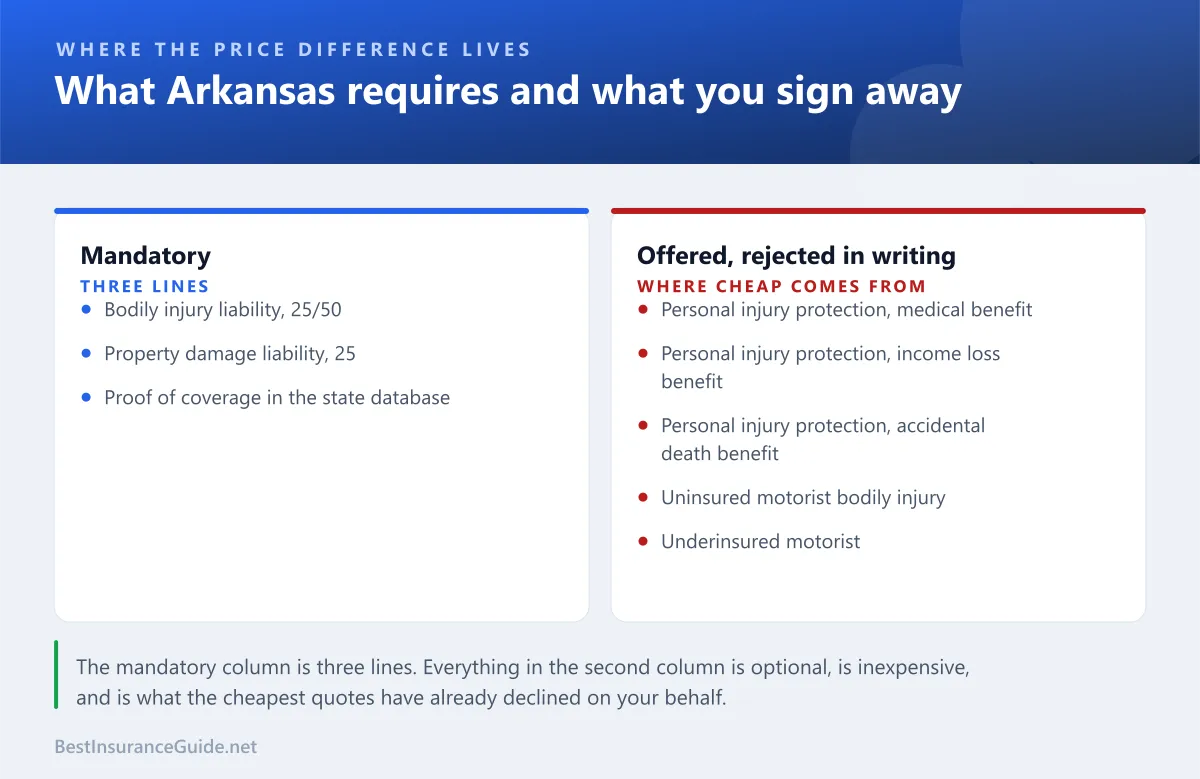
Most cheap Arkansas quotes are cheap for a specific and traceable reason. The state requires insurers to offer three coverages, and it lets you decline them by signing a form. The cheapest quotes have declined all three.
What the state requires
| Coverage | Arkansas position |
|---|---|
| Bodily injury liability, per person | $25,000, mandatory |
| Bodily injury liability, per accident | $50,000, mandatory |
| Property damage liability | $25,000, mandatory |
| Personal injury protection | Must be offered, rejected in writing |
| Uninsured motorist bodily injury | Must be offered, rejected in writing |
| Underinsured motorist | Must be offered, rejected in writing |
The mandatory part is three lines. The other three are where the price difference between quotes usually lives.
The three you sign away
Personal injury protection. Arkansas PIP is unusual in being split into components: medical benefits, income loss, and accidental death benefit. It pays regardless of fault, which means it meets your medical bills immediately rather than waiting for a liability claim to resolve. It is inexpensive and it is the coverage most commonly declined.
Uninsured motorist bodily injury. Answers the at-fault driver who carries nothing. Arkansas records a meaningful uninsured driver rate, which makes this more valuable here than the premium suggests.
Underinsured motorist. Answers the at-fault driver who carries too little, which is a much larger group than the uninsured population given 25/50 minimums across the region.
Worked example: the same crash, two Arkansas policies
Injuries and lost income of $120,000, at-fault driver carrying state minimum limits.
| Full coverage set | All three rejected | |
|---|---|---|
| At-fault driver’s insurer pays | $25,000 | $25,000 |
| Your PIP medical benefit | Paid immediately | $0 |
| Your PIP income loss benefit | Paid weekly | $0 |
| Your underinsured motorist cover | Up to $100,000 | $0 |
| Recovered | Around $125,000 plus PIP | $25,000 |
| Annual premium difference | — | Perhaps $180 to $350 |
That premium difference is the entire reason the second column exists on a comparison page. It is not a saving; it is a decision to self-insure the largest risk on the policy.
The storm exposure
Arkansas sits at the eastern edge of the severe convective storm corridor and stacks several comprehensive risks.
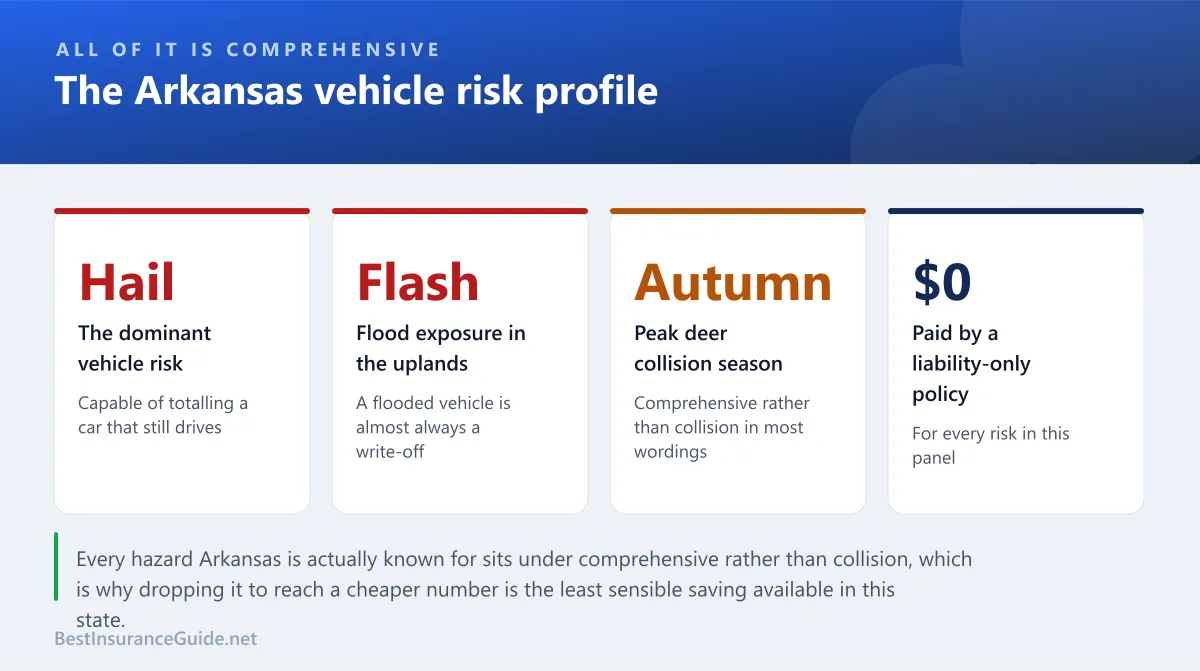
Hail, the dominant vehicle risk in the state, capable of totalling a car that drives perfectly well because the repair cost across panels, roof and glass exceeds the vehicle’s actual cash value.
Straight-line wind and tornado debris.
Flooding, both riverine and flash, in a state with substantial river systems and steep terrain in the north and west. A flooded vehicle is almost always a total loss.
Deer collisions, at a high rate, peaking in autumn. In most wordings these are comprehensive rather than collision, which matters at renewal.
Falling trees, in a heavily wooded state.
All of those are comprehensive claims. A liability-only policy pays nothing toward any of them, which is why comprehensive is not genuinely optional on a vehicle worth keeping in Arkansas.
What actually makes an Arkansas quote cheap
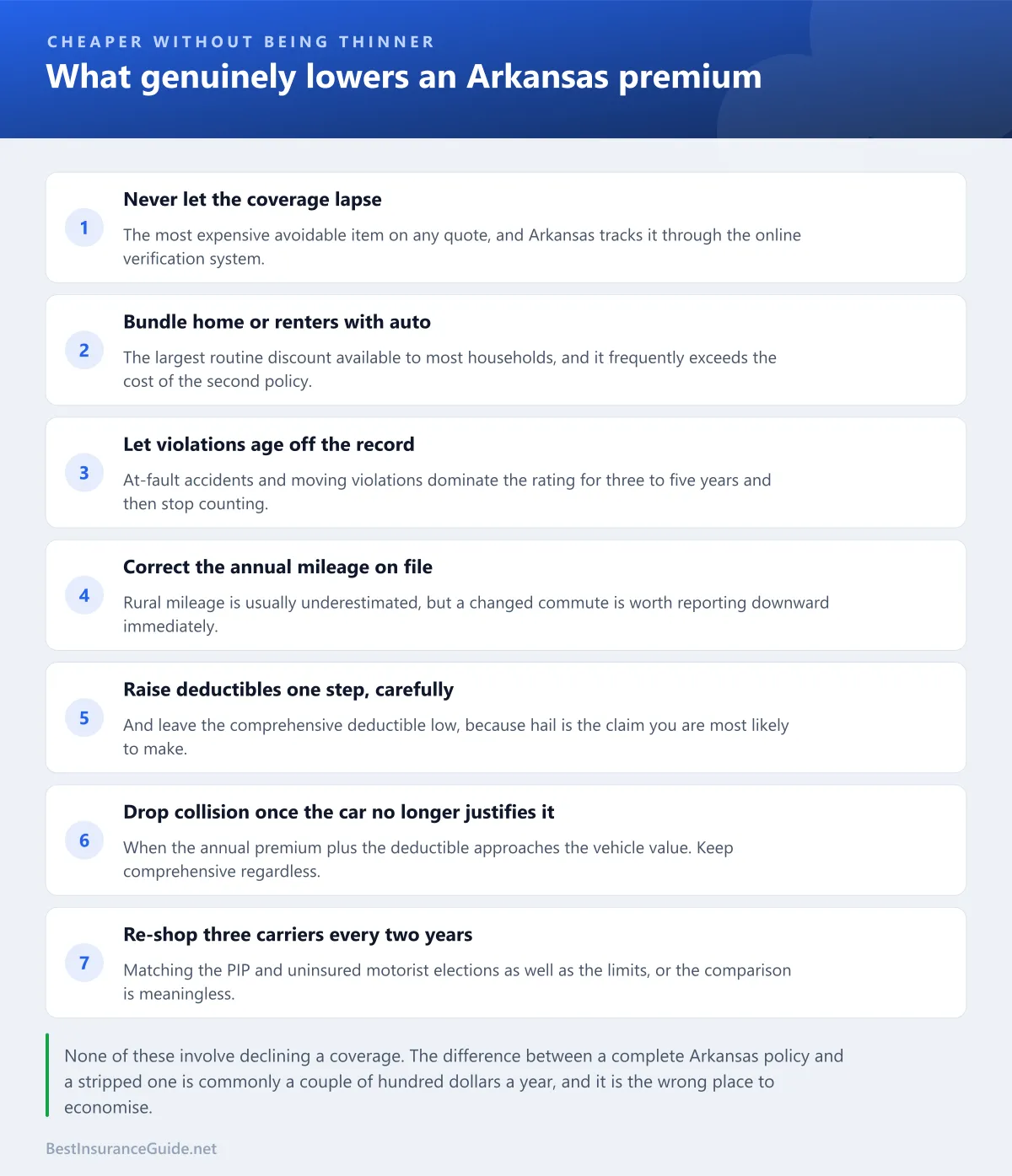
Continuous coverage with no lapse, the most expensive avoidable item on any quote, and one Arkansas tracks through its online verification system.
Bundling home or renters with auto, the largest routine discount available to most households.
Letting violations age off, since at-fault accidents and moving violations dominate the rating for three to five years.
Accurate mileage, which in a rural state is frequently underestimated rather than over, and correcting it downward where a commute has changed.
Deductible steps, one at a time, with care on comprehensive because that is the claim you are most likely to make.
Dropping collision on a low-value vehicle once the annual premium plus deductible approaches what the car is worth. Keep comprehensive.
Re-shopping three carriers every two years at matched coverage, matching the PIP and UM elections as well as the limits.
What to carry
Liability at 100/300/100 or higher. The state minimum does not replace a modern vehicle or fund a serious injury.
Personal injury protection, rather than the rejection form. It is cheap, it pays fast and it pays regardless of fault.
Uninsured and underinsured motorist at limits matching the liability.
Comprehensive, without hesitation, on any vehicle worth keeping.
Collision, on any vehicle you could not comfortably replace.
Rental reimbursement, because a regional hail event fills every body shop in the state for months.
An umbrella policy above the auto liability if you have assets.
The short version
Arkansas makes three of the most useful coverages optional and lets you decline them on a form. Cheap quotes in this state are usually cheap because those three boxes were ticked, and the difference between a complete policy and a stripped one is commonly a couple of hundred dollars a year.
Personal injury protection pays your medical bills and part of your income immediately and regardless of fault. Underinsured motorist cover answers the far more common problem of being hit by someone carrying too little. Both are inexpensive and both are routinely signed away.
Add comprehensive for the hail, the water and the deer, raise the liability limits well above the floor, and compare quotes only after fixing what is on the policy.
For the full discount list, see auto insurance discounts, and for switching without creating a gap, how to switch car insurance.
How the rejection form actually works
The written rejection is a real document with real consequences, and it is worth knowing how it behaves.
It applies until you change it. A rejection signed years ago on a previous policy frequently carries forward through renewals and even through some carrier changes without anybody mentioning it again.
It is per coverage. You can carry PIP and reject uninsured motorist, or the reverse. Most stripped quotes reject all three because that produces the lowest number.
It can be reversed at any time. Adding the coverage back is a phone call and a small premium adjustment. There is no waiting period and no underwriting hurdle for it.
Nobody will remind you. The renewal notice restates the policy rather than the decision, and the coverage stays absent for as long as you leave it.
The practical action is simple: look at your declarations page and see whether PIP, uninsured motorist and underinsured motorist appear at all. If any of them show as rejected or are absent entirely, that is a decision somebody made, quite possibly years ago, and it is reversible this week.
Arkansas regions, and what changes between them
Little Rock and central Arkansas rate highest on frequency, theft and repair cost, with a meaningful spread inside the metro.
Northwest Arkansas, meaning Fayetteville, Springdale, Rogers and Bentonville, has grown rapidly and carries rising frequency alongside a young driver market around the university.
Fort Smith and the river valley sit between metro and rural rates.
The Delta and southern Arkansas rate lower on frequency and carry longer emergency response distances.
The Ozarks and Ouachitas carry the state’s steepest terrain, the highest deer collision exposure and significant flash flood risk.
After a crash in Arkansas
Call the police and obtain a report number, on anything involving injury or meaningful damage.
Photograph before the vehicles move: positions, damage on both vehicles, road markings, signage, skid marks, debris, weather and light.
Photograph the other driver’s licence and insurance card.
Collect witness contact details. Arkansas uses modified comparative negligence with a 50% bar, so being found half responsible ends the claim entirely. Witnesses decide contested fault far more often than argument does.
Say nothing about fault to anyone at the scene or afterwards.
Report to your own insurer promptly, and if you carry PIP, claim it immediately rather than waiting for the liability position to resolve.
Get medical attention the same day if there is any question of injury.
When to re-shop
Every two years, and immediately after a move, a household change, a vehicle change, a violation ageing off the record, or any renewal that arrived materially higher without an obvious cause.
Each time, write down the coverage package first, including the PIP and uninsured motorist elections, and quote that exact specification. In Arkansas more than most states, the difference between two quotes is frequently not the price of the same thing.
What each PIP component actually does
Arkansas PIP is unusual in being written as three separate benefits rather than one pooled limit, and each answers a different problem.
Medical benefits pay treatment costs following a crash, regardless of fault, up to the limit. For a household on a high-deductible health plan, this is what meets the bills that arrive in the first weeks while any liability claim is still years from resolving.
Income loss benefits pay a portion of lost earnings, usually as a weekly amount subject to a cap and a duration. For a household with no short-term disability cover, this is what keeps the mortgage paid while somebody is off work.
Accidental death benefit pays a stated sum, which is modest but is paid quickly and without the delays that attach to a life insurance claim or a wrongful death action.
The important structural point is that these pay regardless of fault and regardless of the liability position. A driver who was entirely at fault still receives their own PIP benefits, which is exactly the situation in which nothing else on the policy pays them anything.
Worked example: at fault, single vehicle
A driver leaves the road on a wet bend, no other vehicle involved. $22,000 of treatment and five weeks off work.
| PIP carried | PIP rejected | |
|---|---|---|
| Liability cover pays the driver | $0 | $0 |
| Collision cover, on the vehicle | Value less deductible | Value less deductible |
| PIP medical benefit | Paid | $0 |
| PIP income loss benefit | Paid weekly | $0 |
| Injury and income cost borne personally | Reduced substantially | All of it |
There is no other coverage on a standard Arkansas policy that pays the at-fault driver’s own medical costs. That is the whole argument for PIP, and it costs a small fraction of the premium.
Where Arkansas drivers overpay, and where they underinsure
The overpaying is ordinary: a stale mileage figure, no bundling, a coverage lapse in the record, and never re-shopping.
The underinsuring is the state-specific problem. Three genuinely valuable coverages are optional here and are rejected by default in the cheapest quotes, and the total cost of carrying all three is commonly a couple of hundred dollars a year.
Look at the declarations page rather than the quote. If PIP, uninsured motorist and underinsured motorist are absent, that is the entire explanation for the price, and it is reversible this week.
The ten-minute version
If you do nothing else, do this.
Find your declarations page and look for three lines: personal injury protection, uninsured motorist and underinsured motorist. Note whether each is present, at what limit, or shown as rejected.
Note your liability limits. If they read 25/50/25, that is the state floor.
Note your comprehensive deductible, and whether comprehensive is present at all.
Call your insurer and ask what it would cost to add whatever is missing and to raise the liability to 100/300/100. The answer is commonly a few hundred dollars a year for all of it together.
That call is worth more than any amount of comparison shopping, because it is fixing what the policy does rather than what it costs.
How neighbouring states differ
Arkansas makes personal injury protection and uninsured motorist cover optional, subject to a written rejection. Its neighbours differ on both.
Missouri mandates uninsured motorist cover. Kansas mandates personal injury protection as a no-fault state. Oklahoma shares the optional structure and the severe storm exposure, and Kentucky offers a choice of system entirely.
A note on scope
Premium figures here are illustrative rather than quotes, and Arkansas pricing varies substantially by county, driving record, vehicle, coverage selected and individual insurer. Statutory minimums, the PIP components and the rejection requirements are set by Arkansas law and change over time.
The Arkansas Insurance Department publishes the current requirements, consumer guidance and complaint records for licensed insurers, and the NAIC publishes comparative data by state. Nothing here is legal advice. This site is independent and not affiliated with any insurer.