Car Insurance in Montana: Long Distances, Big Animals, Thin Coverage
Montana car insurance requirements, animal collision exposure, why medical payments and uninsured motorist cover matter here, and how to compare quotes.

Table of contents
Montana looks like a cheap state to insure a car in and behaves like an expensive one, and three specific features of driving here explain why.
What the state requires
| Coverage | Montana minimum |
|---|---|
| Bodily injury liability, per person | $25,000 |
| Bodily injury liability, per accident | $50,000 |
| Property damage liability | $20,000 |
| Uninsured motorist | Must be offered, rejected in writing |
$20,000 of property damage liability is among the lower figures in the country and does not replace a modern pickup, which in Montana is what a substantial share of the vehicles on the road actually are.
The animal problem
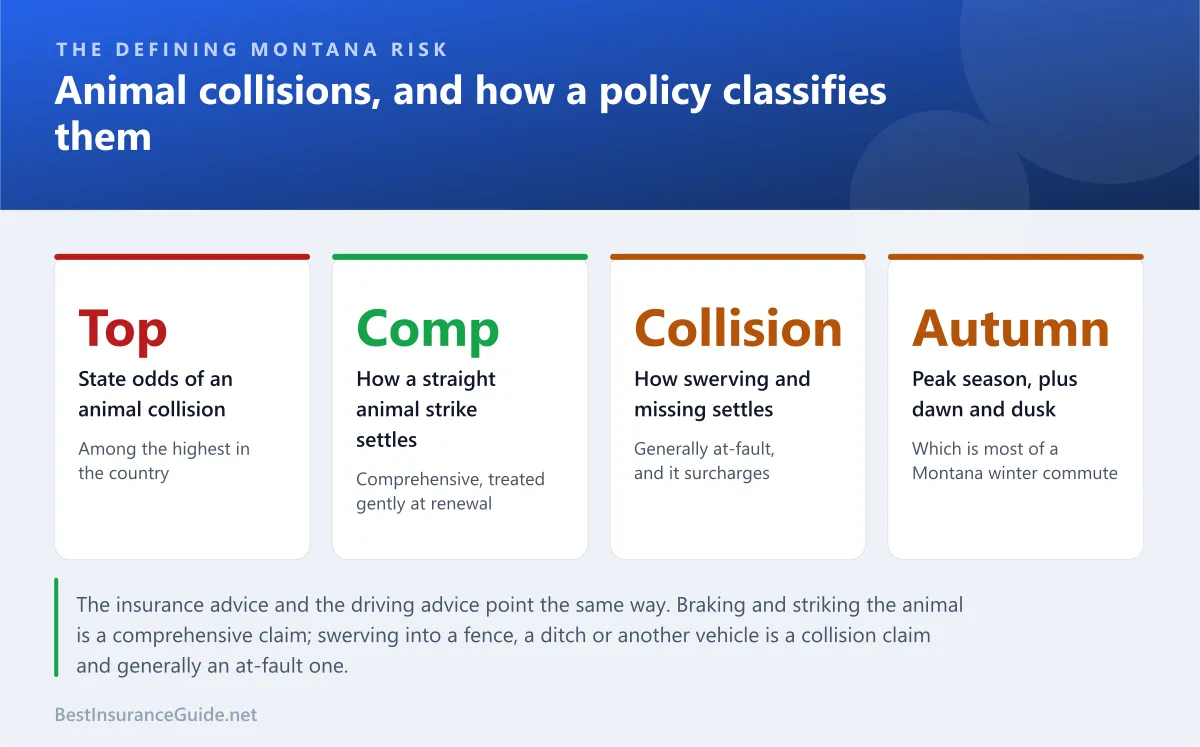
Montana consistently records among the highest odds of an animal collision of any state in the country, and this is not a minor rating footnote. It is the defining vehicle risk here.
Three things about it matter.
It is usually a comprehensive claim. Striking an animal falls under comprehensive in most wordings, not collision. That matters at renewal, because comprehensive claims are generally treated more gently than at-fault collisions.
Swerving changes the classification. If you swerve to avoid an animal and hit a fence, a ditch or another vehicle, that is generally a collision claim and is generally treated as at-fault. The insurance advice and the driving advice point the same way: brake, do not swerve.
Large animals are an injury risk, not just a vehicle one. A collision with an elk or a moose at highway speed is a fundamentally different event from a deer strike, and it is one of the reasons the injury coverages matter here.
The season matters too. Animal collisions concentrate sharply in autumn and again around dawn and dusk year-round, and Montana’s winter daylight hours push a great deal of ordinary commuting into exactly those windows.
The distance problem
This is the second Montana-specific feature and it is the one that most affects what a serious crash costs.
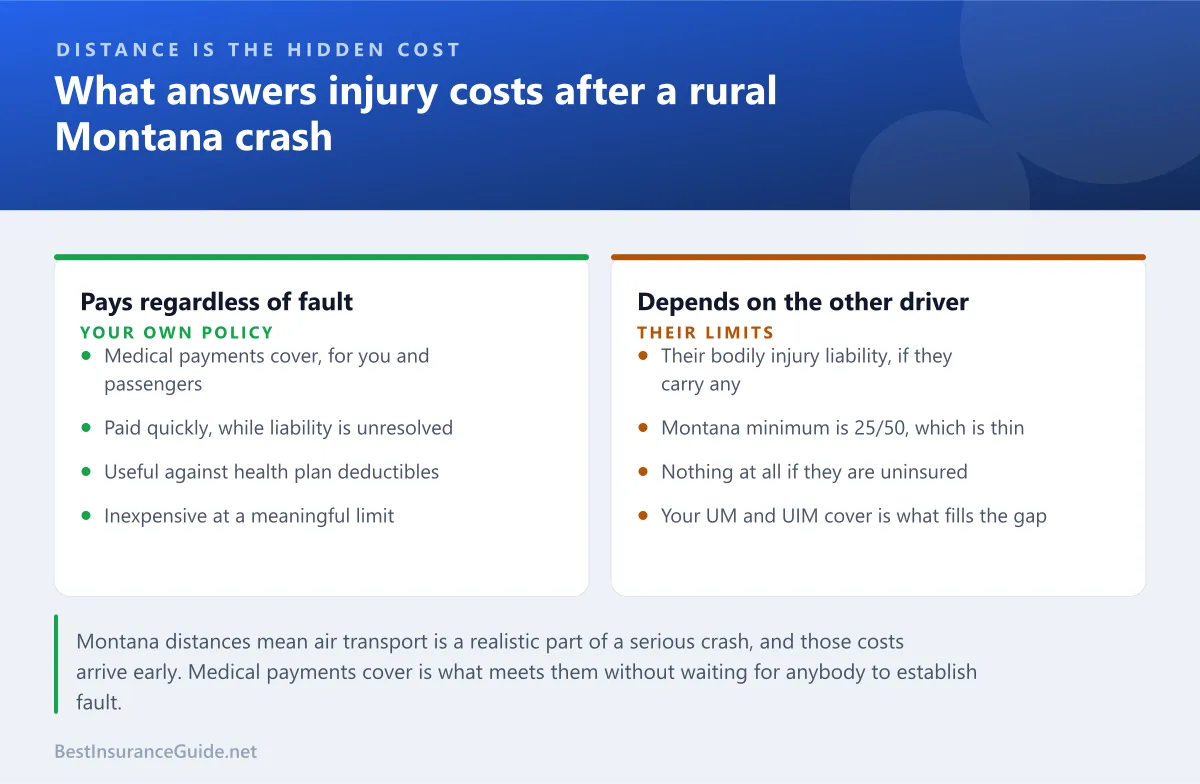
Montana is large, sparsely populated, and has long distances between trauma centres. Air ambulance transport is a realistic component of a serious crash here in a way it is not in a dense state, and the costs involved are substantial.
Two coverages respond to that.
Medical payments coverage, usually called med pay, pays medical expenses for you and your passengers regardless of fault. It is inexpensive, it pays quickly, and in a state where the first bill after a serious crash may be a transport bill, it is doing real work.
Uninsured and underinsured motorist bodily injury, which is what pays when the at-fault driver has nothing or too little. Montana records a meaningful uninsured driver rate, and the coverage must be offered but may be rejected in writing.
Worked example: a rural crash with air transport
Injuries, transport and treatment totalling $190,000. The at-fault driver carries Montana minimum limits.
| Med pay and $250k UIM | Neither carried | |
|---|---|---|
| At-fault driver’s insurer pays | $25,000 | $25,000 |
| Your med pay, regardless of fault | Paid immediately, to the limit | $0 |
| Your underinsured motorist cover | Up to $250,000 | $0 |
| Recovered | Most of the loss | $25,000 |
The premium for meaningful med pay and underinsured motorist cover on a Montana policy is a small fraction of the total. Rejecting both is common and is the worst trade available on the quote.
The road and weather problem
Montana adds a set of comprehensive exposures that between them make liability-only coverage a poor idea on any vehicle worth keeping.
Gravel and chip-sealed roads, which produce windscreen damage at a rate that surprises drivers from elsewhere. Many policies offer glass coverage with a reduced or waived deductible, and it is worth asking for.
Hail, particularly on the eastern plains.
Wildfire, which is both a direct vehicle risk and a reason evacuation routes matter.
Winter losses, including ice damage and objects falling from other vehicles. Losing control on ice is a collision claim and is generally treated as at-fault.
Flooding, in spring runoff and after summer storms.
Falling trees, in the forested west.
What moves a Montana quote
Your record, dominating for three to five years.
Annual mileage, which in Montana is genuinely high and is frequently underestimated on application forms. A misstated mileage figure is a problem at claim time as well as a mispriced policy.
Where you park it. Billings, Missoula, Bozeman, Great Falls and Kalispell rate above the rural counties, though the intra-state spread is narrower than in states with a single dominant metro.
Continuous coverage, where a lapse is the most expensive avoidable item on any quote.
The vehicle, specifically repair cost and parts availability. In a rural state, a vehicle whose parts have to be shipped a long way costs more to insure and takes longer to repair.
Coverage choices, including limits, deductibles, glass cover and the uninsured motorist election.
What to carry
Liability at 100/300/100 or higher. The state property damage minimum of $20,000 is particularly thin given what people drive here.
Medical payments coverage, at a meaningful limit rather than a token one.
Uninsured and underinsured motorist at matching limits.
Comprehensive, without hesitation, on any vehicle worth keeping.
Collision, on any vehicle you could not comfortably replace.
Glass coverage with a reduced deductible, which is cheap and which in Montana you will use.
Roadside assistance and towing, which matters far more here than in a dense state because the tow is long and the wait is longer.
Rental reimbursement, because rural repair times are extended by parts shipping.
An umbrella policy above the auto liability if you have assets.
The short version
Montana pairs the highest animal collision odds in the country with long distances to medical care and a meaningful uninsured driver population. Those three facts point at the same set of coverages.
Comprehensive answers the animals, the hail, the wildfire and the gravel. Medical payments cover answers the transport and treatment bills regardless of fault. Uninsured and underinsured motorist cover answers the driver who cannot pay for what they caused.
All three are inexpensive relative to what they do, and all three are commonly rejected. Add glass cover and towing while you are at it, because in Montana you will use both.
For what happens after a crash that was not your fault, see car accident not your fault, and for the full discount list, auto insurance discounts.
Winter driving and what it does to a claim
Montana winters produce a specific set of losses, and the classification matters.
Losing control on ice or snow is a collision claim and is generally treated as at-fault, which affects renewal pricing. On a modest repair it is frequently better absorbed than claimed.
Ice or snow falling from another vehicle onto yours is comprehensive, and potentially a liability claim against the other operator.
Damage from road treatment and gravel, including windscreen chips and paint damage, is comprehensive where it is covered at all.
A vehicle stranded in a storm raises towing and recovery costs that can be substantial given the distances, which is the argument for towing cover at a meaningful limit rather than a token one.
Freeze damage to a vehicle left standing is usually treated as mechanical rather than accidental, and is frequently not covered.
The general test that applies across every line of insurance applies to winter claims too: below roughly one and a half times the deductible, absorb it. Above about three times, claim.
Montana regions, and what changes between them
Billings rates highest on frequency as the state’s largest city.
Missoula and Bozeman carry rising frequency alongside growth, and Bozeman in particular has seen substantial change in traffic volume.
Great Falls and Kalispell sit in the middle, with Kalispell carrying wildfire and forest exposure.
Eastern Montana rates lowest on frequency and highest on mileage, with long distances between services and the state’s heaviest reliance on towing and roadside cover.
The mountain west carries wildfire, falling timber and steep-grade winter conditions.
Two Montana checks worth doing this year
Confirm the annual mileage on your declarations page is accurate. Montana drivers routinely cover far more miles than the figure a quote engine assumed, and an understated mileage is a mispriced policy and a potential problem at claim time.
Check whether uninsured and underinsured motorist cover and medical payments cover appear at all. All three are optional in Montana and all three are commonly rejected on a form signed years ago, carried forward silently through renewals. Adding them back is a phone call and a modest adjustment, and in a state with these distances and this uninsured rate they are the coverages doing the most work.
What to carry, revisited for the distances
Two coverages deserve a second mention because Montana changes their value, and both are ordinarily treated as afterthoughts.
Towing and roadside assistance. In a dense state this is a convenience worth a few dollars. In Montana a recovery can involve a long tow to a town that has the parts, and the difference between a token limit and a realistic one is measured in hundreds of dollars per incident. Check the limit rather than just the presence of the coverage.
Rental reimbursement. Rural repair timelines are extended by parts shipping rather than by shop capacity, and a vehicle waiting on a part is a vehicle waiting weeks. The daily limit matters as much as the total cap, because it determines what class of replacement you can actually rent.
Both are inexpensive and both are used more often in Montana than the national averages behind their pricing would suggest.
When to re-quote
Every two years as a baseline, and immediately after a move, a household change, a vehicle change, a violation ageing off the record at three to five years, or any renewal that arrived materially higher without an obvious cause.
Each time, write the whole package down first: the liability limits, the uninsured and underinsured motorist limits, the medical payments limit, glass cover, towing limits and the deductibles. Then quote that exact specification across three carriers including an independent agent who can reach regional insurers.
Where Montana drivers overpay, and where they underinsure
The overpaying is ordinary: a lapse in the record, no bundling, and never re-shopping in a market where the spread between carriers on the same driver is frequently several hundred dollars a year.
The underinsuring is specific to the state.
Carrying the $20,000 statutory property damage minimum, which will not replace the pickup you are most likely to hit.
Rejecting medical payments cover in a state where the first bill after a serious crash may be an air transport bill.
Rejecting uninsured and underinsured motorist cover in a state with a meaningful uninsured driver population and long distances between witnesses.
Dropping comprehensive, which removes the coverage that answers animal collisions, hail, wildfire, gravel damage and flooding all at once.
Treating glass and towing as optional extras, when both are used far more here than the national pricing behind them assumes.
How other states compare
Montana’s combination of long distances and the highest animal collision odds in the country is unusual, and parts of it are shared.
Kansas and Oklahoma share the long rural distances and the severe convective storm exposure that makes comprehensive cover matter. Missouri shares the deer exposure and the hail. None of them share the air transport distances, which is what most raises the value of medical payments cover here.
A note on scope
Premium figures here are illustrative rather than quotes, and Montana pricing varies substantially by county, driving record, vehicle, mileage, coverage selected and individual insurer. Statutory minimums and rating practices are set by Montana law and change over time.
The Montana Commissioner of Securities and Insurance publishes the current requirements, consumer guidance and complaint records for licensed insurers, and the NAIC publishes comparative data by state. Nothing here is legal advice. This site is independent and not affiliated with any insurer.