Motorcycle Insurance in Michigan: No-Fault Does Not Cover You
Michigan motorcycles are excluded from no-fault PIP. Where medical benefits come from after a crash, the helmet rule, and what coverage riders actually need.

Table of contents

Michigan is the most complicated state in the country for motorcycle insurance, and the complication is not a detail. It changes where your medical bills come from after a crash.
Motorcycles are outside no-fault
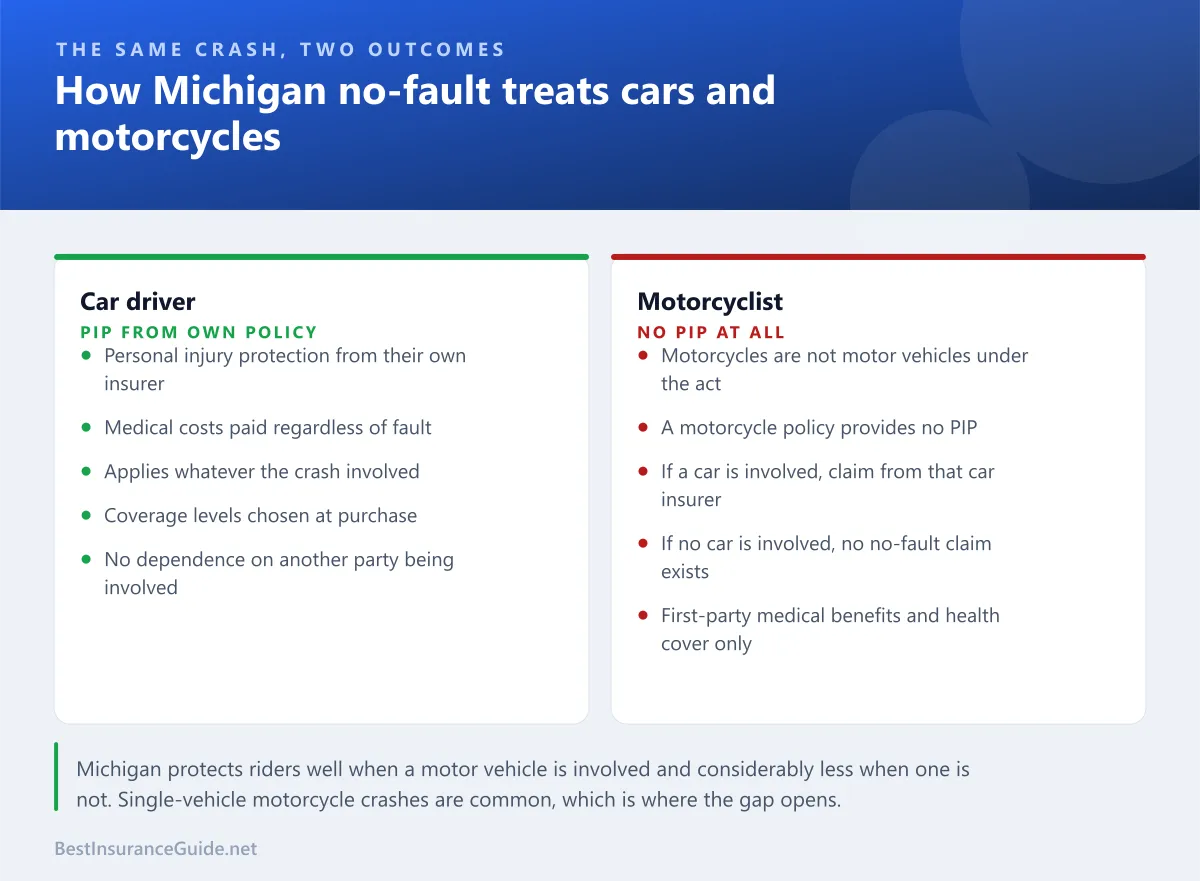
Michigan runs a no-fault system for cars. A car owner’s own policy provides personal injury protection, paying medical costs regardless of who caused the crash.
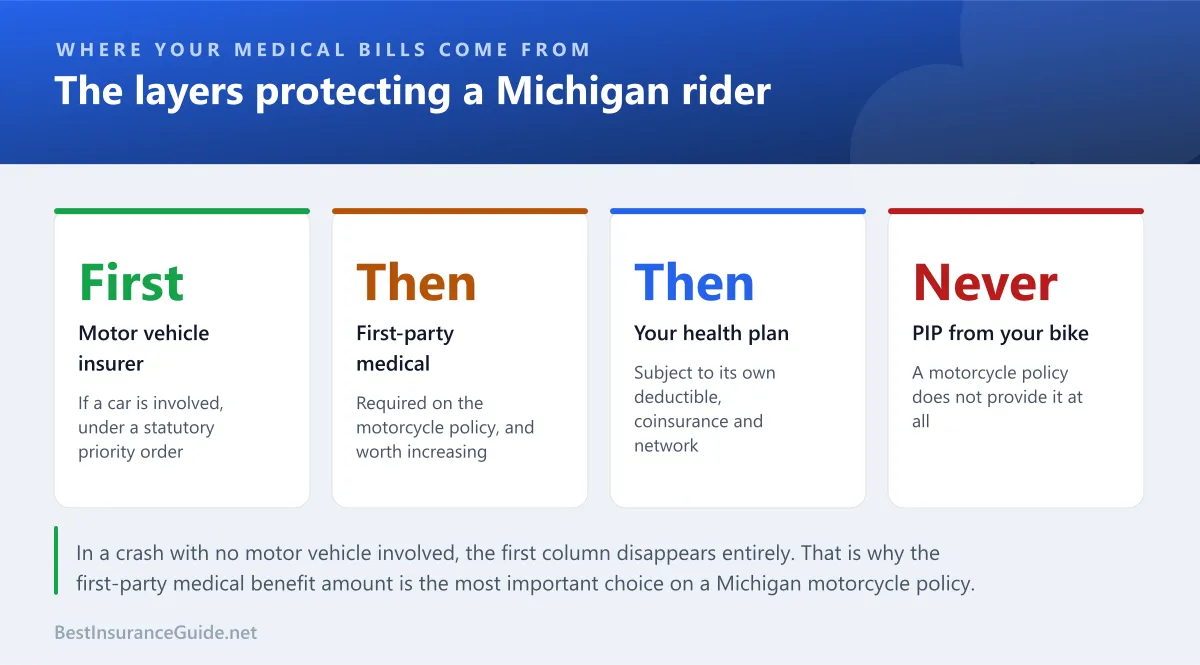
Motorcycles are not motor vehicles under the no-fault act. So a motorcycle policy does not provide PIP, and a rider does not receive no-fault benefits from their own motorcycle insurer.
That single fact drives everything else in this article, and it is genuinely counter-intuitive for anyone who assumes Michigan’s famously comprehensive no-fault system extends to them.
Where your benefits actually come from
The system has an answer, and it depends on what you hit or what hit you.
If a motor vehicle is involved in the crash, the injured motorcyclist claims no-fault benefits from that vehicle’s insurer, under a statutory order of priority. Broadly, the claim runs to the insurer of the owner or registrant of the involved motor vehicle first, then the operator’s insurer, and onward through the order if those are unavailable.
That is a genuinely valuable protection, and it is why a Michigan rider struck by a car is often better positioned than a rider in a state with no comparable rule.
If no motor vehicle is involved, there is no motor vehicle insurer to claim from. A single-vehicle crash, a collision with a deer, or losing the bike on gravel produces no no-fault claim at all.
In that case what responds is:
Your own first-party medical benefits on the motorcycle policy, which Michigan requires motorcycle policies to include.
Your health insurance, subject to its own deductible, coinsurance and network rules.
This is the gap riders most often discover late. Michigan’s protective structure works well when a car is involved and does considerably less when one is not, and single-vehicle motorcycle crashes are common.
The medical benefits number matters more here
Michigan requires motorcycle policies to carry first-party medical benefits, and riders relying on the helmet exemption must carry a higher specified amount.
Two points follow.
The required minimum is a legal floor. Serious motorcycle injuries produce costs far above it, and a single-vehicle crash means that floor plus your health plan is the whole of your protection.
Buy more than the minimum if it is offered. The incremental cost of higher first-party medical benefits is usually modest relative to the exposure, and in Michigan it is doing more work than the equivalent coverage in most states.
Ask your insurer specifically what first-party medical benefit your policy carries and what higher options are available. It is not the same as medical payments coverage in other states, and it is not PIP.
The helmet rule ties to coverage
Under 21: helmet required.
21 and over: may ride without a helmet provided they carry a specified minimum of first-party medical benefits and have either held a motorcycle endorsement for a defined period or completed an approved motorcycle safety course.
Passengers 21 and over must separately carry the required medical benefits to ride without a helmet. That catches people, because the operator qualifying does not automatically qualify the passenger.
As with the coverage question generally, the statutory amount is a compliance threshold rather than adequate protection. A serious head injury will exhaust it quickly, and in a single-vehicle crash there is no motor vehicle insurer behind it.
Liability, and the 2019 reform
Michigan’s no-fault system was substantially reformed in 2019, changing PIP coverage levels, introducing choice for drivers, and altering liability requirements.
Because the figures and available options shifted with that reform and have continued to be adjusted, this is one area where quoting specific numbers in an article is unhelpful. Confirm current minimum liability limits and the available first-party medical benefit levels with the Michigan Department of Insurance and Financial Services, which publishes them.
What has not changed is the principle: minimums are a compliance floor. Motorcycle crashes produce serious injuries at a much higher rate than car crashes, and liability limits should reflect what a serious injury claim actually costs rather than what the statute permits.
What to buy in Michigan
Given the structure above, the priority list differs from most states.
First-party medical benefits above the required minimum. The most important decision a Michigan rider makes, because it is what responds when no car is involved.
Uninsured and underinsured motorist coverage. Still valuable, because it covers the shortfall when an at-fault driver has too little, and because it responds to your injuries where liability is contested.
Liability well above the statutory floor.
Comprehensive and collision for the bike, required by any lender and worth having on anything of value.
Custom parts scheduling if the bike has aftermarket work. Standard policies cap accessories low, and our guide to custom motorcycle insurance covers agreed value and documentation.
The winter question
Michigan has a real off-season, and riders reasonably ask whether to cancel for four or five months.
Reducing coverage is sensible. Cancelling is usually not.
A lapse in continuous coverage raises your next premium, because continuous coverage is itself a rated factor, and a reported lapse can create registration problems. Meanwhile a stored bike is still exposed to theft, fire and water damage, which is exactly what comprehensive covers.
The better arrangement is a storage or lay-up period: keep comprehensive, reduce or suspend collision and liability while the bike is off the road, and restore full cover in spring. Most insurers writing in northern states support this, and it preserves both the theft protection and the continuous-coverage credit.
Worked example: lay-up against cancelling
| Full cover year-round | Lay-up arrangement | Cancelled for winter | |
|---|---|---|---|
| Months of full cover | 12 | 7 | 7 |
| Theft and fire cover in winter | Yes | Yes | No |
| Continuous coverage preserved | Yes | Yes | No |
| Effect on next premium | None | None | Increase |
The rider who cancels saves slightly more than the lay-up rider and loses theft cover, the continuous-coverage credit and, in some cases, their registration standing.
What moves a Michigan premium
Southeast Michigan prices highest. Detroit and the surrounding metro carry higher claim costs and theft rates than rural Michigan or the Upper Peninsula.
Michigan has historically been an expensive auto insurance state, and motorcycle pricing reflects the same local claim environment.
Bike type, with sport bikes well above cruisers.
Rider age and experience, with a steep youth curve.
Safety course completion, which produces a discount and satisfies part of the helmet exemption.
Storage, since garaged bikes cost less and are stolen less.
Shortened riding season, which reduces exposure relative to Florida or Texas and enables the lay-up option.
The short version
Michigan motorcycles sit outside the no-fault system, so your own motorcycle policy provides no PIP. If a motor vehicle is involved in your crash you claim no-fault benefits from that vehicle’s insurer under a statutory order of priority, which is a genuinely strong protection.
If no motor vehicle is involved, none of that applies. Your first-party medical benefits and your health insurance are the whole of your cover, which makes the amount of first-party medical benefit you carry the single most important choice on a Michigan motorcycle policy.
The helmet exemption for riders over 21 depends on carrying a specified medical benefit plus either experience or a safety course, and passengers must qualify separately.
Carry more medical benefit than the minimum, keep uninsured motorist cover, take the safety course, and use storage cover over winter rather than cancelling.
For how other states handle the same questions, see motorcycle insurance by state.
Choosing your first-party medical benefit level
Because this is the decision that matters most in Michigan, it deserves a practical framing.
Ask your insurer what levels are available and what each costs. The incremental premium for a higher first-party medical benefit is usually modest, and the scenario it covers is the one where nothing else responds.
Three questions to work through.
What does your health insurance actually cover for a motorcycle injury? Some health plans exclude or limit injuries from motorcycle use, and a high-deductible health plan leaves a substantial gap even where it covers. Read the exclusions before assuming your health cover fills the space.
Could you absorb your health plan’s out-of-pocket maximum? In a single-vehicle crash that is effectively your exposure, on top of the first-party medical benefit.
How much do you ride alone, on rural roads, or in conditions where no other vehicle would be involved? Deer strikes, gravel and single-vehicle losses are the scenarios where the motor vehicle route disappears entirely, and northern Michigan riding has plenty of all three.
The more your riding looks like that, the more the first-party medical benefit is doing.
Passengers, and the separate requirement
Worth its own note because it is genuinely easy to get wrong.
A passenger aged 21 or over who wishes to ride without a helmet must separately satisfy the medical benefit requirement. The operator qualifying does not extend to them.
That has an awkward practical consequence: taking a passenger who is not covered, on the assumption that your own compliance covers the bike, does not work. If you carry passengers regularly, the simplest answer is that everyone wears a helmet, which is also the answer with the best injury outcomes.
Deer, and a Michigan-specific claim
Michigan has one of the highest rates of vehicle-deer collisions in the country, and for a motorcyclist a deer strike is a serious event rather than a bodywork claim.
Two insurance points.
Damage to the bike is a comprehensive claim, not collision, in most wordings, because animal strikes are typically classed as comprehensive. That usually means a lower deductible, so it is worth knowing which to claim under.
No motor vehicle is involved, so the no-fault route described above does not apply to your injuries. Your first-party medical benefit and your health insurance are the whole of your medical cover. This is the clearest everyday example of the gap.
Riding at dawn and dusk in autumn carries the highest risk, and it is the season most Michigan riders are trying to make the most of.
The short checklist for a Michigan rider
Confirm your first-party medical benefit amount, and increase it if higher levels are offered.
Do not decline uninsured and underinsured motorist coverage.
Carry liability well above the statutory minimum.
Take an approved safety course, which counts toward the helmet exemption and produces a discount.
Use storage cover over winter rather than cancelling, to preserve continuous coverage and keep theft protection.
Schedule any custom parts with invoices and photographs.
Confirm the current statutory figures with the Michigan Department of Insurance and Financial Services, because they have changed since the 2019 reform and may change again.
Comparable states
Michigan places motorcycles outside its no-fault system, which is the same structural position as Massachusetts and Pennsylvania. On seasonal lay-up decisions it sits closest to Ohio.
A note on scope and sources
Michigan’s no-fault act was substantially reformed in 2019 and the coverage levels, options and minimum requirements have changed since. The order of priority for no-fault claims, the required first-party medical benefit amounts and the helmet exemption conditions are all set by statute.
Confirm the current position with the Michigan Department of Insurance and Financial Services, which publishes consumer guidance on no-fault and motorcycle coverage, and with the Michigan Secretary of State for licensing and registration. Nothing here is legal advice, and this site is independent and not affiliated with any insurer.