Motorcycle Insurance in Arizona: Low Minimums, Long Season, Real Heat
Arizona motorcycle insurance minimums are among the lowest nationally. Lane filtering rules, heat and dust hazards, and what to carry above the state floor.

Table of contents
Arizona is one of the best places in the country to ride and one of the easier places to be badly under-insured, and those two facts are connected.
What the state requires
Arizona requires liability insurance to register and operate a motorcycle, at minimum limits of:
- $25,000 bodily injury per injured person
- $50,000 bodily injury per accident
- $15,000 property damage
Written 25/50/15. Arizona increased these from considerably lower figures in recent years, which is an improvement, and they remain a compliance floor rather than a recommendation.
Helmets are required for riders and passengers under 18. There is no universal helmet law. Eye protection is required for all riders unless the motorcycle has a windscreen.
Why the minimums are the problem
The gap between what Arizona requires and what a motorcycle crash costs is the central issue for riders here.
A serious motorcycle injury — a fracture needing surgical fixation, several days in hospital, and rehabilitation — passes $25,000 before anyone discusses lost income. Multi-trauma runs into six figures routinely.
So even when the driver who hits you is fully compliant with Arizona law, their policy will very likely be exhausted long before your losses are covered.
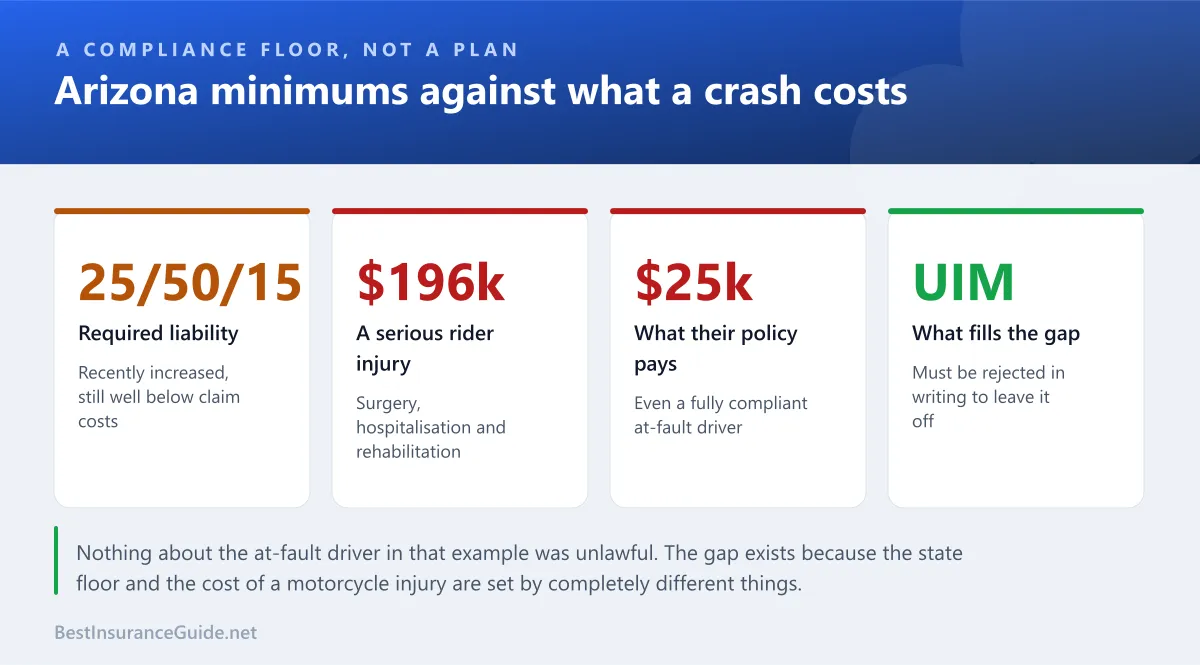
Underinsured motorist coverage is what fills that gap, and it is the single most valuable optional coverage an Arizona rider can buy. Insurers must offer uninsured and underinsured motorist cover, and you must reject it in writing to go without.
If you do not remember making that choice, check your declarations page, because it may have been made for you at the point of sale on a price-driven quote.
Worked example: a fully compliant driver, an underinsured rider
A rider is struck by a driver carrying Arizona minimums. Injuries and losses total $196,000.
| Source | Amount |
|---|---|
| At-fault driver’s bodily injury limit | $25,000 |
| Rider’s underinsured motorist, $100,000 | $75,000 |
| Rider’s medical payments, $25,000 | $25,000 |
| Total recovered | $125,000 |
| Shortfall | $71,000 |
With no UM or UIM at all, the recovery would have been $25,000 against $196,000 of loss. Nothing about the other driver’s conduct was unlawful.
Lane filtering
Arizona permits limited lane filtering under defined conditions, which is not the same as the general lane splitting permitted in California.
The conditions broadly involve stopped traffic, a road with a lower posted speed limit, and the motorcycle passing at a low speed. Filtering in moving traffic, at speed, or on a higher-speed road falls outside the permission.
The insurance consequence is fault apportionment rather than the citation. Arizona applies comparative fault to injury claims, so a rider found partly responsible has their recovery reduced proportionally. Filtering within the law is lawful conduct and does not establish negligence; filtering outside it hands the other side an argument.
Because the conditions are specific, confirm the current rules with the Arizona Department of Transportation rather than relying on a summary or on what another rider told you.
Heat, and what it does to riding
Arizona summer riding is genuinely hazardous in a way that is easy to underestimate, and it produces crashes that look like ordinary rider error.
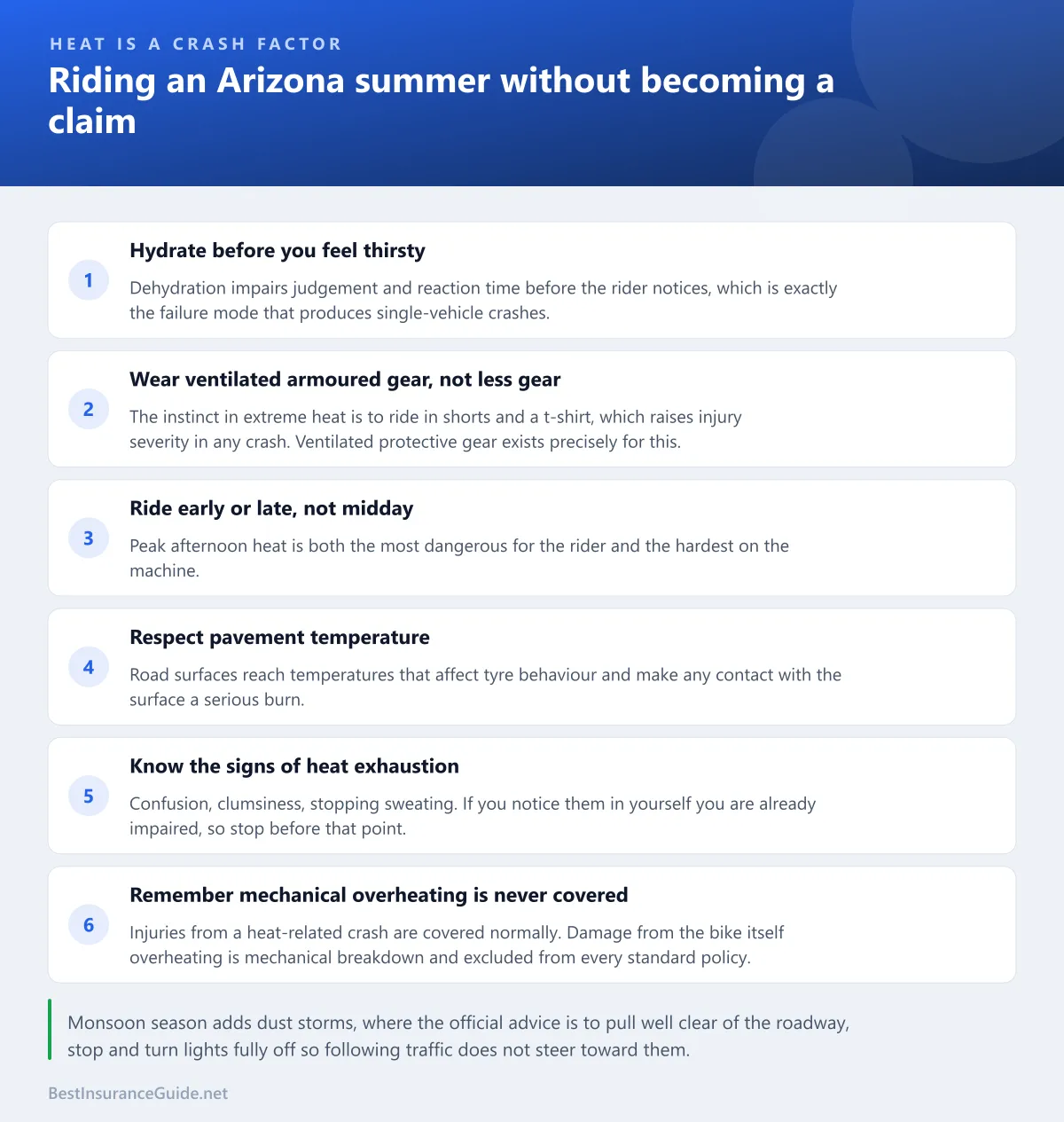
Dehydration and heat exhaustion impair judgement and reaction time before the rider recognises it, which is exactly the failure mode that produces single-vehicle crashes.
Protective gear becomes a trade-off. The instinct in extreme heat is to ride in less gear, which raises injury severity in any crash. Ventilated armoured gear exists precisely for this and is the better answer than shorts and a t-shirt.
Pavement temperature. Road surfaces reach temperatures that affect tyre behaviour and make any contact with the surface a serious burn.
Insurance treats a heat-related crash as a crash. Injuries are covered normally. What is not covered is mechanical damage from the bike overheating, because mechanical breakdown is excluded from standard policies regardless of cause.
Dust storms
Haboobs are a genuine Arizona hazard, arriving quickly and reducing visibility to near zero.
The official advice for vehicles is to pull well off the roadway, stop, turn off lights entirely so following traffic does not steer toward them, and wait. On a motorcycle the exposure is worse, because there is no cabin.
For insurance, a crash in a dust storm is a covered crash. The complication is fault: a rider who continued into obviously unsafe conditions may have some responsibility apportioned, which reduces recovery under Arizona’s comparative fault rules.
Theft, and comprehensive
Theft is the most common comprehensive claim on motorcycles nationally, and the Phoenix and Tucson metros see plenty of it.
Comprehensive covers theft, fire, vandalism, weather and animal strikes. It is generally the cheaper of the two physical damage coverages.
Settlement is at actual cash value unless you have agreed value cover, which matters on anything older or modified. Our guide to custom motorcycle insurance covers agreed value and documenting a build.
Security genuinely affects both risk and premium. A locked garage, a ground anchor, a disc lock and a tracker all help, and several attract insurer discounts.
Arizona adds a second comprehensive consideration in monsoon season: flash flooding and wind-driven debris, both of which damage bikes parked outside.
The year-round season
Arizona rides all year, which has two premium consequences.
Annual exposure is higher than in northern states, which is part of why year-round states price above places like Ohio or Michigan for the same rider and machine.
There is no lay-up option. Riders in Ohio cut premium by suspending coverage for five months while keeping comprehensive. Arizona riders cannot, so the savings levers here are different: the safety course discount, garaging and security, higher deductibles, multi-policy bundling and mileage-based rating where it is offered.
If you genuinely ride very little, ask specifically about low-mileage or pleasure-use rating. Not every insurer offers it and it is rarely volunteered.
The short version
Arizona requires 25/50/15 liability, with helmets for under-18s and eye protection for everyone without a windscreen. Those minimums are a compliance floor and they are well below what a serious motorcycle injury costs.
The most valuable thing an Arizona rider can buy is uninsured and underinsured motorist coverage, because even a fully compliant driver’s policy is likely to be exhausted by your injuries.
Limited lane filtering is permitted under precise conditions, and staying inside them protects your fault apportionment as well as your licence.
Heat is a genuine crash factor rather than a comfort issue, ventilated armoured gear is the right answer to it, and mechanical overheating damage is never covered.
Carry comprehensive for theft and monsoon exposure, garage the bike where possible, and take the safety course for the discount and the skills.
For how other states handle the same questions, see motorcycle insurance by state.
Seasonal and snowbird riders
Arizona has a large population of seasonal residents who ride here for part of the year and elsewhere the rest, and that arrangement creates insurance questions worth resolving before a claim.
Where is the bike garaged? Insurers rate on the address where the vehicle is principally kept. A bike stored in Arizona for six months and Minnesota for six months has a principal garaging address, and getting it wrong is a misrepresentation that surfaces at claim time.
Tell the insurer the actual arrangement. Most will rate it sensibly. Guessing, or leaving an old address on the policy, is the problem.
Registration and insurance should align. A bike registered in one state and insured against an address in another creates complications, and Arizona has its own registration requirements for vehicles kept in the state beyond a defined period.
Consider a single policy covering the full year rather than cancelling and rebuying each season. Cancelling breaks continuous coverage, which is a rated factor, and rebuying each year means paying new business pricing repeatedly.
If the bike genuinely sits unused for months, ask about a storage arrangement for that period rather than cancelling, exactly as northern riders do over winter.
Comparing quotes properly in Arizona
Match five fields before comparing any price: bodily injury liability, property damage, uninsured and underinsured motorist limits, comprehensive deductible and collision deductible.
Then four Arizona-specific questions.
Is uninsured and underinsured motorist on the quote, and at what limit? Given how low the state minimums are relative to injury costs, this is the field most worth checking, and it is the one most often quietly set to the minimum on a price-driven quote.
How is monsoon and flood damage treated under comprehensive?
What is the custom parts and accessories limit?
Is there a low-mileage or pleasure-use rating available? Worth asking if you ride seasonally.
Our guide to comparing insurance quotes the right way sets out the general discipline. The Arizona-specific point is that a quote at state minimums is not a cheaper policy, it is a different and much thinner product, and the gap only becomes visible after a crash.
Buying a used bike in Arizona
Arizona is a good place to buy a used motorcycle and a place where a few specific checks matter, and both have insurance consequences.
Dry climate means less corrosion. Arizona bikes generally have better frames, fasteners and exhausts than equivalents from the Rust Belt, which is why they are shipped out of state regularly.
Sun damage is the trade. Plastics, seats, wiring insulation, rubber components and paint degrade under intense UV. A bike that looks structurally excellent can have brittle wiring and perished seals, and neither is an insurance claim because both are wear.
Check the title and registration history before buying. A salvage or rebuilt title materially affects both value and insurability, and some insurers will not write comprehensive and collision on a rebuilt title at all. Ask your insurer before you buy, not after.
Theft recovery affects the market. Arizona’s metro theft rates mean recovered stolen bikes enter the used market, sometimes with damage histories that are not obvious.
For insurance purposes, two practical steps. Quote the specific bike before you buy, because the difference between two machines you are considering can exceed their price difference. And photograph the bike at purchase, including the odometer, VIN and any existing damage, which makes any later claim considerably simpler.
A note on figures and sources
Premium and cost figures in this article are illustrative rather than quotes. Actual pricing depends on your postcode, machine, riding record, age and coverage selections.
Arizona’s minimum limits were increased in recent years and the lane filtering provisions are recent, so confirm the current position with the Arizona Department of Transportation Motor Vehicle Division and the Department of Insurance and Financial Institutions rather than relying on any summary. Nothing here is legal advice.
Comparable states
Arizona permits lane filtering, which it shares with Colorado, the other state covered here where the practice is lawful in limited form. On low statutory minimums it sits closest to Florida, which goes further and requires no liability cover at all to register a bike.
A note on scope and sources
Arizona’s minimum financial responsibility requirements, helmet and eye protection rules, and lane filtering conditions are set by statute and administered by the Arizona Department of Transportation Motor Vehicle Division, with insurance regulated by the Arizona Department of Insurance and Financial Institutions.
Minimum limits were increased in recent years and the filtering provisions are recent, so confirm the current position with those agencies rather than relying on any summary. Premium and cost figures here are illustrative rather than quotes. Nothing here is legal advice, and this site is independent and not affiliated with any insurer.