Do You Need Insurance for a Motorcycle in Florida? Legally, No
Florida does not require motorcycle liability insurance to register. What financial responsibility means after a crash, the helmet rule, and what to carry.

Table of contents
Florida is the national outlier on this question, and the answer surprises riders who move here from almost anywhere else.
You are not required to carry liability insurance to register or ride a motorcycle in Florida.
That is legally accurate and practically misleading, and the gap between those two things is what this article is about.
Why Florida is different
Florida runs a no-fault system for cars. Car owners must carry personal injury protection and property damage liability to register a vehicle.
Motorcycles sit outside that system. They are not motor vehicles for the purposes of the no-fault statute, so the PIP requirement does not apply, and Florida does not separately require bodily injury liability to register a motorcycle.
So a rider can lawfully register a bike, get a tag, and ride with no insurance at all.
What the law does require
The obligation does not disappear; it moves to a different point in time.
Florida operates a financial responsibility requirement that applies after you are at fault in a crash involving injuries or significant damage. At that point you must demonstrate the ability to cover the harm you caused, commonly stated as $10,000 per person and $20,000 per accident for bodily injury, plus $10,000 for property damage.
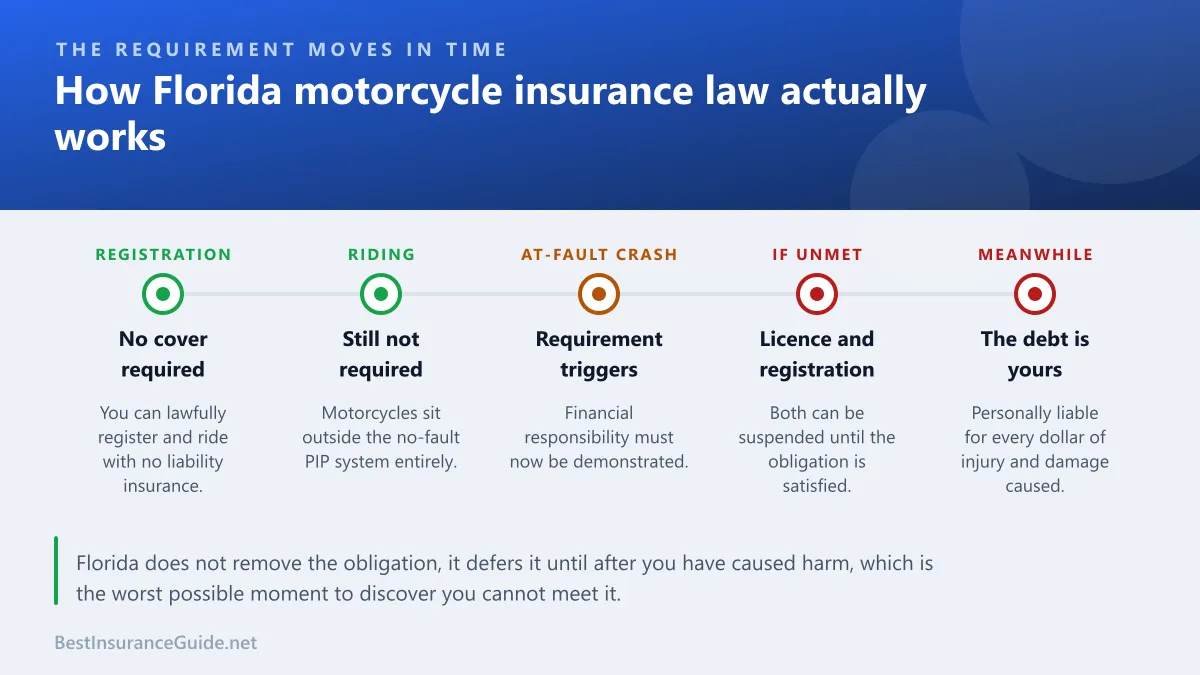
If you cannot satisfy it, the consequences fall on your licence and registration, which can be suspended until you do, as well as on your finances. Satisfying it after the fact typically means either paying, or filing proof of insurance going forward, or posting security.
So the accurate framing is not that Florida does not require motorcycle insurance. It is that Florida defers the requirement until after you have already caused harm, which is the worst possible moment to discover you cannot meet it.
The arithmetic of riding uninsured
A serious motorcycle crash with injuries routinely produces claims in the hundreds of thousands. Liability-only motorcycle cover in Florida is inexpensive.
Worked example: an at-fault crash with no liability cover
| Item | Amount |
|---|---|
| Other party’s medical treatment and rehabilitation | $164,000 |
| Lost earnings claim | $71,000 |
| Vehicle damage | $18,000 |
| Legal defence costs | $26,000 |
| Total claimed against the rider | $279,000 |
| Covered by insurance | $0 |
| Personal liability | $279,000 |
That figure is a personal debt, subject to judgment, wage garnishment and liens, alongside a suspended licence until financial responsibility is satisfied.
The premium avoided was a few hundred dollars a year. That is the whole trade, stated plainly.
The gap nobody warns riders about
Here is the part that matters most, and it follows directly from motorcycles being outside the no-fault system.
Florida motorcyclists get no PIP. A car driver injured in a crash has personal injury protection paying their initial medical costs regardless of fault. A motorcyclist in the same crash, on the same road, has nothing equivalent unless they bought it.
That means a Florida rider’s own injuries — which on a motorcycle are the dominant financial risk — are unprotected by default.
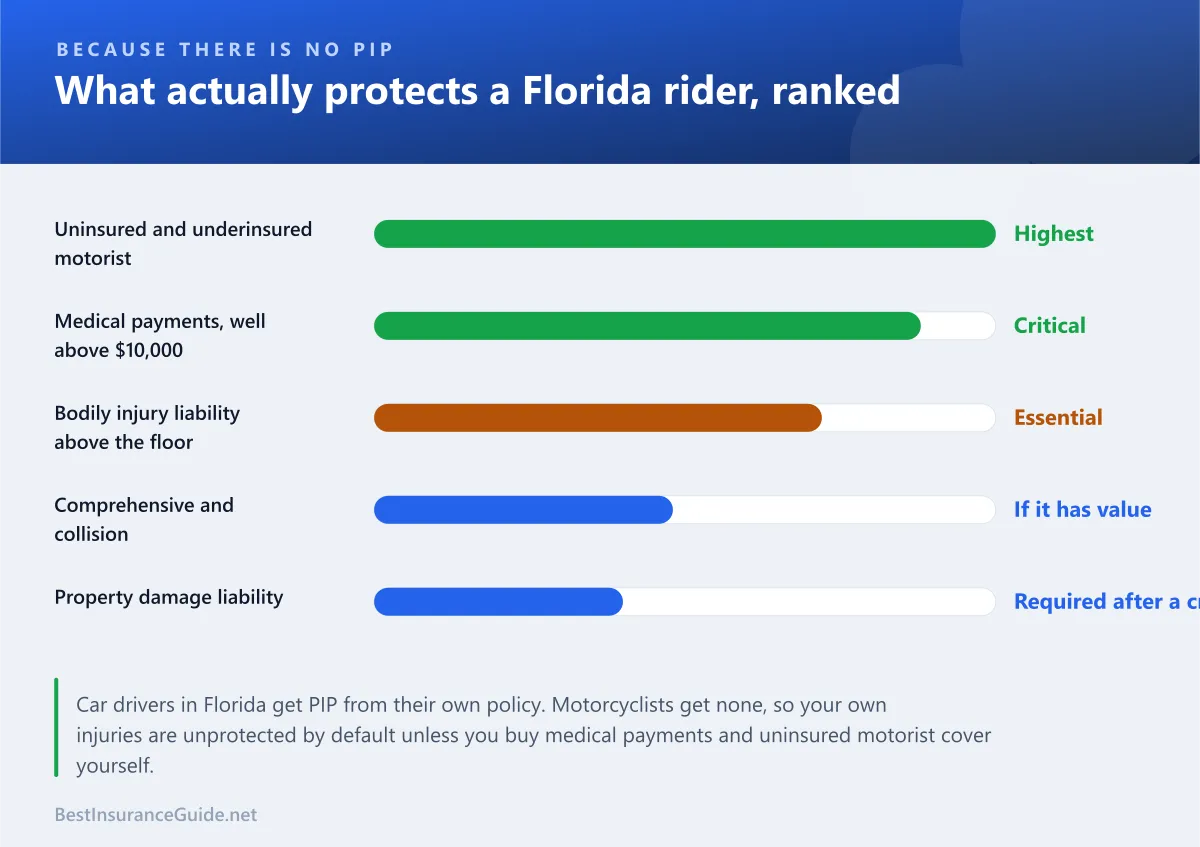
Two coverages close it.
Medical payments coverage pays your medical bills regardless of fault, and it also satisfies the helmet exemption discussed below. It is optional and it is the closest thing a Florida rider has to PIP.
Uninsured and underinsured motorist coverage is the most important line on a Florida motorcycle policy. Florida has a high uninsured driver rate, and among insured drivers many carry minimum limits that a serious motorcycle injury exhausts immediately.
There is a bitter logic here: the same permissiveness that lets riders go uninsured means many of the people around you have very little cover either. Your own UM coverage is what pays when they have nothing.
The helmet rule, which is also an insurance rule
Under 21: helmet required, no exceptions.
21 and over: may ride without a helmet provided they carry at least $10,000 in medical benefits for injuries sustained in a motorcycle crash.
Eye protection is required regardless of age, unless the motorcycle is equipped with a windscreen.
Two practical points, both of which catch riders.
Check the coverage is actually on your policy. Medical payments is optional in Florida, and a cheap liability-only policy frequently does not include it. Riding helmetless on the assumption that you qualify, without the coverage in force, is riding in breach of the exemption.
$10,000 is a statutory threshold, not adequate protection. A serious head injury runs to six figures and beyond. Treating the legal minimum as sufficient is the same error as treating minimum liability limits as sufficient.
What to actually buy
Given the structure above, the priority order for a Florida rider is different from most states.
Uninsured and underinsured motorist coverage, at meaningful limits. First priority, because it protects you against the large uninsured population.
Medical payments coverage, well above $10,000. Second, because there is no PIP behind it.
Bodily injury liability, well above the financial responsibility floor. Not legally required to ride, but the alternative is personal exposure to six figures.
Property damage liability.
Comprehensive and collision if the bike has value or is financed. Florida theft rates in the metros are a genuine consideration.
Custom parts scheduling if the bike has aftermarket work, since standard policies cap accessories low. Our guide to custom motorcycle insurance covers agreed value and documentation.
What moves a Florida premium
Metro against rural. Miami-Dade, Broward, Tampa and Orlando price above rural and north Florida, following claim costs, traffic density and theft.
Bike type. Sport bikes cost substantially more than cruisers of similar value.
Rider age and experience, with a steep youth curve.
Year-round riding season, which raises exposure and removes the winter lay-up option northern riders use.
Storage, since garaged bikes cost less and are stolen less.
Safety course completion, which produces a discount with most insurers.
Hurricane exposure, which affects comprehensive pricing in coastal counties.
Delivery riding
Personal motorcycle policies exclude carrying goods for compensation, and Florida’s metros have a large delivery population.
Platform coverage is staged and frequently thin between accepting a job and collecting it. A crash in that window can fall between your excluded personal policy and inadequate platform cover. Our guide to motorcycle courier insurance sets out where each period begins and ends.
If you deliver, declare it and get the endorsement.
The short version
Florida does not require motorcycle liability insurance to register or ride. It requires you to satisfy financial responsibility after an at-fault crash with injuries, which is the worst possible moment to find out you cannot.
More importantly, motorcycles are excluded from Florida’s no-fault system, so riders receive no PIP. Your own injuries, which are the main financial risk on a bike, are unprotected unless you buy medical payments and uninsured motorist coverage yourself.
Because so many Florida drivers carry nothing or minimum limits, uninsured and underinsured motorist coverage is arguably the most valuable line on the policy rather than an optional extra.
Carry liability well above the financial responsibility floor, buy medical payments well above the $10,000 helmet threshold, and do not decline UM cover.
For how other states handle this, see motorcycle insurance by state.
The uninsured motorist problem, compounded
Florida’s structure produces a feedback loop that riders should understand before deciding what to buy.
Because liability insurance is not required to register a motorcycle, a meaningful share of riders carry none. Because Florida’s car insurance requirement is PIP and property damage rather than bodily injury liability, a large number of Florida drivers also carry no bodily injury cover at all.
Put those together and the person who hits you may well have nothing available to pay for your injuries, even if they are fully compliant with Florida law.
That is not a hypothetical. It is the ordinary case, and it is the strongest argument for uninsured motorist coverage anywhere in the country.
Worked example: hit by a compliant but uninsured driver
A rider is struck by a driver carrying only Florida’s required PIP and property damage cover. The rider’s injuries and losses total $190,000.
| Source | Amount |
|---|---|
| At-fault driver’s bodily injury liability | $0, none carried |
| Their property damage liability, toward the bike | $10,000 |
| Rider’s own PIP | $0, motorcycles excluded |
| Rider’s medical payments, $25,000 | $25,000 |
| Rider’s uninsured motorist, $100,000 | $100,000 |
| Total recovered | $135,000 |
| Shortfall | $55,000 |
Without UM and medical payments, the recovery on $190,000 of loss would have been $10,000 toward the bike and nothing toward the rider.
That table is the whole case for buying coverage Florida does not require.
Stacking, and a term worth asking about
Florida permits stacked uninsured motorist coverage, which multiplies your UM limit by the number of vehicles on the policy, and unstacked, which does not.
Stacked cover costs more and provides substantially more protection where you insure more than one vehicle. For a household with a car and a motorcycle, this is a question genuinely worth asking about, and it is rarely raised at the point of sale.
Insurers must offer UM cover and obtain a written rejection if you decline it, and the stacked or unstacked election is documented similarly. Read what you signed.
What to do before your next ride
Do not decline uninsured motorist coverage, and ask about stacking if you insure more than one vehicle.
Buy medical payments well above the $10,000 helmet threshold. With no PIP behind it, this is your first line for your own injuries.
Carry bodily injury liability despite it not being required to register. The alternative is personal exposure to six figures and a suspended licence.
Take a rider safety course for the discount and the skills.
Schedule custom parts if the bike has aftermarket work.
Confirm your policy actually includes medical benefits if you ride without a helmet on that basis.
Our motorcycle insurance by state guide sets the Florida position against the rest of the country, and custom motorcycle insurance covers documenting a build.
What moves a Florida premium
Metro against rural. Miami-Dade, Broward, Tampa and Orlando price above rural and north Florida, following claim costs, traffic density and theft rates.
Bike type. Sport bikes cost substantially more than cruisers of similar value, reflecting both how they are ridden and how often they are stolen.
Rider age and experience, with a youth curve steeper than for cars.
Year-round riding, which raises annual exposure and removes the winter lay-up option northern riders use to cut premium.
Storage and security, since garaged bikes cost less and are stolen less.
Safety course completion, which produces a discount with most insurers.
Hurricane exposure, which affects comprehensive pricing in coastal counties, since a bike is fully exposed to wind and flood damage.
Comparable states
Florida’s position, requiring no liability insurance to register a motorcycle, is unique among the states covered here. The nearest comparison is Arizona, which sets very low minimums rather than none. On helmet rules, Texas takes the same approach of tying an exemption to carrying medical cover.
A note on scope and sources
Florida’s registration, financial responsibility, helmet and eye protection requirements are set by statute and administered by the Florida Department of Highway Safety and Motor Vehicles, with insurance regulated by the Florida Office of Insurance Regulation. Both publish current requirements and both change from time to time.
Confirm the current position and the exact financial responsibility thresholds with those agencies rather than relying on any article. Nothing here is legal advice, and this site is independent and not affiliated with any insurer.