Motorcycle Insurance in Georgia: A Universal Helmet Law and Atlanta Traffic
Georgia has a universal motorcycle helmet law. Insurance requirements, Atlanta metro pricing, and the coverages that matter most for riders here.

Table of contents

Georgia is one of a minority of states with a universal helmet law, and that single fact separates it from most of its neighbours in ways that reach into insurance.
What the state requires
Georgia requires liability insurance to register and operate a motorcycle, at minimum limits of:
- $25,000 bodily injury per injured person
- $50,000 bodily injury per accident
- $25,000 property damage
Written 25/50/25. As everywhere, these are compliance minimums rather than a recommendation.
All riders and passengers must wear an approved helmet, regardless of age, experience or what insurance they carry. Eye protection is required unless the motorcycle has a windscreen.
Why the universal helmet law matters
Riders coming from Florida or Texas frequently expect an exemption and there is not one.
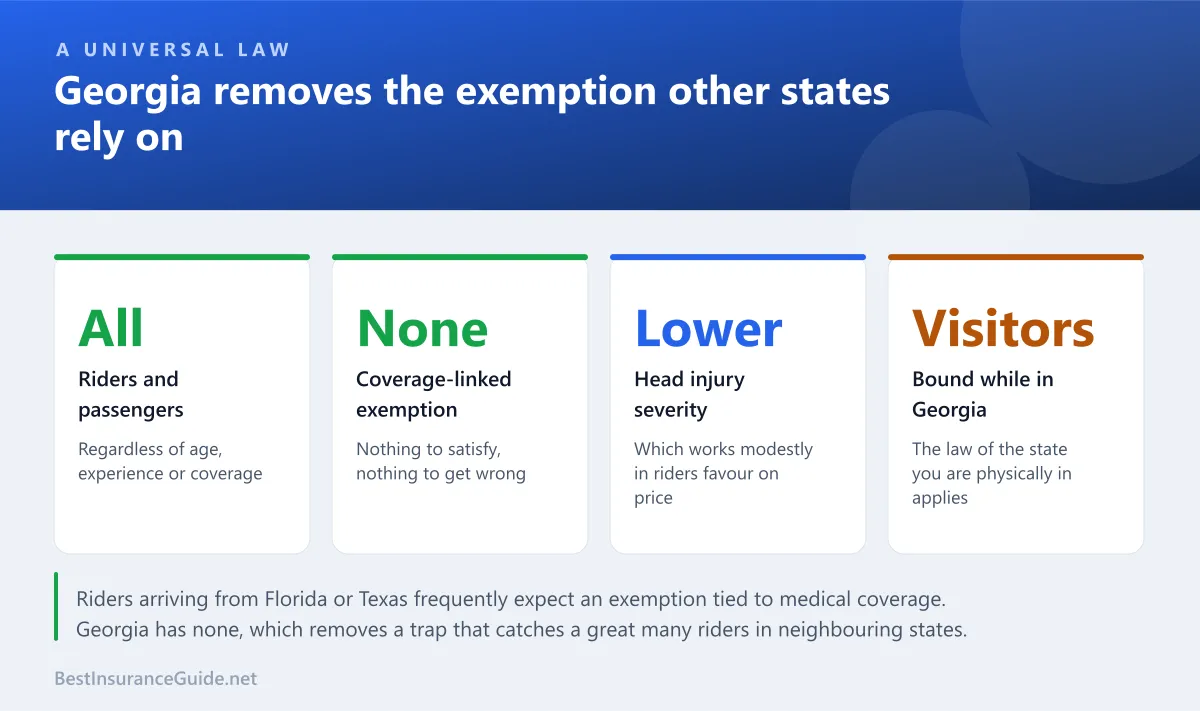
Three consequences worth understanding.
There is no coverage-linked exemption to get wrong. In Florida and Texas, riders over 21 can go without a helmet if they carry a specified amount of medical benefits, and a large number rely on that without confirming the coverage is actually on their policy. Georgia removes that trap entirely by removing the choice.
Head injury severity is lower where helmet use is universal, which reduces claim costs across the rider population over time. That is a modest downward influence on premiums rather than a dramatic one, but it works in Georgia riders’ favour.
Compliance is simple. An approved helmet, worn, every time. There is no paperwork to maintain and no coverage threshold to check at renewal.
The practical implication for buying insurance is that you can concentrate entirely on the coverages that protect you financially, rather than on satisfying a statutory condition.
The coverage that actually matters
State minimums protect other people. On a motorcycle the person most likely to be seriously injured is you, and liability does nothing for that.

Uninsured and underinsured motorist coverage is the most valuable optional line. Georgia insurers must offer it and obtain a written rejection to leave it off.
Georgia also allows UM coverage to be written on an added-on basis, which stacks on top of the at-fault driver’s limits, or a reduced-by basis, which subtracts them. Added-on costs more and pays substantially more. It is worth asking which you have, because the difference is large and it is rarely explained at the point of sale.
Medical payments coverage pays your medical bills regardless of fault and without waiting for liability to be resolved. Georgia is a fault state with no PIP requirement, so this is the coverage that responds immediately.
Comprehensive and collision if the bike has value or is financed. Comprehensive covers theft, which is a genuine metro Atlanta consideration, plus storm and hurricane damage on the coast.
Custom parts and accessories, since standard policies cap aftermarket work low. Our guide to custom motorcycle insurance covers scheduling and agreed value.
Worked example: added-on against reduced-by
A rider with $100,000 of UM cover is struck by a driver carrying Georgia minimums. Injuries total $180,000.
| Added-on UM | Reduced-by UM | |
|---|---|---|
| At-fault driver’s limit | $25,000 | $25,000 |
| Your UM limit | $100,000 | $100,000 |
| UM available after their limit | $100,000 | $75,000 |
| Total recovered | $125,000 | $100,000 |
A $25,000 difference on one claim, from a distinction most riders have never been told about.
Metro Atlanta
Georgia’s premium spread is dominated by one metro, and Atlanta prices well above the rest of the state.
Traffic density. Metro Atlanta congestion produces the low-speed, multi-vehicle situations that account for a large share of urban motorcycle crashes.
Repair and medical costs are higher in the metro, which is what insurers are ultimately pricing.
Theft rates are meaningful, and theft is the most common comprehensive claim on motorcycles nationally.
Outside the perimeter, and particularly in south and rural Georgia, the same policy for the same rider costs noticeably less. Our pet insurance by state guide makes the same point about intra-state spread in a different line, and the principle is identical: rating follows local cost, not the state name.
Lane splitting
Georgia does not permit lane splitting or lane filtering.
Beyond the citation, this matters because Georgia applies modified comparative negligence to injury claims. A rider found partly at fault has their recovery reduced by their share, and above a threshold share recovers nothing.
Riding between lanes where it is prohibited gives the other party’s insurer a straightforward argument that you contributed to the crash. On a six-figure injury claim, a shift in apportionment costs more than any premium you saved.
The year-round season
Georgia rides all year, with two consequences.
Annual exposure is higher than in northern states, which is part of why year-round states price above places like Ohio.
There is no lay-up option. Riders in Michigan and Ohio cut premium by suspending liability and collision for months while keeping comprehensive. Georgia riders cannot.
So the savings levers here are different: the safety course discount, garaging and security, higher deductibles, multi-policy bundling, and low-mileage or pleasure-use rating where an insurer offers it. Ask specifically about the last one if you ride rarely, because it is seldom volunteered.
Coastal exposure
Savannah and coastal Georgia carry genuine hurricane and flooding exposure.
Storm damage to the bike is a comprehensive claim, covering wind, falling debris and flooding. A motorcycle parked outside is fully exposed, and unlike a car it cannot simply be driven inland at short notice by someone else.
Injuries during or after a storm are covered as accidents.
What is not covered is anything resembling displacement or transport costs, which are a homeowners or renters question rather than a motorcycle insurance one.
If you keep a bike on the coast, comprehensive is doing more work than in the rest of the state, and dropping it to save money on an older machine is a poorer trade than it looks in June.
The short version
Georgia requires 25/50/25 liability and a helmet for every rider and passenger regardless of age. There is no coverage-linked exemption to satisfy, which removes a complication that catches riders in Florida and Texas.
That lets you focus entirely on the coverages that protect you financially. The most important is uninsured and underinsured motorist cover, and specifically whether yours is written added-on or reduced-by, because that distinction can be worth tens of thousands on a single claim.
Add medical payments, since Georgia has no PIP and it is what responds immediately. Keep comprehensive for theft in the metro and storms on the coast. And do not lane split, because it costs you fault apportionment as well as a ticket.
For how other states compare, see motorcycle insurance by state.
New riders in Georgia
Georgia has a defined licensing pathway, and completing it properly has insurance consequences beyond the licence itself.
The instructional permit stage carries restrictions, typically including no night riding, no passengers and no limited-access highways. Riding outside those restrictions is a violation, and a violation while on a permit is treated seriously by insurers.
An approved rider training course can satisfy part of the licensing requirement and produces an insurance discount with most insurers. Taking it is close to free money for a new rider, because the discount frequently offsets a meaningful share of the course cost in the first year alone.
The first years carry a loading regardless. Insurers rate on riding experience separately from age, so a 40-year-old first-time rider still pays more than an experienced one. That loading reduces annually with a clean record, which is an argument for maintaining continuous coverage rather than dipping in and out.
Choose the first bike with an insurance quote in hand. For a new rider the difference between a mid-size cruiser and a supersport is frequently larger than the difference in purchase price, and it persists for years.
Comparing quotes properly in Georgia
Match five fields across every quote before looking at price: bodily injury liability, property damage, uninsured and underinsured motorist limits, comprehensive deductible and collision deductible.
Then three Georgia-specific questions.
Is the uninsured motorist coverage added-on or reduced-by? The single most valuable question in this state, and the answer can be worth tens of thousands on a claim. Ask for it in writing.
What is the custom parts and accessories limit?
How is storm and flood damage treated under comprehensive, particularly if you keep the bike on the coast?
Our guide to comparing insurance quotes the right way covers the general method. In Georgia the added-on versus reduced-by distinction sits above everything else, because two policies that look identical on a comparison page can settle a serious claim $25,000 apart.
What to do after a crash in Georgia
Georgia applies modified comparative negligence, which means what you do at the scene affects what you recover. A rider found partly at fault has their recovery reduced by their share, and above a threshold share recovers nothing at all.
That makes documentation worth more here than in a pure fault state.
Call the police and get a report. Georgia requires reporting crashes involving injury or significant damage, and an official report is the strongest evidence available when fault is contested.
Photograph before anything moves, if it is safe to wait. Wide shots showing lane position, traffic signals, road markings and sightlines matter far more than damage close-ups, because damage is rarely what gets disputed.
Get independent witness details. Motorcycle crashes attract a specific kind of assumption about rider behaviour, and an independent witness is the most effective answer to it.
Do not discuss fault. Apologising at a crash scene is a human reflex and it is quoted back later.
Photograph your gear. Damaged helmets, jackets and boots evidence both the severity of the impact and that you were wearing protective equipment. Since Georgia requires helmets universally, evidence you were compliant removes an argument entirely.
Report to your own insurer promptly, even if the other party was clearly at fault. Your policy requires notice regardless of blame.
See a doctor the same day if there is any possibility of injury. A gap between the crash and the first medical record is the most effective argument an insurer has that an injury came from elsewhere.
Our guide to what to do after a car accident that was not your fault covers the general sequence, and nearly all of it applies to riders.
A note on figures and sources
Premium figures here are illustrative rather than quotes, and actual pricing depends on your postcode, machine, record, age and coverage selections. Confirm Georgia’s current minimum limits and helmet requirements with the Department of Driver Services and the Office of Commissioner of Insurance and Safety Fire.
Comparable states
Georgia’s universal helmet law is shared with Massachusetts, which also excludes motorcycles from its no-fault system. Texas takes the opposite approach, tying a helmet exemption to a medical coverage requirement rather than mandating helmets outright.
A note on scope and sources
Georgia’s minimum financial responsibility requirements, universal helmet law and eye protection rules are set by statute and administered by the Georgia Department of Driver Services and the Department of Revenue, with insurance regulated by the Office of Commissioner of Insurance and Safety Fire.
Confirm the current position with those agencies rather than relying on any article, and ask your own insurer in writing whether your uninsured motorist cover is added-on or reduced-by. Premium and cost figures here are illustrative rather than quotes. Nothing here is legal advice, and this site is independent and not affiliated with any insurer.