Pet Insurance in Michigan: Rising Tick Risk and Hard Winters
Pet insurance in Michigan: Detroit and Ann Arbor pricing, spreading Lyme disease risk, winter claims, and the policy terms that decide payouts.

Table of contents

Michigan’s pet insurance picture has shifted over the past two decades, and the reason is ticks.
What sets the price
Pet insurance reimburses a share of your actual vet bill, so the premium follows local veterinary pricing rather than anything about your animal.
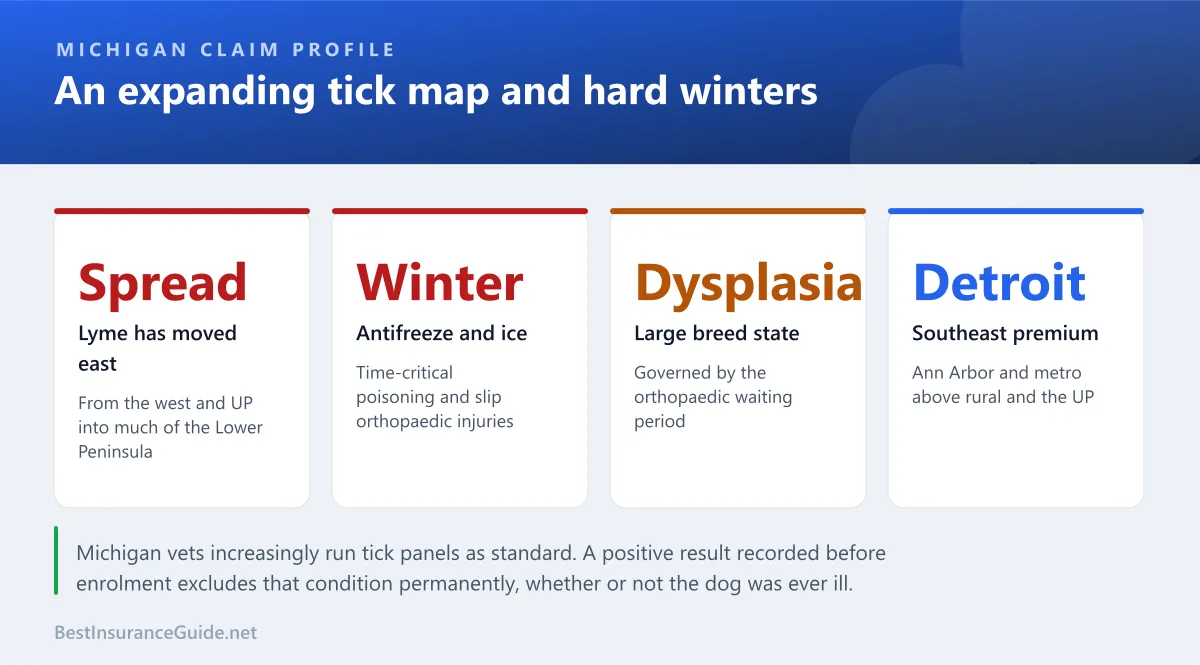
Southeast Michigan is the expensive end. Detroit, Ann Arbor and the surrounding metro carry higher clinic overheads and a strong concentration of specialists and 24-hour emergency hospitals, including a major veterinary teaching presence. Where referral care is available, more cases escalate to it.
Grand Rapids and Lansing sit below that, and rural Michigan and the Upper Peninsula lower again.
The policy language is broadly the same statewide, because the same national insurers write it. Only the expected bill changes. Our pet insurance by state guide explains why the spread inside a state is often larger than the gap between two states.
The tick situation has changed
This is the genuinely Michigan-specific point.
Canine Lyme disease was historically concentrated in the western Lower Peninsula and parts of the Upper Peninsula. Over recent decades the blacklegged tick has expanded steadily eastward and southward, and canine Lyme now appears across much of the state. Anaplasmosis travels with it.
Three practical consequences.
Treatment is covered; prevention is not. An acute Lyme or anaplasmosis case is a covered illness. Tick preventives, the Lyme vaccine and annual screening are wellness items that core insurance does not touch.
The expensive outcome is Lyme nephritis. Uncommon, but a chronic kidney complication that is serious, long-running and costly. That is the scenario the policy exists for rather than the straightforward course of antibiotics.
Routine screening creates a pre-existing condition trap. Michigan vets increasingly run tick panels as standard. A positive result recorded before you enrol excludes that condition permanently with essentially every insurer, whether or not the dog was ever ill.
If you are insuring a Michigan dog, enrolling before the first spring panel is worth more than shopping for a slightly cheaper premium afterwards.
Worked example: Lyme nephritis, first year
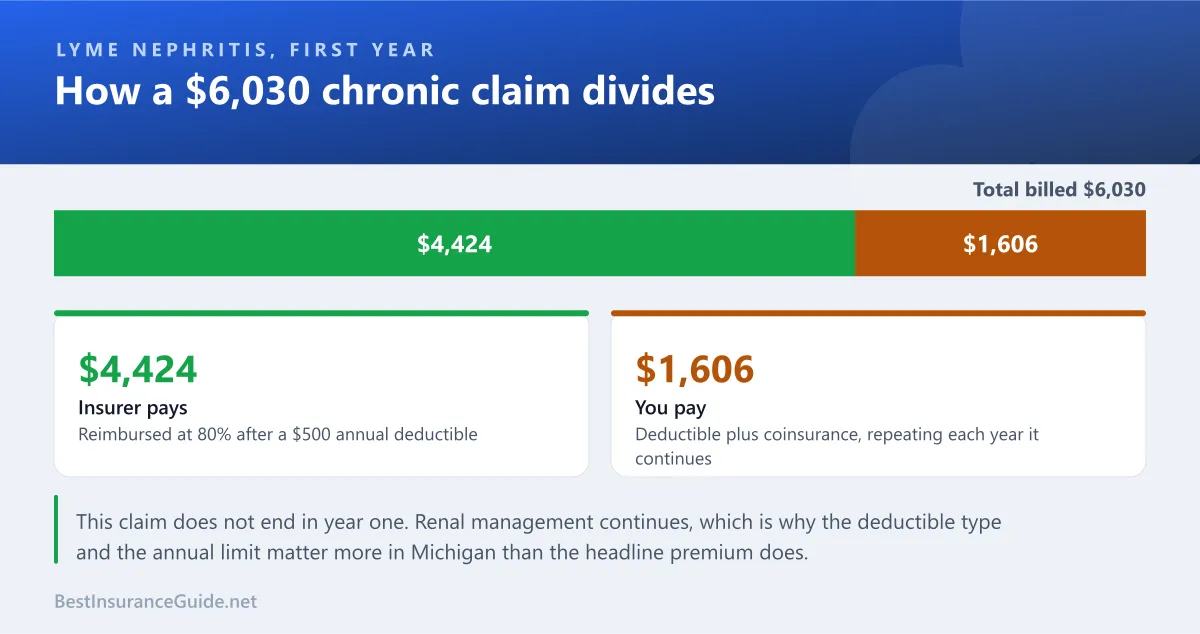
Policy: $500 annual deductible, 80% reimbursement, $10,000 annual limit.
| Item | Cost |
|---|---|
| Exam, bloods, urinalysis and tick panel | $720 |
| Hospitalisation, four days with IV fluids | $2,950 |
| Internal medicine referral | $320 |
| Renal medication and prescription diet | $1,280 |
| Quarterly monitoring bloods | $760 |
| Total | $6,030 |
| Less deductible | $500 |
| Reimbursed at 80% | $4,424 |
| Owner pays | $1,606 |
Note that this claim continues into subsequent policy years. That makes the deductible type important: an annual deductible resets once a year, while some per-condition designs treat chronic conditions less favourably across renewals.
The winter claims
The mix changes with the temperature.
Antifreeze poisoning. Ethylene glycol is sweet, animals drink it, and it destroys kidneys within hours. Treatment is time-critical and involves multi-day hospitalisation with intensive monitoring. Covered as an accident, and expensive enough that it justifies a policy on its own.
Road salt and ice melt. Paw irritation, chemical burns, and gastrointestinal upset from licking it off. Usually smaller claims, but frequent.
Slip and orthopaedic injuries. Ice produces cruciate ligament tears and soft tissue injuries. This is where the orthopaedic waiting period matters: many insurers apply six or twelve months to cruciate and hip conditions rather than the few days covering ordinary accidents. Ask about it specifically, and ask whether a clean vet exam can shorten it.
Hip dysplasia deserves its own mention, since it is common in the large breeds popular across Michigan and is governed by the same orthopaedic waiting period. Any sign noted before enrolment makes it pre-existing.
The summer claims
Blue-green algae on inland lakes, rapidly dangerous and covered as toxin ingestion.
Ear infections and skin disease rising with swimming and humidity, frequently chronic.
Foreign body ingestion, the most common expensive emergency nationally and no less common here.
How to buy
Match the annual limit, the deductible and its type, the reimbursement percentage and the waiting periods across every quote before comparing price.
Three Michigan leanings:
Prefer an annual deductible, because tick complications and chronic ear and skin conditions both span years.
Check the orthopaedic waiting period, given both the winter injury pattern and the popularity of large breeds.
Buy a limit that survives a chronic year, not just one acute episode. A $5,000 cap is thin for ongoing renal or orthopaedic management.
Vaccines, neutering and wellness riders
As everywhere, core pet insurance covers neither vaccines nor neutering. Both are preventive or elective.
A wellness rider reimburses them against fixed allowances. Michigan tilts the calculation slightly in its favour, because year-round tick prevention and the Lyme vaccine are things most owners here should be buying anyway. It still returns most of its value in a puppy’s first year, when the vaccination series and the neuter land together.
Regulation
Pet insurance is regulated by the Michigan Department of Insurance and Financial Services as a property and casualty line, not as health insurance. That is why it reimburses you after the fact and why there is no network to worry about.
Several states have adopted rules based on the NAIC Pet Insurance Model Act, standardising disclosure of waiting periods, pre-existing condition definitions and exam requirements. Adoption has moved quickly, so check the Department’s current position rather than assuming.
Regardless, read the pre-existing condition definition yourself. In a state where tick screening is becoming routine, that clause decides more claims than any other.
Large breeds and the dysplasia problem
Michigan is a large-breed state. Labradors, retrievers, German shepherds and the giant breeds are all well represented, and that shapes the insurance decision more than the weather does.
Hip and elbow dysplasia are developmental conditions. They are not caused by an accident, they often show no signs until a dog is one or two, and they are the single most likely reason a Michigan owner discovers that their policy does not cover what they assumed.
Three rules decide whether you are covered.
The orthopaedic waiting period. Commonly six or twelve months, against the few days that apply to ordinary accidents. A dog diagnosed inside that window is excluded, permanently.
Anything already in the notes. An intermittent limp at nine months, a note about a bunny-hopping gait, a breeder’s disclosure. Any of it can be read as the first sign of a condition that was therefore pre-existing.
Bilateral clauses. If one hip or elbow is affected and later excluded, some insurers treat the other side as the same pre-existing condition and decline it too. Dysplasia is frequently bilateral, so this clause matters enormously.
Worked example: bilateral hip dysplasia in a four-year-old shepherd
Policy: $500 annual deductible, 80% reimbursement, $10,000 annual limit, enrolled at ten weeks.
| Item | Cost |
|---|---|
| Orthopaedic consultation and radiographs | $740 |
| Total hip replacement, first side | $6,200 |
| Hospitalisation and post-operative care | $980 |
| Rehabilitation, twelve sessions | $1,440 |
| Second side, following policy year | $6,900 |
| Total across two policy years | $16,260 |
| Deductibles | $1,000 |
| Reimbursed at 80% | $12,208 |
| Owner pays | $4,052 |
That claim only paid because the dog was enrolled at ten weeks, cleared the orthopaedic waiting period while healthy, and held a policy without a restrictive bilateral clause. Change any one of those and the number in the bottom row moves by five figures.
If you are buying a large-breed puppy in Michigan, insuring it before the first vet visit is the single highest-value decision in this entire article.
What the premium does as the dog ages
| Age band | Indicative monthly premium | Paid in the band |
|---|---|---|
| Years 1 to 3 | $44 | $1,584 |
| Years 4 to 6 | $61 | $2,196 |
| Years 7 to 9 | $92 | $3,312 |
| Years 10 to 12 | $138 | $4,968 |
| Total to age twelve | $12,060 |
Large breeds sit at the higher end of these bands and also have shorter lifespans, which partly offsets the total. The pattern is the same either way: premiums accelerate after seven, which is exactly when owners cancel and exactly when the claims begin.
Raise the deductible or reduce the reimbursement percentage at renewal rather than cancelling. Both keep the enrolment date, and the enrolment date is what you have been buying all along.
The mistakes that cost Michigan owners money
Enrolling after the puppy’s first orthopaedic note. In a large-breed state this is the most expensive timing error available.
Not asking about the bilateral clause. It is rarely volunteered and it is decisive for hips, elbows and cruciates.
Buying in spring, after the tick panel. Michigan’s tick map has expanded steadily and screening is increasingly routine.
Choosing a per-condition deductible. Chronic renal disease from Lyme and chronic orthopaedic management both punish it.
Assuming rehabilitation is covered. Post-surgical hydrotherapy and physiotherapy are standard in orthopaedic recovery and are sublimited or excluded by a meaningful number of policies.
Cats and multi-pet households
Cats cost substantially less to insure than large-breed dogs, and their expensive claims are different: urinary blockage, chronic kidney disease, hyperthyroidism, dental disease and foreign body ingestion.
Michigan outdoor cats add vehicle trauma and, increasingly, tick exposure. Indoor cats avoid most of that, and still warrant cover because urinary blockage in a male cat is a sudden emergency with a four-figure bill.
Multi-pet discounts of roughly five to ten per cent per additional animal are widely available. Worth requesting, not worth choosing an insurer over.
Getting the quote right
Compare three quotes at matched limits, matched deductibles and matched reimbursement percentages, then read the terms that never appear on a quote page: the pre-existing condition definition, the orthopaedic waiting period, the bilateral clause, and whether exam fees are reimbursed.
For a Michigan large breed, the bilateral clause and the orthopaedic waiting period are worth more than a few dollars a month in premium. A policy that is ten per cent cheaper and excludes the second hip is not cheaper in any sense that matters.
If you are moving into Michigan with an insured dog, update the address with your existing insurer rather than shopping for a local policy. The premium will re-rate, but the enrolment date and every condition covered since then stays intact. Switching insurers converts your dog’s entire medical history into pre-existing exclusions on the first day of the new policy, and for a dog of five or six that is usually the most expensive decision available.
A note on figures
Premium and treatment figures here are illustrative rather than quotes, drawn from typical ranges. Actual pricing depends on your ZIP code, the breed, species and age of the animal, and the limits you select, and veterinary costs differ meaningfully between practices within the same region.
Quote your own postcode and animal, and confirm terms in the policy wording rather than the marketing summary.
Comparable states
Michigan’s spreading Lyme exposure and hard winters are shared around the Great Lakes. Minnesota and Wisconsin carry heavier tick burdens with the same winter claim pattern, and Illinois shares the metro-and-farmland split.
The short version
Michigan pet insurance covers two seasons: spreading tick-borne disease and its chronic complications through the warm months, and antifreeze, ice injuries and orthopaedic damage through the cold ones.
Southeast Michigan prices above the rest of the state, following vet costs. Choose an annual deductible, buy a high annual limit, and check the orthopaedic waiting period before signing.
Above all, enrol before the first tick panel. In a state where the risk map has been expanding for twenty years, timing beats price shopping.
For lifetime cost expectations, see the pet insurance cost guide.