Pet Insurance in Minnesota: Tick Belt Winters and Twin Cities Pricing
Pet insurance in Minnesota: Twin Cities pricing, Lyme and anaplasmosis risk, winter hazards, and the four fields to match before comparing any quote.

Table of contents

Minnesota gives you two distinct risk seasons, and a pet policy bought here should account for both.
What sets the price
Pet insurance reimburses a share of your actual vet bill, so the premium follows local veterinary costs rather than anything about your pet.
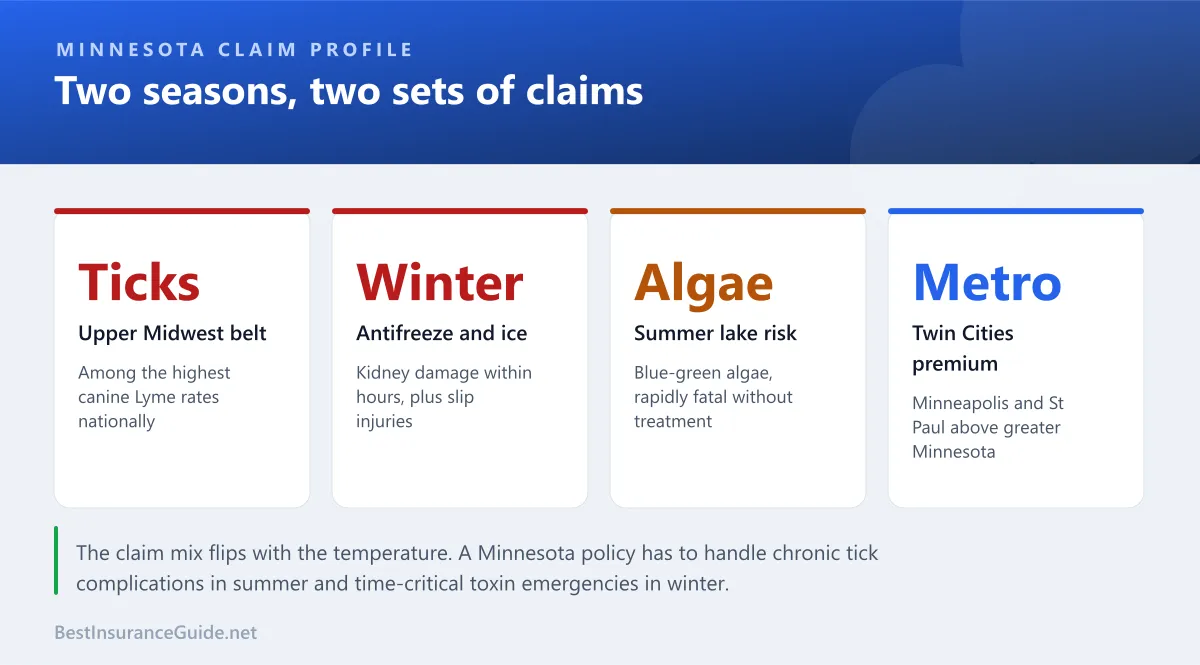
The Twin Cities premium. Minneapolis and St Paul carry higher clinic overheads and a deep concentration of specialists and 24-hour emergency hospitals. More cases escalate to referral care where referral care exists, and that utilisation is priced in.
Greater Minnesota is cheaper. Quote the same dog in Duluth, Rochester or a rural county and the number typically falls.
Claim frequency is above average, largely because of ticks.
Our pet insurance by state guide covers why the spread within a state is often wider than the gap between states.
The tick season
Minnesota sits in the upper Midwest tick belt, alongside Wisconsin, and canine Lyme disease and anaplasmosis rates here are among the highest in the country. The lake country and wooded regions carry the heaviest burden, but exposure is not confined to them.
Three consequences for insurance.
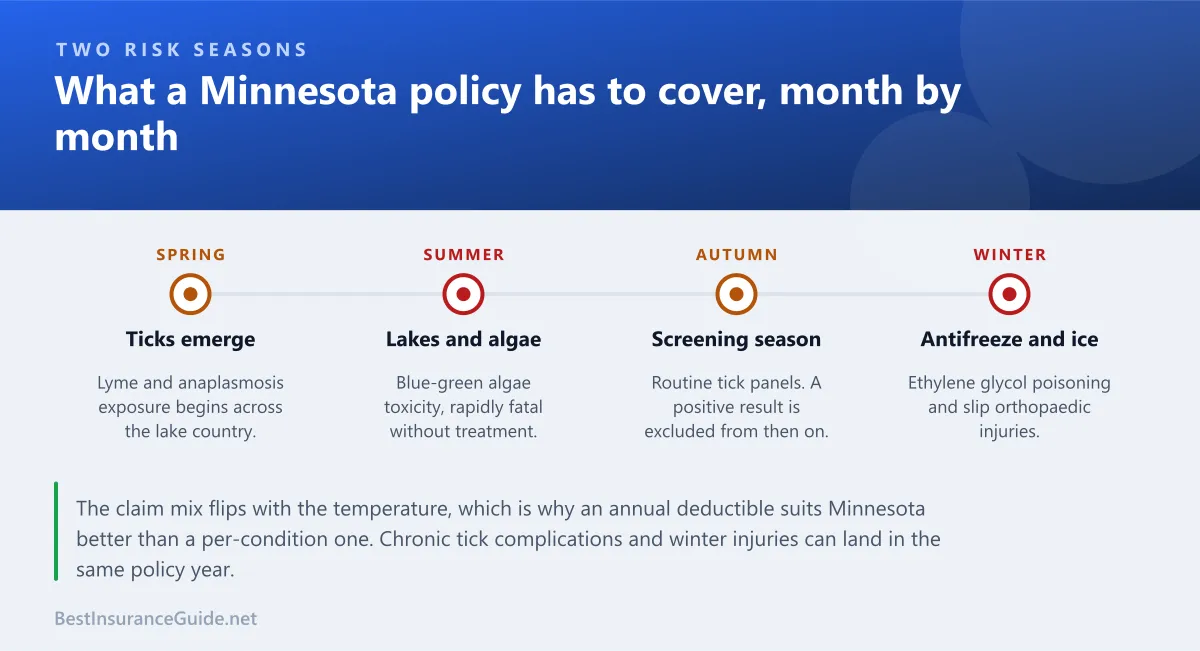
Treatment is covered, prevention is not. An acute Lyme or anaplasmosis case is a covered illness. Tick preventives, the Lyme vaccine and annual screening are wellness items.
The expensive version is Lyme nephritis, a kidney complication that is uncommon but serious, chronic and costly to manage. That is the scenario a policy genuinely exists for.
Routine screening creates a pre-existing condition risk. Minnesota vets test for tick-borne disease as a matter of course. A positive result before enrolment excludes that condition permanently. Enrolling before a dog’s first spring in Minnesota is worth more than enrolling after it.
Worked example: anaplasmosis progressing to complications
Policy: $500 annual deductible, 80% reimbursement, $10,000 annual limit.
| Item | Cost |
|---|---|
| Exam, bloods and tick panel | $580 |
| Hospitalisation, three days | $2,400 |
| Follow-up bloods and imaging | $690 |
| Internal medicine consultation | $280 |
| Medication and rechecks over six months | $940 |
| Total | $4,890 |
| Less deductible | $500 |
| Reimbursed at 80% | $3,512 |
| Owner pays | $1,378 |
The winter season
The claim mix flips once the temperature does.
Antifreeze poisoning. Ethylene glycol is sweet, dogs and cats drink it, and it destroys kidneys quickly. Treatment is time-critical, involves several days of hospitalisation and intensive monitoring, and is genuinely expensive. Covered as an accident.
Ice melt and road salt. Paw irritation and chemical burns, and gastrointestinal upset when licked off. Usually a smaller claim but a common one.
Frostbite and cold injury, particularly on ears, tails and paws in short-coated breeds.
Slip injuries. Soft tissue and orthopaedic injuries from ice, and the seasonal spike in cruciate ligament tears that comes with them. Worth noting because orthopaedic waiting periods on many policies run six or twelve months rather than the few days that apply to ordinary accidents. Ask about that term specifically.
Lake and water hazards in summer round out the year: blue-green algae toxicity is a real risk on Minnesota lakes and is rapidly fatal without treatment.
How to buy
Match the annual limit, the deductible and whether it is annual or per condition, the reimbursement percentage, and the waiting periods before comparing any premium. Those four decide almost everything.
Three Minnesota leanings:
Prefer an annual deductible. Tick-borne complications can become chronic and span policy years, which is where per-condition designs quietly cost more.
Check the orthopaedic waiting period. Given the winter injury pattern, a twelve-month cruciate exclusion is a meaningful gap. Some insurers will shorten it after a clean vet exam.
Buy a limit that survives a chronic year. A $5,000 annual cap is adequate for a single acute episode and thin for ongoing renal or orthopaedic management.
Vaccines, neutering and wellness riders
As everywhere, core pet insurance covers neither vaccines nor neutering. Both are preventive or elective, and core cover exists for the unexpected.
A wellness rider reimburses them against fixed allowances. In Minnesota the calculation tilts slightly in its favour because year-round tick prevention and the Lyme vaccine are things most owners here buy anyway. It still earns its keep mainly in a puppy’s first year, when the vaccination series and the neuter land together.
Regulation
Pet insurance is regulated by the Minnesota Department of Commerce as a property and casualty line rather than as health insurance. That is why it reimburses you after the fact and why there is no network: any licensed vet works.
Several states have adopted rules based on the NAIC Pet Insurance Model Act, standardising how waiting periods, pre-existing conditions and exam requirements are disclosed. Adoption has been moving, so check the Department’s current position rather than assuming a protection applies.
Whatever the rules say, read the pre-existing condition definition yourself. In a high-screening state it is the term most likely to decide a claim.
Insuring an older dog you already have
Plenty of Minnesota owners come to this after years without cover, usually because a friend just had a $7,000 year. The options narrow with age but they do not close.
Most insurers have an upper age limit for new accident and illness policies, commonly somewhere between ten and fourteen depending on the company and sometimes on breed. Above it, accident-only cover is often still available.
Everything already in the notes is excluded. For a dog of eight or nine that has been seen regularly, this is usually a meaningful list. Read what the insurer proposes to exclude before you pay anything, because the value of the policy depends entirely on what is left.
Accident-only policies are underrated for older dogs. They cost considerably less, they cannot be undermined by a long medical history, and they cover the scenario that most often produces a sudden four-figure bill: a fracture, a laceration, a foreign body, a road accident. For a nine-year-old with several documented conditions, accident-only cover is frequently the honest recommendation.
Compare against self-insuring. For an older dog with extensive exclusions, putting the premium into a dedicated account can genuinely be the better plan. The test is whether you would actually leave the money alone, and whether you could absorb a bad month before the fund had grown.
Worked example: the same dog, two ages
| Enrolled at 12 weeks | Enrolled at 9 years | |
|---|---|---|
| Accident and illness available | Yes | Sometimes, with exclusions |
| Pre-existing exclusions | None | Typically several |
| Indicative monthly premium | $38 | $96 |
| Orthopaedic waiting period | Runs while healthy | Runs while already at risk |
| Practical value | High | Depends entirely on exclusions |
That table is the whole argument for enrolling early, and it is why the cheapest pet insurance decision anyone makes is the timing one.
What the premium does over fifteen years
Premiums rise with age at every insurer, and the steepest increases come after about seven.
| Age band | Indicative monthly premium | Paid in the band |
|---|---|---|
| Years 1 to 3 | $38 | $1,368 |
| Years 4 to 6 | $52 | $1,872 |
| Years 7 to 9 | $77 | $2,772 |
| Years 10 to 12 | $115 | $4,140 |
| Years 13 to 15 | $162 | $5,832 |
| Total | $15,984 |
Over a healthy dog’s whole life you will probably pay more in premium than you claim back. That is what insurance is: you are buying protection against the year that costs $9,000 unexpectedly, not a savings product.
The failure mode is cancelling at eleven because the premium has tripled, immediately before the claims arrive, having already paid for a decade of cover. If the number becomes unaffordable, raise the deductible or cut the reimbursement percentage at renewal. Both preserve the enrolment date; cancelling destroys it.
The mistakes that cost Minnesota owners money
Enrolling after the spring tick panel. Same trap as everywhere in the tick belt, and Minnesota screens routinely.
Choosing a per-condition deductible. Chronic tick complications and chronic orthopaedic issues both punish that design over several years.
Ignoring the orthopaedic waiting period before winter. A policy bought in November with a twelve-month cruciate exclusion covers nothing for the ice season it was bought for.
Assuming prescription diets are covered. Renal and urinary diets are a genuine ongoing cost and many policies exclude food.
Not insuring the indoor cat. Urinary blockage in a male cat is an emergency with a four-figure bill and no warning. Minnesota cats are cheap to insure and the claim arrives regardless of whether they go outside.
Cats and multi-pet households
Cats cost meaningfully less to insure than dogs almost everywhere, and Minnesota is no exception. Their expensive claims are urinary blockage, chronic kidney disease, hyperthyroidism, dental disease and foreign body ingestion, none of which are seasonal in the way the dog claims here are.
Outdoor cats add trauma and tick exposure. Indoor cats avoid most of that and still justify cover on the urinary risk alone.
Multi-pet discounts are widely offered, usually around five to ten per cent per additional animal. Ask for it, but do not choose an insurer on it.
Getting the quote right
Three quotes, matched on annual limit, deductible, deductible type and reimbursement percentage. Then read the four terms that never make the summary page: the pre-existing condition definition, the orthopaedic waiting period, whether exam fees are reimbursed, and whether a chronic condition carries across renewals.
Exam fees matter more in Minnesota than most owners expect. A dog being monitored after a tick-borne infection generates a long run of consultations, and insurers split roughly evenly on whether the consultation itself is reimbursable. Over three years of monitoring that is a several-hundred-dollar difference hiding behind an identical-looking premium.
If you move into Minnesota with an insured pet, change the address rather than the insurer. Your premium will re-rate to local vet costs, which is fair, but the enrolment date and everything covered since it stay intact. Shopping for a new local policy resets waiting periods and converts your pet’s entire history into pre-existing exclusions, which for a middle-aged dog usually costs far more than any premium saving.
One more Minnesota note: the boarding gap
Pet insurance covers your animal’s medical care. It does not cover what happens to your animal when something happens to you.
Some policies include a small boarding benefit if you are hospitalised for a set number of days, typically a few hundred dollars. Many do not. In a state where winter accidents put people in hospital with some regularity, it is worth knowing which you have before you need it.
Similarly, third-party liability for damage your dog causes is not part of a pet insurance policy in the United States. That sits under your homeowners or renters liability coverage, and some insurers exclude particular breeds. Our renters insurance guide covers how that liability works and why the limit matters.
Comparable states
Minnesota combines high tick-borne disease rates with hard winters and metro vet costs. Wisconsin is the closest comparison and adds blastomycosis, while Michigan shares the winter and lake profile. Maine carries similar tick pressure with much thinner referral access.
The short version
Minnesota pet insurance has to cover two seasons: ticks and their complications in the warm months, and antifreeze, ice and orthopaedic injuries in the cold ones.
Twin Cities postcodes price above greater Minnesota, following local vet costs. Choose an annual deductible over a per-condition one, buy a high annual limit, and check the orthopaedic waiting period before you sign.
Most importantly, enrol before your dog’s first tick panel comes back positive. In a state with this much exposure and this much routine screening, timing is worth more than shopping.
For lifetime cost expectations, see the pet insurance cost guide.