Pet Insurance in Missouri: Tick Central and Where Your Puppy Came From
Pet insurance in Missouri: heavy tick-borne disease burden, commercial breeding history and hereditary exclusions, and the terms that decide claims here.

Table of contents

Missouri has two features that shape pet insurance here more than the premium does. One is ticks. The other is where a large share of the country’s purebred puppies are bred.
What sets the price
Pet insurance reimburses a percentage of your actual vet bill, so the premium follows local veterinary pricing.
Missouri practice pricing runs below the national average, and that is the whole reason quotes here sit toward the cheaper end. It is a cost-of-care difference rather than a coverage difference; the same national insurers write broadly identical contracts here and in Connecticut.
St Louis, Kansas City and Columbia price above rural counties, following clinic overheads and the concentration of emergency and referral capacity. The University of Missouri’s veterinary teaching hospital in Columbia provides genuine specialist access without metro pricing.
Rural Missouri is cheapest, with the usual trade of longer drives to specialist care.
Our pet insurance by state guide covers why the ZIP code rather than the state line is the real rating factor.
Missouri is not Lyme country, and that matters
Most writing about canine tick disease is really writing about Lyme, because Lyme dominates the Northeast. Missouri’s burden is different and, in aggregate, heavier than most Midwestern states.
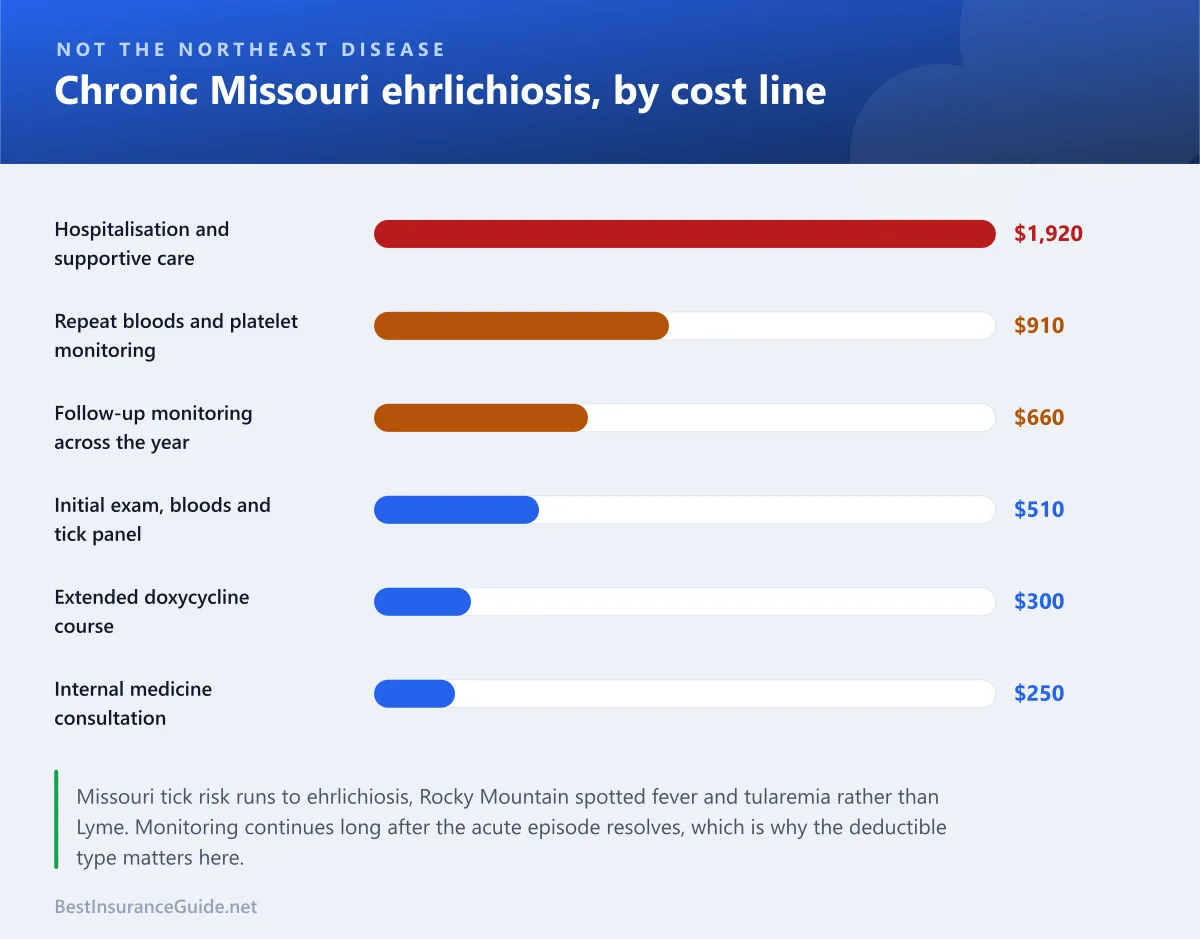
Ehrlichiosis is the significant one, carried principally by the lone star tick, which is abundant across Missouri. It can present acutely with fever, lethargy and low platelets, and it can become chronic, which is where the claims get expensive.
Rocky Mountain spotted fever is likewise well represented. It moves fast, it is genuinely dangerous, and it needs prompt treatment.
Tularemia appears in Missouri more than in most states, in both dogs and cats, usually from contact with infected rabbits or rodents or from tick bites.
The insurance position mirrors everywhere: treatment is covered, prevention is not. Year-round tick preventives are wellness items.
And the same pre-existing condition trap applies. Missouri vets run tick panels routinely at annual visits, and a positive result recorded before enrolment excludes that condition permanently, whether or not the dog was ever ill.
Worked example: chronic ehrlichiosis
A five-year-old dog with lethargy and abnormal bloodwork progressing to chronic disease. Policy: $500 annual deductible, 80% reimbursement, $10,000 annual limit.
| Item | Cost |
|---|---|
| Initial exam, bloods and tick panel | $510 |
| Hospitalisation and supportive care, three days | $1,920 |
| Repeat bloodwork and platelet monitoring | $910 |
| Extended doxycycline course | $300 |
| Internal medicine consultation | $250 |
| Follow-up monitoring across the year | $660 |
| Total | $4,550 |
| Less deductible | $500 |
| Reimbursed at 80% | $3,240 |
| Owner pays | $1,310 |
Monitoring continues long after the acute episode resolves, which makes the deductible type matter: an annual deductible handles a months-long condition better than some per-condition designs.
Where your puppy came from
Missouri has historically been the largest source of commercially bred puppies in the United States, and a great many dogs sold in pet shops and online across the country originate here. That fact changes the insurance conversation in a way no other state’s does.
Three practical consequences.
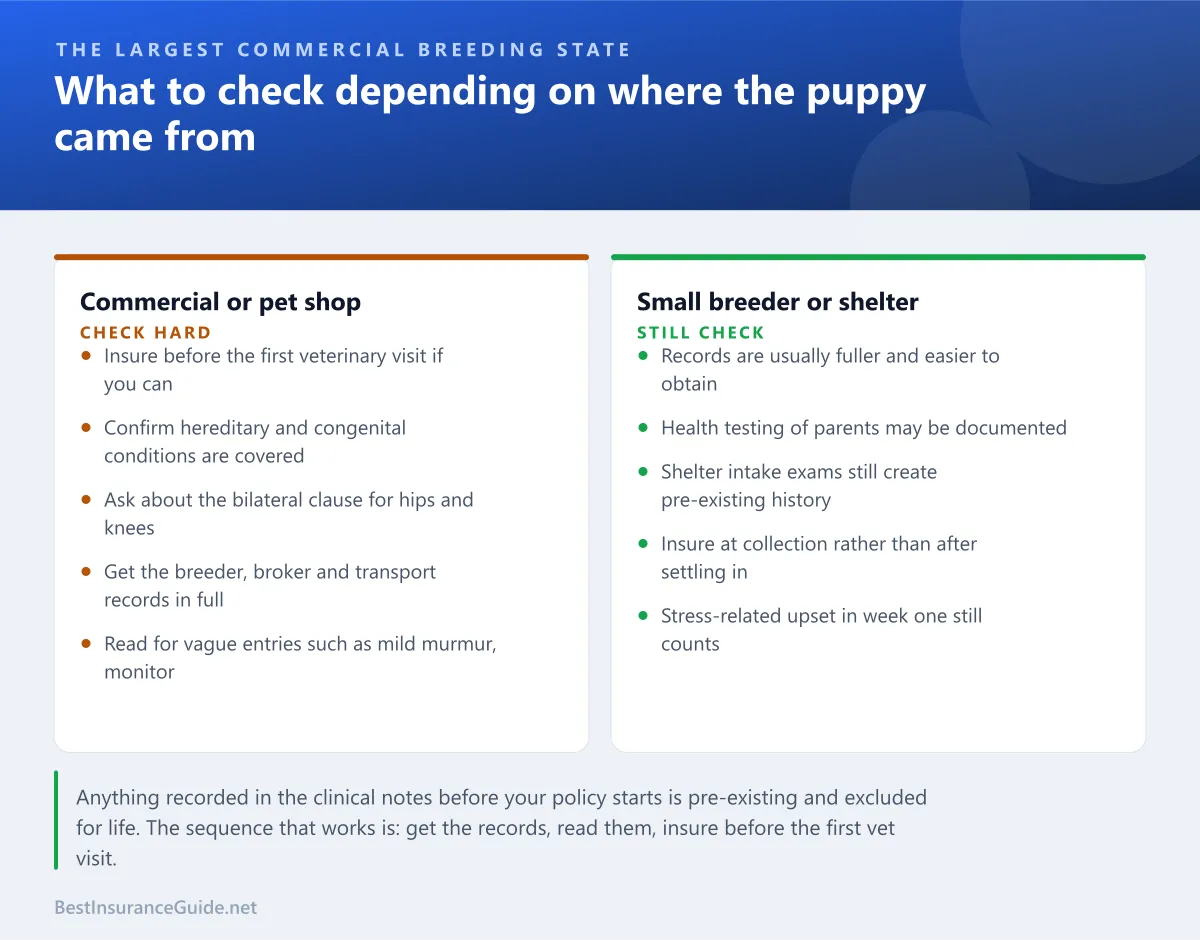
Insure at the point of collection. Anything recorded in the clinical notes before your policy starts is pre-existing and excluded permanently. Puppies from high-volume operations frequently arrive with something already noted at the first veterinary visit: a heart murmur, a hernia, kennel cough, giardia, a luxating patella. If the policy is not in force when that visit happens, the condition is uninsurable for life.
Check whether hereditary and congenital conditions are covered. Many good insurers do cover them, provided no signs were present at enrolment. Some cheaper policies exclude them outright. For a purebred dog from a commercial operation, hereditary conditions are precisely the risk you are insuring against, so a policy that excludes them is close to pointless.
The conditions that matter most: hip and elbow dysplasia, luxating patella, heart defects, brachycephalic airway syndrome, and progressive eye disease.
Get the complete records before you enrol, and read them. The breeder’s records, the pet shop’s veterinary check, and anything from a transport or broker. Insurers request full history at the first claim and anything missing is resolved against you. Ambiguous entries such as “mild murmur, monitor” are the ones that later support an exclusion.
None of this is an argument about breeding practices. It is a practical point about sequencing: get the records, read them, insure before the first vet visit if you possibly can.
The rest of the Missouri profile
Heartworm. Moderate to high prevalence with a long mosquito season. Year-round prevention is standard advice; prevention is a wellness item and treatment is covered provided the dog was clear at enrolment.
Four-season claims. Missouri gets genuine winters, so antifreeze poisoning and ice-related orthopaedic injuries appear, and genuine summers, so heat injury does too. The orthopaedic waiting period matters here, commonly six or twelve months on cruciate and hip conditions rather than the few days covering ordinary accidents.
Snake bites. Copperheads are widespread, with cottonmouths and rattlesnakes regionally. Covered as accidents.
Blue-green algae on Missouri lakes and slow water in summer, rapidly dangerous and covered as toxin ingestion.
Foreign body ingestion, the most common expensive emergency nationally.
How to buy in Missouri
Match four fields across every quote before comparing a premium: the annual limit, the deductible and whether it is annual or per condition, the reimbursement percentage, and the waiting periods.
Four Missouri leanings.
Confirm hereditary and congenital conditions are covered. More important here than in almost any other state given the breeding landscape.
Ask about the bilateral clause. If one hip, elbow or knee is affected, does the insurer treat the other side as the same pre-existing condition? For dysplasia and luxating patella, which are frequently bilateral, this is decisive.
Prefer an annual deductible. Chronic tick complications and orthopaedic management both span months.
Check the orthopaedic waiting period, and ask whether a clean veterinary examination can shorten it. Several insurers will, and almost nobody is told this unprompted.
Vaccines, prevention and wellness riders
Core pet insurance covers neither vaccines nor neutering, and it does not cover tick or heartworm prevention. All are preventive or elective.
Missouri’s preventive load is substantial: year-round tick prevention, year-round heartworm prevention, annual testing and core vaccinations run into several hundred dollars a year, and every Missouri owner should be carrying most of it regardless.
Whether a wellness rider pays is arithmetic. Total the insurer’s published allowances, subtract the rider premium, and buy only if the result is positive for care you would purchase anyway. It generally earns its keep in a puppy’s first year, when the vaccination series and the neuter land together, and loses money afterwards.
Regulation
Pet insurance in Missouri is regulated by the Department of Commerce and Insurance as a property and casualty line rather than as health insurance. That is why it reimburses you after the fact and why there is no network: any licensed vet works, including Columbia.
A growing number of states have adopted rules based on the NAIC Pet Insurance Model Act, standardising how waiting periods, pre-existing condition definitions and exam requirements are disclosed. Check the Department’s current position rather than assuming.
Read the pre-existing condition definition yourself in any case. In a state where both routine tick screening and commercially bred puppies are common, that clause does more work than anywhere else in the contract.
The mistakes that cost Missouri owners money
Insuring a puppy after the first vet visit rather than before it. The most expensive timing error available here.
Buying a policy that excludes hereditary conditions for a purebred dog. That is the risk you were insuring against.
Not asking about the bilateral clause. Rarely volunteered, decisive for dysplasia.
Enrolling after the annual tick panel. Missouri vets test as standard.
Choosing a per-condition deductible. Chronic tick-borne disease and orthopaedic management both punish it.
Cancelling as premiums rise with age. Raise the deductible or lower the reimbursement percentage instead; both preserve the enrolment date.
Cats in Missouri
Cats cost considerably less to insure and their expensive claims differ: urinary blockage, chronic kidney disease in older cats, hyperthyroidism, dental disease and foreign body ingestion.
Outdoor cats in Missouri carry substantial tick exposure and can contract tularemia, which presents seriously in cats. Abscesses from fight wounds are a common claim. Indoor cats avoid most of that and still warrant cover, because a male cat with a urinary blockage is a sudden emergency with a four-figure bill and no warning.
Multi-pet discounts run around five to ten per cent per additional animal. Worth asking for, never worth delaying an enrolment over.
A note on figures and sources
Premiums and treatment costs here are illustrative, drawn from typical ranges rather than any single insurer’s rate filing. Actual pricing depends on your ZIP code, the species, breed and age of the animal, and the limits chosen, and veterinary charges differ meaningfully between rural practice and referral centres.
Tick species distribution and heartworm prevalence both shift over time. The Companion Animal Parasite Council and the American Heartworm Society publish regularly updated county-level prevalence maps, both more current than any article, and your own veterinarian will know what is actually presenting locally.
What the premium does over time
Premiums rise with age at every insurer and accelerate after about seven. Missouri’s lower baseline means the absolute numbers are gentler than in a coastal metro, but the shape is identical.
| Age band | Indicative monthly premium | Paid in the band |
|---|---|---|
| Years 1 to 3 | $35 | $1,260 |
| Years 4 to 6 | $49 | $1,764 |
| Years 7 to 9 | $73 | $2,628 |
| Years 10 to 12 | $109 | $3,924 |
| Total to age twelve | $9,576 |
The predictable failure is cancelling at ten, having paid for a decade, immediately before the claims begin. If the number stops working, raise the deductible or lower the reimbursement percentage at renewal instead. Both keep the enrolment date, and for a Missouri dog that has been screened annually in tick country, the enrolment date is most of what you have been paying for.
Missouri’s lower pricing also means the gap between a $5,000 and a $15,000 annual limit costs less here than in an expensive metro, which is the argument for buying the higher one at the outset.
Comparable states
Missouri’s tick burden is ehrlichiosis and Rocky Mountain spotted fever rather than Lyme, which it shares with Oklahoma. Its metro-and-rural pricing split matches Illinois, and its position as the largest commercial breeding state gives it a hereditary condition profile no neighbour shares.
The short version
Missouri is a cheaper state to insure a pet in, and the saving reflects local veterinary pricing rather than a thinner policy.
Its tick problem is ehrlichiosis, Rocky Mountain spotted fever and tularemia rather than Lyme, and it is heavier than most of the Midwest. Treatment is covered; prevention is not; a positive panel before enrolment closes that condition permanently.
And because Missouri is the country’s largest commercial breeding state, the hereditary condition question matters here more than anywhere. Insure at the point of collection, confirm hereditary and congenital conditions are covered, and ask about the bilateral clause before you sign.
For lifetime costs and how premiums climb with age, see the pet insurance cost guide.