What Does Out of Network Mean? The Most Expensive Word in Health Insurance
What out of network means, why it costs so much more, balance billing, the No Surprises Act protections, and how to check a provider before you go.

Table of contents

Out of network is a contractual fact with financial consequences that surprise almost everybody the first time. The fact itself is simple.
What it actually means
Your insurer has a contract with in-network providers, agreeing a price for each service. In exchange the provider gets patient volume and the insurer gets predictable costs.
An out-of-network provider has no such contract. No agreed price, no obligation to accept what your insurer pays, and no restriction on what they charge.
Everything that follows comes from that one difference.
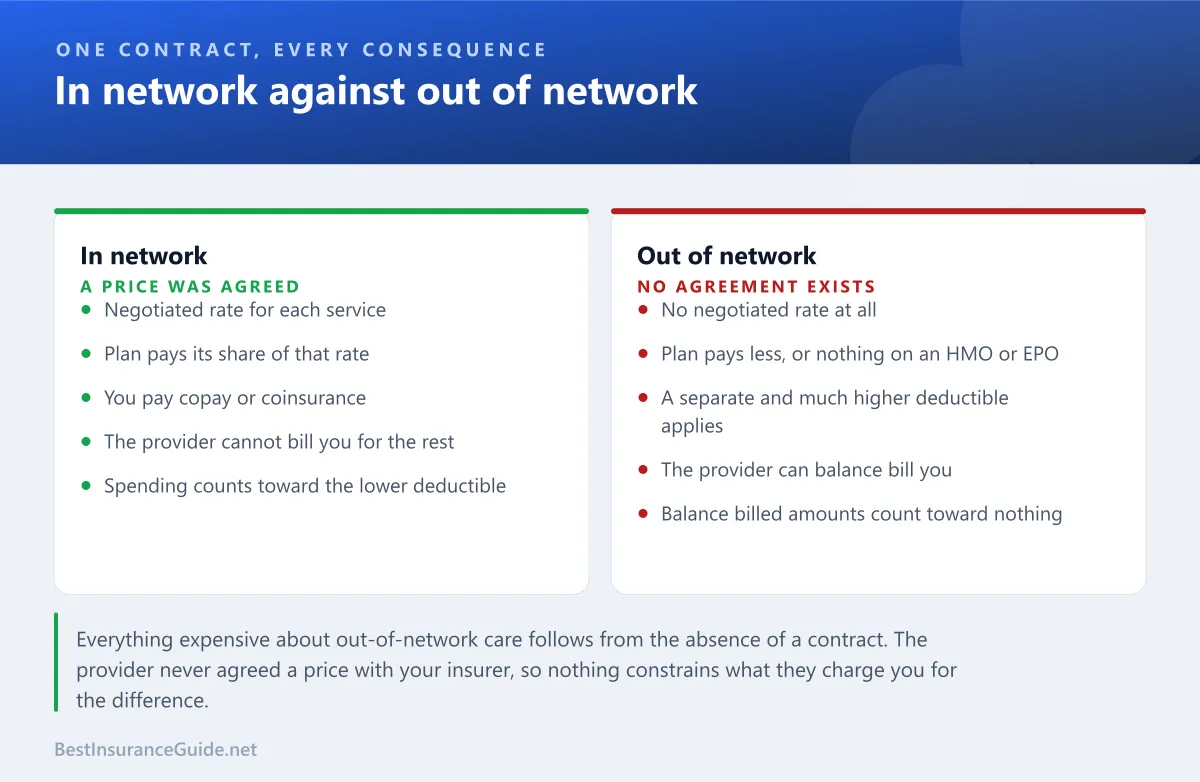
In network: a negotiated rate, your plan pays its share, you pay your copay or coinsurance, and the provider cannot bill you for the rest.
Out of network: no negotiated rate, your plan pays less or nothing, a separate and higher deductible applies, and the provider can bill you for the balance.
Balance billing, which is the expensive part
This is the mechanism that turns a moderate bill into a catastrophic one.
An out-of-network provider charges their full rate. Your insurer, if it covers out-of-network care at all, pays a percentage of an amount it considers reasonable, which is frequently far below the charge. The provider then bills you for the difference.
Worked example: the same procedure, two networks
A procedure with an in-network negotiated rate of $2,400 and a full charge of $9,800.
| In network | Out of network | |
|---|---|---|
| Provider charge | $9,800 | $9,800 |
| Allowed amount | $2,400 negotiated | $3,100, insurer determined |
| Plan pays after deductible | 80% of $2,400 = $1,920 | 60% of $3,100 = $1,860 |
| Your coinsurance | $480 | $1,240 |
| Balance billed to you | $0, prohibited | $6,700 |
| Your total | $480 | $7,940 |
The procedure was identical. The difference is a contract you were not party to.
The two-track structure
Plans that cover out-of-network care generally run two parallel sets of limits, and this is worth understanding because it compounds the cost.
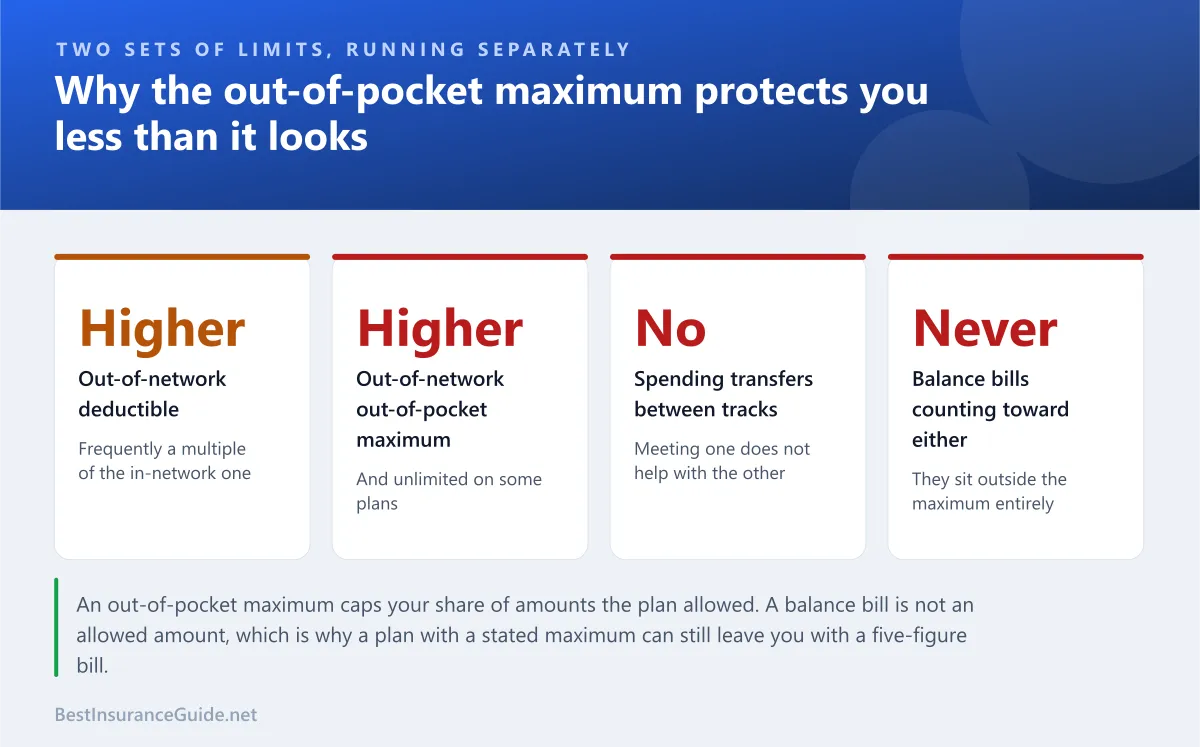
A separate out-of-network deductible, usually much higher than the in-network one.
A separate out-of-network out-of-pocket maximum, also much higher, and in some plans unlimited, which means there is no ceiling on what you can spend.
Spending on one track does not usually reduce the other. Meeting your in-network deductible does not help with an out-of-network claim.
Balance-billed amounts do not count toward anything. They sit outside the out-of-pocket maximum entirely, which is why that maximum offers less protection than its name suggests.
That last point is the one people find hardest to believe and it is the most important. An out-of-pocket maximum caps your share of allowed amounts. A balance bill is not an allowed amount.
Plan types, and what each does
HMO. Generally no out-of-network coverage except emergencies. Care must be within the network, usually with a primary care physician coordinating referrals.
EPO. Similar to an HMO on networks, typically without the referral requirement.
PPO. Out-of-network coverage at a higher cost share. The most flexible and the most expensive in premium.
POS. A hybrid, usually requiring referrals with some out-of-network coverage.
Our guide to HMO versus PPO sets out how to identify which you have from the card itself.
The No Surprises Act
Federal protections now cover the situations where patients had no realistic choice, and they are substantial.
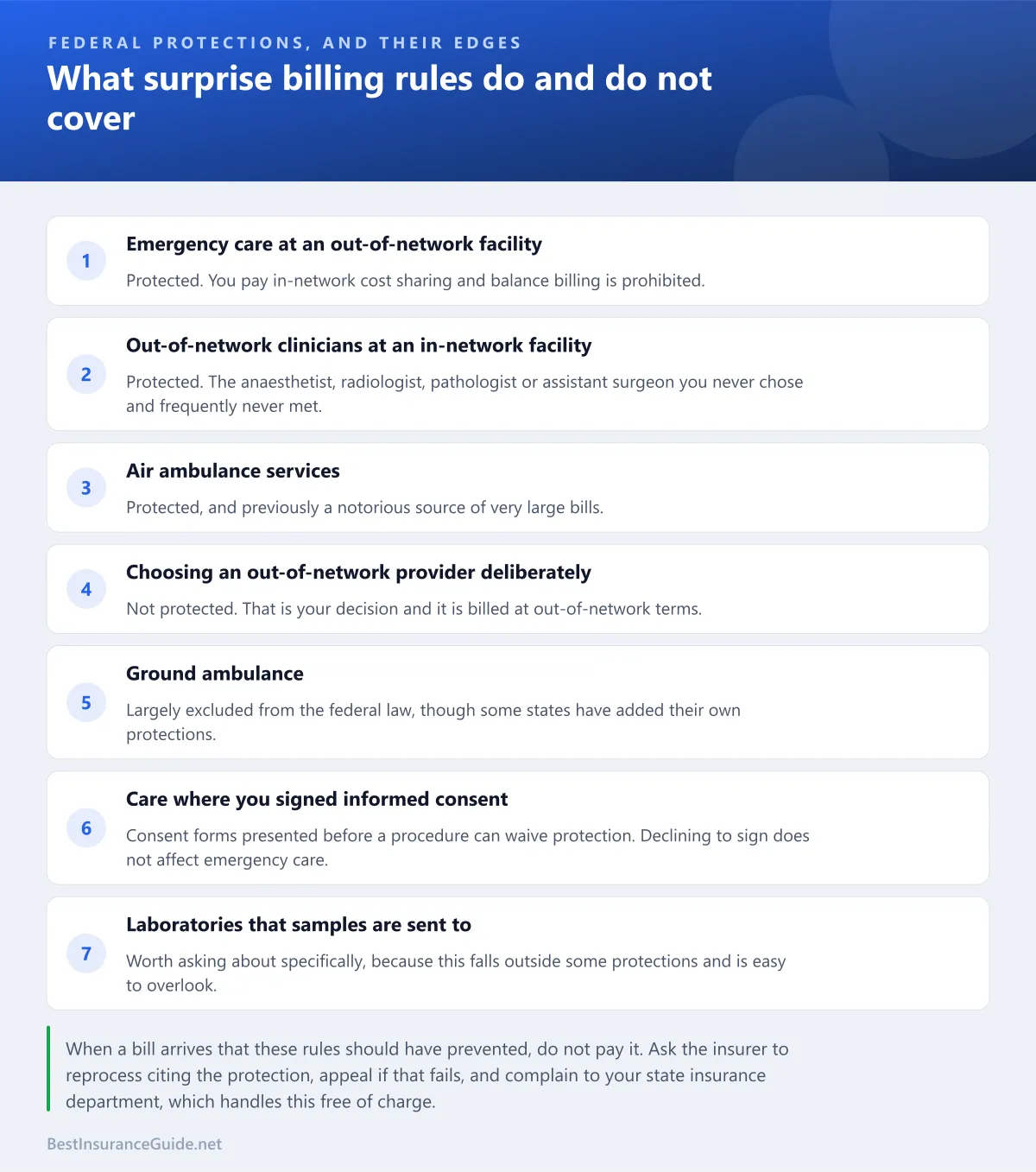
Emergency care at an out-of-network facility. You pay in-network cost sharing, and balance billing is prohibited.
Non-emergency care from out-of-network clinicians at an in-network facility. This is the anaesthetist, radiologist, pathologist, assistant surgeon or laboratory you did not choose and frequently never met. In-network cost sharing applies and balance billing is prohibited.
Air ambulance services, which were a notorious source of very large bills.
What remains outside the protections:
Choosing to go out of network deliberately, which is your decision and is billed accordingly.
Ground ambulance, which was largely excluded from the federal law, though some states have added protections.
Certain services where you gave informed written consent to be treated out of network. Be careful with consent forms presented before a procedure; declining to sign one does not affect emergency care.
Providers outside the law’s scope, and some plan types.
Checking before you go
The single most effective habit, and it takes five minutes.
Verify with your insurer, not the provider. Provider directories are frequently out of date, and a receptionist saying “we take your insurance” may mean they will bill it rather than that they are in network.
Give the exact plan name from your card. Insurers have many networks, and a provider can be in one and not another from the same company.
Ask about everyone involved, not just the surgeon: the facility, the anaesthetist, the laboratory, the pathologist, and any implant or device supplier.
Get a reference number and a date for the call.
Re-check before each course of treatment, because networks change and a provider in network last year may not be now.
Ask for a good faith estimate, which providers must supply on request in many circumstances.
If a surprise bill arrives
Do not pay it immediately. A large share of these are wrong, and paying establishes acceptance.
Ask for an itemised bill and compare it against the explanation of benefits from your insurer.
Check whether federal protections apply. Emergency care, or an out-of-network clinician at an in-network facility, is very likely protected, and the bill should not have been sent.
Contact your insurer and ask them to reprocess, citing the protection.
Appeal formally if that fails, using the plan’s internal appeal process and then external review.
Contact your state insurance department, which handles complaints and in many states has its own surprise billing protections.
Negotiate directly where the bill is genuinely owed. Providers frequently reduce balances substantially for prompt or agreed payment, and non-profit hospitals generally have financial assistance policies.
The short version
Out of network means your insurer has no price agreement with that provider. Because there is no agreed price, the provider can charge what they like and bill you for whatever your insurer does not pay.
Out-of-network care usually runs on a separate and much higher deductible and out-of-pocket maximum, and balance-billed amounts do not count toward either, which is why the out-of-pocket maximum protects you less than it appears to.
Federal protections now cover emergencies and out-of-network clinicians at in-network facilities, which removes the most common surprise bills. They do not cover deliberately choosing an out-of-network provider.
Verify network status with your insurer rather than the provider, ask about every clinician involved, and get a reference number. Five minutes prevents the great majority of these bills.
For plan structures, see HMO versus PPO, and for the cost terms, deductible versus out-of-pocket maximum.
The four situations that catch people
Beyond the general rule, four specific patterns produce most out-of-network bills.
The clinician at the in-network hospital. An anaesthetist, radiologist, pathologist or assistant surgeon who does not participate in your plan even though the facility does. Federal protections now cover most of these, which is the single largest improvement in this area.
The laboratory. A sample taken at an in-network office and sent to an out-of-network laboratory. Ask specifically where samples go, because this one falls outside some protections.
The out-of-area emergency. Covered at in-network cost sharing under federal protections, though the follow-up care after stabilisation may not be, which is a distinction worth knowing while travelling.
The provider who left the network. A doctor you have seen for years whose contract ended. Plans generally notify members, and the notice is easy to miss. Some plans offer continuity of care for an ongoing course of treatment, which is worth asking about.
Worked example: one surgery, four bills
An in-network hospital, an in-network surgeon, and two other clinicians.
| Bill | Network status | Position |
|---|---|---|
| Hospital facility | In network | Standard cost sharing |
| Surgeon | In network | Standard cost sharing |
| Anaesthetist | Out of network | Protected, in-network cost sharing applies |
| Pathology laboratory | Out of network | Protected in most circumstances, worth checking |
Before the federal protections, the last two rows were where surprise bills came from. They are now largely addressed, and knowing that is what allows you to challenge a bill that should not have been sent.
Two habits worth building
Verify network status with the insurer before every new course of treatment, with a reference number and a date. Not the provider’s website, not the receptionist.
Read the explanation of benefits when it arrives and compare it against any bill. The explanation of benefits is not a bill; it tells you what the insurer allowed and paid, and a provider bill exceeding your stated responsibility is the signal to challenge rather than to pay.
Reading an explanation of benefits
The explanation of benefits is the document that tells you whether a bill is right, and most people never read one.
It is not a bill. It is a statement of what the provider charged, what the plan allowed, what the plan paid, and what your responsibility is.
Find the allowed amount. For an in-network claim this is the negotiated rate. For an out-of-network claim it is what the insurer determined, which may be far below the charge.
Find your responsibility. Deductible, copay and coinsurance combined.
Compare that against the provider’s bill. If the bill exceeds your stated responsibility, either the claim was processed as out of network, or you have been balance billed, or there is an error. All three are worth a phone call.
Check the network indicator, which most explanations show, since a provider you believed was in network being processed as out of network is a common and correctable error.
Worked example: spotting a wrong bill
| Line | Explanation of benefits | Provider bill |
|---|---|---|
| Charge | $4,200 | $4,200 |
| Allowed amount | $1,650 | — |
| Plan paid | $1,320 | — |
| Your responsibility | $330 | $2,880 |
The gap between $330 and $2,880 is a balance bill. If this was emergency care, or a clinician at an in-network facility, federal protections likely prohibit it and the bill should be challenged rather than paid.
Two habits that prevent most of it
Verify with the insurer before every new course of treatment, using the exact plan name on your card, asking about every clinician and facility involved, and noting the reference number and date. Provider directories are frequently out of date and a receptionist saying they take your insurance is not a network confirmation.
Read the explanation of benefits against every bill. The explanation states what your responsibility is; a bill that exceeds it is either a balance bill, a processing error or a network misclassification, and all three are worth challenging rather than paying.
Five minutes before and five minutes after is what stands between most people and the bills this article is about.
When going out of network is the right decision
Nothing here argues that out-of-network care is always wrong. Sometimes it is the correct choice and it is worth making deliberately.
A specialist for a rare or complex condition who is not in any local network. The expertise may genuinely be worth the cost, and the plan may grant a network exception where no in-network provider can deliver the care.
Continuity during an active course of treatment, where changing providers mid-treatment carries clinical risk.
A provider relationship over many years, where the alternative is starting again with somebody who does not know the history.
In each case, three things make it manageable.
Ask the plan for a network exception or gap exception, which if granted means in-network cost sharing applies. Plans do grant these where no in-network provider is available for the required care.
Negotiate the price in advance, in writing, with the provider. Many will agree a rate, particularly for self-pay or for a known insurer allowance.
Ask for a good faith estimate before treatment, which providers must supply in many circumstances.
The problem this article describes is not choosing out-of-network care. It is receiving it without knowing, at a price nobody quoted.
A note on scope
Nothing here is legal or medical advice. Network rules, plan designs, surprise billing protections and state-level additions vary and change over time, and the figures used are illustrative rather than actual charges.
The Centers for Medicare and Medicaid Services publishes guidance on federal surprise billing protections, your state insurance department handles complaints and publishes any state-level protections, and your plan documents and insurer are the authoritative source on network status and cost sharing. This site is independent and not affiliated with any insurer.